
The pileated woodpecker: Our largest tree-clinger
The pileated woodpecker seldom fails to impress
By Bob Kornegay
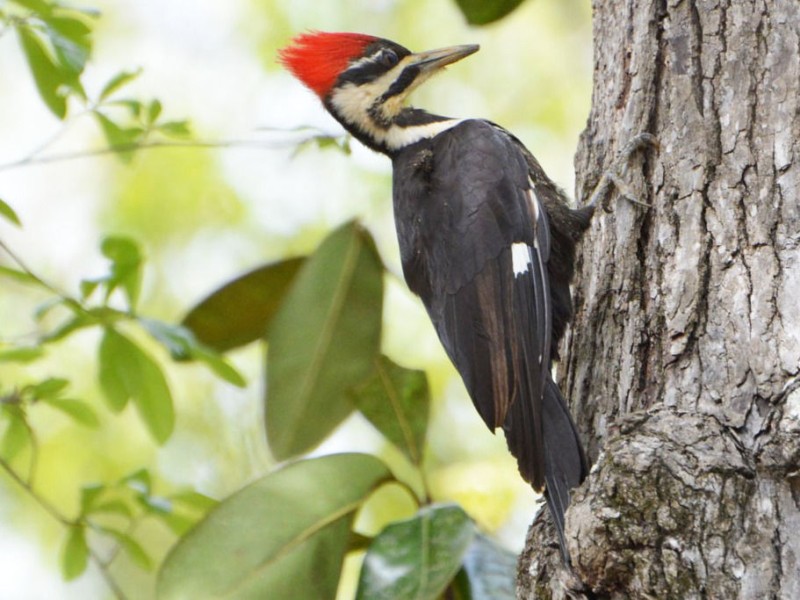
The pileated woodpecker, sometimes locally called a “Lord God” or “Indian hen,” is the largest resident woodpecker found today. The one exception would have been the larger native ivory-billed woodpecker, a bird long believed to be extinct due to the vast destruction of its old growth forested habitat. Unfortunately, no recent reliable sightings or scientific evidence suggests the existence of the fabled ivory-billed. Thus, the equally attractive and impressive pileated weighs in as our resident woodpecker “king.”
The pileated woodpecker is a strikingly beautiful crow-sized woodpecker ranging throughout forested areas of Georgia and other eastern states. It is also found in the western United States from Washington south to California and east to North Dakota, and in Canada from British Columbia east to Nova Scotia.
Both sexes of the species are dark black in color and similar in appearance. Both male and female have a bright red-pointed crest and crown, but only the male has a red forehead and “mustache” that distinguishes him from the female. Both have a white stripe on the sides of the face extending from the base of the bill to under the eye and down the neck. There is a white stripe above the eye and the throat area is white. White also adorns the bases of the primary feathers and underwing linings. A large contrasting white patch underneath the front half of each wing can easily be seen when the bird is in flight.
Shy and wary of humans, the pileated woodpecker is not known to migrate long distances. Its flight is strong with irregular flaps of the wings. Both sexes drum on a selected hollow dead tree, a loud rolling tap that can last up to five minutes, proclaiming their territorial dominance to other forest inhabitants and to attract a mate. It also drums before it is about to go to roost. The pileated emits a loud repetitive call, never just a single note. Once one has heard and identified the call (almost a laughing sound) of the pileated woodpecker, he will not likely forget it.
When foraging, the pileated uses its large strong bill to strip bark and chisel characteristic rectangular holes up to six inches in width in decaying trees. Its diet consists mainly of wood-boring insects and it is especially fond of carpenter ants. It is common to see where the pileated has demolished rotten stumps and logs in its search for these little morsels. Seasonal nuts and berries also make up this woodpecker’s well-rounded diet.
Pileated woodpeckers are very good parents and thought to pair for life. They are quite selective of their nesting cavities and will return to the same nesting site year after year. Deciduous trees are seemingly preferred for housing the nest cavities. This may be due to the denser composition and physical ability of hardwood trees to endure the wearing elements of nature for a long time period.
Because of its size, the pileated prefers large trees for nesting and for roosting. Tree diameter can be up to and greater than 20 inches. Nesting cavity height can be 15-80 feet above the ground. The somewhat triangular cavity entrance hole is approximately 3 ½ inches across at the top and 4 ½ inches across at the bottom and generally faces in a southerly or easterly direction. The hole is outwardly and downwardly beveled, most likely to aid the woodpecker in entering and leaving the cavity entrance. Depending on the wood density of the selected tree, it may take a pair up to two months to complete a single cavity.
Generally the pileated constructs a new cavity for each brood of young or deepens an old cavity before using it a second time. A cavity can be from 10 to 30 inches deep. It is not uncommon for a single tree that has been used for several years to contain several constructed cavities. Each member of the pair excavates and uses its own roosting cavities located within their territory and not far away from the nesting cavity.
Beginning in early April through May, the female lays three to eight eggs in the cavity, which is lined only with fine splintered wood shavings. Both parents incubate the eggs with the male assuming the incubation role at night. After two weeks, the young hatch naked with eyes closed. The parents are very defensive and caring of their young. They feed the new hatchlings, which will fledge in about a month, regurgitated insects by inserting their long bill into the babies’ throats. The youngsters remain with the parents for up to three months after leaving the security of the nest cavity. During this time, they are taught how to forage for themselves and other secrets of the wild. This period spent with the parents greatly increases their chances of survival.
The pileated woodpecker’s adaptability and good parenting skills have greatly contributed to the survival of this fascinating feathered monarch. The distant cry of a pileated in the forest will turn anyone’s head for just a glimpse of this beautiful bird. No matter how often we see or hear it, the pileated woodpecker seldom fails to impress.
Related Articles

Moving the Chains: Premature Speculation
The orange and blue confetti was still falling from the rafters of San Antonio’s Frost Bank Center when the initial reports came out.

NAIA adds Women’s flag football as championship sport
On Wednesday, June 17, the National Administrative Council (NAC) of the National Association of Intercollegiate Athletics voted to approve Women’s Flag Football as the NAIA’s 30th championship sport beginning with the 2026-27 academic year.

Georgia Tech’s Danny Hall selected for College Baseball Hall of Fame
Legendary Georgia Tech baseball coach Danny Hall has been selected for induction to the College Baseball Hall of Fame, the College Baseball Foundation announced on Thursday.
