
BARRY LEVINE: Mailbag full with Hall of Fame responses
OLD ROCKER: Most favor inclusion of pop stars
By Barry Levine
none
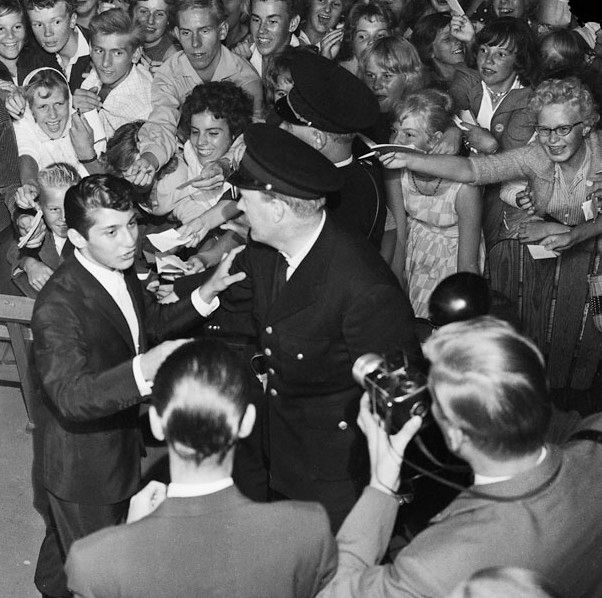
Earlier this month, I wrote a column about my disgust with the Rock and Roll Hall of Fame’s 2016 nominations. Of the 94 who posted comments on the column, an overwhelming majority voiced their displeasure with the exclusion of Paul Anka, Frankie Avalon, Chubby Checker, Connie Francis, Johnny Maestro, Johnny Mathis, Bobby Rydell and Neil Sedaka who we wrote deserve Hall of Fame recognition.
Some respondents were opposed to my point of view.
A respondent stated. “Paul Anka, Frankie Avalon, Chubby Checker, Connie Francis, Johnny Maestro, Johnny Mathis, Bobby Rydell and Neil Sedaka … I’ll say it, rock ‘n’ roll would be exactly the same if none of those folks came around. There is no reason we should celebrate the relative dearth of talent and innovation during the period of time Elvis was drafted and the British Invasion.”
There are two critical reasons these eight should be honored by induction into the Hall of Fame.
They all had long and successful careers producing a plethora of major hit records.
Whether you want to recognize it or not, they helped save rock ‘n’ roll during a critical juncture in the new genre’s history.
Simply put, government officials weren’t overwhelmed with rock ‘n’ roll.
Southern conservatives were opposed to rock ‘n’ roll and referred to it as “the devil’s music.” Racists hated it because they felt it was promoting African-American music.
During that span, officials did everything possible to kill the genre.
Get a copy of the 1978 movie “American Hot Wax,” a story of DJ Alan Freed and a 1959 rock ‘n’ roll show at the legendary Brooklyn (N.Y.) Paramount. The film featured performances by Chuck Berry, Jerry Lee Lewis, Screamin’ Jay Hawkins and Frankie Ford. When Lewis was rockin’ on the piano at the end of the movie, city officials insisted that the lights in the theater be turned on. Lewis stopped playing and said to the officials to dim the lights, let the kids have fun and let me do my job – performing.
A frustrated Freed, played by Tim McIntire, told officials, “You can close the show. You can stop me. But you never can stop rock ‘n’ roll, don’t you know that.”
This even happened in small towns.
When I lived in New Jersey, I tried to promote a rock ‘n’ roll show in 1964 with the Shirelles at a local venue. The Shirelles, a Hall of Fame group, were terrific singers, but hardly the type of performers to generate a disturbance.
After the contracts were signed and promotional posters distributed, local fire officials said you can hold the show, but greatly limited the number of tickets, making the show a losing financial proposition.
The venue, interestingly, was the same one used for Bingo several times a week which allowed three times as many people as I would have been permitted.
It was just another example of local officials being afraid of rock ‘n’ roll.
Another respondent wrote, “I think of most of the musicians you are advocating for are Pop musicians, but not necessarily creators of hard rock & roll.”
The Rock and Roll Hall of Fame has a history of electing performers who hardly could be considered rockers.
Bob Dylan was elected in 1988 and would be considered more of a folk singer than a rocker. The same could be said of the Mamas and Papas and James Taylor, who were elected in 1998 and 2000, respectively.
Johnny Cash was elected in 1992 and certainly would be considered a country singer, not a rocker.
Billy Joel (elected in 1999), Paul Simon (2001) and Neil Diamond (2011) are probably considered more pop singers than rockers.
All seven electees certainly enjoyed long, successful careers, but calling them rockers is a stretch.
Another respondent wrote, “They (Hall of fame officials) have stated on several occasions that number of hits and album sales are not criteria for induction. Innovation and influence are tops with them, along with “musical excellence” (whatever that means).”
Certainly, a way to judge a performer is by his/her success.
As a former member of the Baseball Writers Association of America, I was fortunate to be able to vote for Hall of Fame candidates. The first factor I checked was a player’s statistics. Do they warrant my Hall of Fame vote?
The same should be true for the rock ‘n’ roll nominees, whether officials at the museum like it or not.
How can you possibly nominate a performer who never had one Top 40 hit? That’s worse than nominating a player who had a .190 career batting average!
The eight I felt were Hall of Fame worthy certainly had long and meritorious careers and helped make rock ‘n’ roll what it is today. And they deserve Hall of Fame recognition.
This week in rock history – On Nov. 15, 1965, The Rolling Stones make their U.S. TV debut on “Hullabaloo,” performing “Get Off Of My Cloud.” … After topping the charts with “Come Softly To Me,” The Fleetwoods had their second No. 1 song with “Mr. Blue” Nov. 16, 1959. … The Four Seasons’ “Big Girls Don’t Cry” reached the top spot on Nov. 17, 1962, as their first hit, “Sherry” did earlier in the year. Glen Campbell, a former session musician who appeared on recordings by Frank Sinatra, Nat “King” Cole and The Beach Boys, received Gold records for “By The Time I Get To Phoenix” and “Gentle On My Mind” on Nov. 18, 1968. …
The Supremes had their eighth No. 1 hit with “You Keep Me Hangin’ On” on Nov. 19, 1966. … Rock ‘n’ Roll DJ Alan Freed was fired from WABC TV in New York on Nov. 20, 1959, for refusing to say that he never accepted payola. Eight days later, he would be canned from WNEW-TV New York. … “Stay” by Maurice Williams & the Zodiacs topped the charts on Nov. 21, 1960. At 97 seconds in length, “Stay” is the shortest No. 1 record in Rock history.
Barry Levine is an entertainment writer for The Albany Herald. He can be reached at [email protected].
Related Articles
From cotton to cloud: In the data center debate, is rural Georgia once again being asked to carry the cost?
Across much of rural Georgia, the abandoned cotton warehouses and shrinking tax bases remain — enduring reminders that industries built to serve distant markets do not necessarily stay rooted in the communities that first sustained them.
My Grandpa Was Killed in World War II. I Met Him Through His Letters Home
Gina Wolf’s grandfather died before she was born. His letters sent to her grandmother from Europe during World War II made it possible to know what kind of man he was.

‘Sounds Like a Mutiny.’ Secret Recording Exposes Claims of Toxic Leadership After a Marine’s Suicide
This week’s War Horse story follows the systemic failures before and after the death of Cpl. Drew Mobley who was the third in two years at Marine Corps Base Quantico to die by suicide.
