
Town hall meeting focuses on the new Albany State University
Critics of the new ASU’s mission statement decry the omission of HBCU
By Chauntel Powell
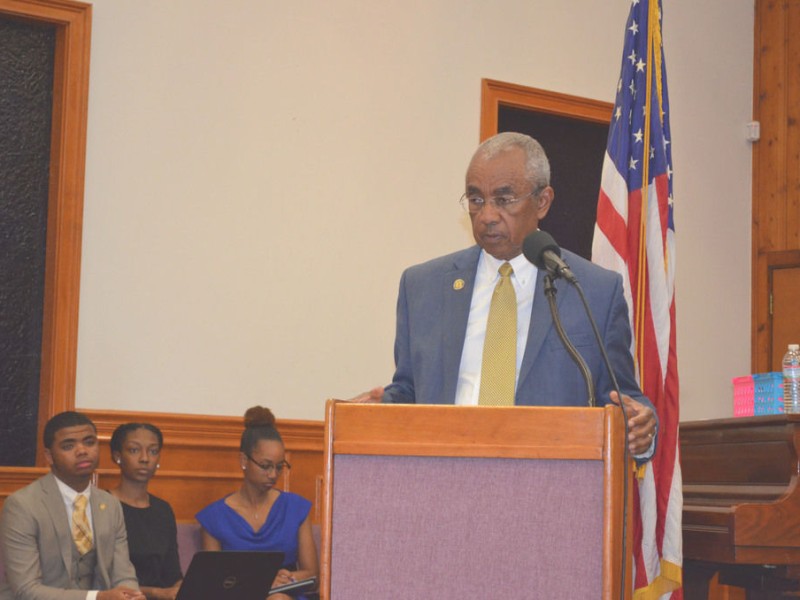
ALBANY — Concerns that a new Albany State University would be removed from its role as an Historically Black College and University were expressed by members of the community at a Thursday night meeting with ASU President Art Dunning at an Albany church.
Students, faculty, alumni and members of the community met at Union Missionary Baptist to express their opinions and concerns following the release of the school’s new mission statement. That statement, released March 9, outlines the mission of the new university that will be formed with the merger of ASU and Darton State College, but does not refer to the new institution as an HBCU. Including that reference was suggested by ASU’s student government association during the drafting process, and many in the community were disappointed by its omission from the statement, including students who protested on campus March 11.
After Thursday’s meeting, Dunning confirmed that the mission statement had been approved by the Georgia Board of Regents and that no changes would be made to it. Earlier Thursday, the university released the Consolidation Implementation Committee’s second of four core-value documents for the new ASU — Guiding Principles.
That second document includes “historically black institution” in its Embrace Diversity section. In its section Elevate Historically Underserved Population, the document says, ASU “will recognize and address the many challenges that face African Americans and other students of color, adult learners, first generation students, students from low socioeconomic backgrounds, and others from underserved populations, and form strong partnerships with K-12, government agencies, and community outreach organizations to increase access and success rates.”
Critics of the HBCU omission from the mission statement contend it erases ASU’s legacy and could have a snowball effect that leads to subsequent changes that distance the new ASU from its HBCU legacy, ignoring the voice of the school’s predominately African-American student population.
Dunning noted that Albany State wasn’t officially labeled an HBCU until 1965 and added that no one can take away its history. He also encouraged the crowd to continue to stay involved and create dialogue.
The group was also concerned about transparency. Some questioned why the town hall meetings were called after the fact instead of during the mission statement process so that concerns could be heard. That includes ASU senior Jazz Kelly, who said students are being referred to a website, but that it contains vague language.
“There’s been a lack of communication all around when it comes to student leadership or the president communicating with us,” she said. “Somebody made a statement that we have a consolidation website. I’ve read that from top to bottom, I know it by heart. It’s on my favorites list, but none of that information indicates when the dates are of the meetings, how far in advance they’re planning for the meetings and when they’re sending this information to the Board of Regents.
“It’s not being clarified on the website. Saying all this information is on the website is false claiming, because it’s not.”
An explanation by Dunning as to why HBCU was not included in the mission statement sparked intense reactions from those attending. He said, “What I want for this next level, that puts us on an international scale, is students from around the world …”
After the meeting, Dunning clarified that while ASU looks to expand and attract a wide variety of individuals, the university has never been an institution of exclusion.
“HBCU is a federal designation. HBCUs have never been unwelcoming,” he said. “They did not start out as a closed system or as an exclusionary system by law keeping other races out, so there’s no alienation.”
Kelley echoed those sentiments, saying that while students are fighting to keep the school’s HBCU designation in the forefront, they look forward to an increased, diverse student population. The two student bodies already have begun to merge, she said.
“Darton has already been coming on campus and engaging with us,” she said. “They had an event last week, an entertainment showcase, on campus for both the Albany State and Darton students to come together for entertainment. … They’re for the merger, we’re just all trying to make this work.”
Reactions indicated the 90-minute discussion did not go over well with many in the audience, including Juanita Gardner, a member of the ASU class of 1951.
“I was still not satisfied because of what they said about if you put historically black college (in the mission statement) we’re gonna lose (students),” Gardner said. “I don’t agree with that.”
Kelly concurred, saying and other ASU students were still uneasy about the future of their school.
“Yes, we’re a historically black university on paper right now, but as you know, laws amend and they change,” she said. “Just like the amendment of the 1965 Higher Education Act for us to be considered an HBCU, that had to be amended, that can change.
“We vote on laws to change, for our rules to change, and our concern is for the future and what could happen. If this happens now and y’all don’t hear our voice, what could happen in the future?”
Related Articles

Albany teen, 16, makes bodybuilding debut at Atlanta OCB Pro/Am
Crockett, an Albany resident and student at Albany Technical College Academy, placed second in the teen bikini division this weekend at the OCB Immortal Muscle Pro/Am Bodybuilding Competition in Atlanta, becoming the youngest competitor across all categories at the event.
Albany Technical College celebrates award winners
ALBANY – Albany Technical College has announced the names of students and educators representing our college at upcoming state-level competitions in 2025.
Georgia Southwestern earns SACSCOC reaffirmation accreditation
Georgia Southwestern State University received recognition of a 10-year reaffirmation of accreditation from the Southern …
