
Judge to decide if redrawn state maps comply with order
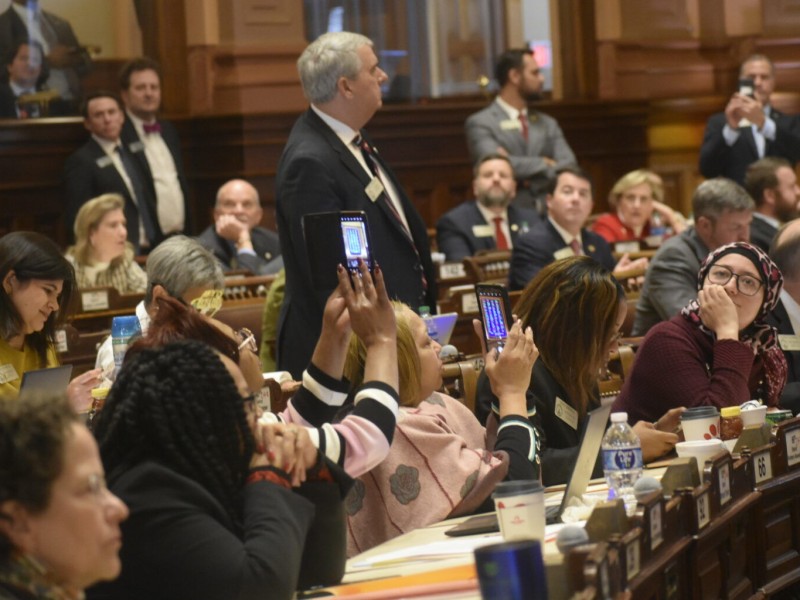
Ross Williams/Georgia Recorder
By Ross Williams
Georgia Recorder
ATLANTA — Depending on who is asked, a newly redrawn congressional map is either an open act of defiance or exactly what federal Judge Steve Jones instructed lawmakers to do when he struck down Georgia’s political maps for diluting the voting strength of black voters.
That map, along with two revised legislative maps, will soon land on Jones’ desk to decide, although an appeal is expected either way. Gov. Brian Kemp signed off on all three maps Friday evening on the final day to submit the plans to the federal judge.
The three maps were quickly ushered through the legislative process during a special session. The high-stakes congressional map received a final vote Thursday after a bitter debate in the House over how GOP lawmakers went about creating the court-ordered new black majority district in west metro Atlanta.
Republicans argue the congressional map complies with the judge’s order to create the new district. Democrats blasted their GOP colleagues for chopping up the racially and culturally diverse 7th District in the north Atlanta suburbs in the process. The 7th District is represented by U.S. Rep. Lucy McBath, who is a black Democrat.
The district’s current form has a voting-age majority made up of a combined 66% black, Latino and Asian people. The new map would make it about 66% white.
“So you put blacks into the 6th District, but are you diluting the vote strength of Asian-American and Latino voters in Gwinnett County, which is also kind of an important thing?” Emory University political science professor Andra Gillespie said. “Are you, for all intents and purposes, fixing one problem but then creating another problem?”
Jones ordered lawmakers to redraw the maps in October after finding that Georgia’s district lines did not reflect the growth of the black population. The state’s growth over the last decade was due to the minority population, yet no new majority black congressional or legislative districts were created.
The judge ordered lawmakers to create the new majority black congressional district and an additional seven majority black legislative districts. In Georgia, black voters tend to support Democrats at high rates, but the new maps are expected to yield minimal Democratic gains in the House and none in the Senate.
“Spoiler alert: Georgia has changed,” said Rep. Gregg Kennard, a Lawrenceville Democrat. “We grew a million people in the last decade, and the overwhelming majority of that growth was people of color and they brought their politics with them.
“Georgia is a purple state, a swing state, and fair maps should reflect that 50-50 political landscape. How can you with a straight face draw a 9-5 congressional map?”
Rep. Sam Park, another Lawrenceville Democrat, argued Republicans cannot say they are complying with the order when they are dismantling a majority minority congressional district.
“This open defiance of a federal court order is alarming. It is reminiscent of the refusal to accept the outcome of the 2020 presidential election that led to the Jan. 6 insurrection,” Park said.
Others have pointedly accused Republicans of following the path of Alabama lawmakers, who unsuccessfully tried to rebuff a court order to create a new majority Black congressional district or “something quite close to it.”
“I oppose this map because this ain’t a Georgia map, this is an Alabama map,” said House Minority Leader James Beverly, a Macon Democrat.
The judge will soon have the opportunity to clear up any questions about his language.
Charles Bullock, a political science professor at the University of Georgia, said that Jones used very clear and precise language throughout his 516-page court ruling, distinguishing black majority districts from minority opportunity districts.
A court hearing has been scheduled for Dec. 20 to review the new maps.
Republican Attorney General Chris Carr requested in a court filing this week that Jones appoint a special master by Jan. 16 to redraw the maps if Jones finds the new ones are not in compliance.
Carr wrote that the governor and General Assembly quickly held the special redistricting session after Jones’ ruling. He also stressed the importance of having district maps approved for a 2024 election cycle that begins with a presidential primary on March 12 and continues with a general election primary on May 21.
Bullock said there is a good chance that the maps that were just drawn will be used in 2024 while the case continues to be litigated. Any new maps must be ready with enough time for candidates and state and local election officials to prepare for an election and to also notify voters about the reshaped districts, he said.
“People say that business business leaders don’t like uncertainty, well neither do political leaders,” Bullock said. “You’re hired and fired by the people in your district so you want to know exactly who those people are and be responsive to them as well as trying to raise money from them.”
Two common forms of gerrymandering — redrawing districts to favor a certain outcome — are cracking, which occurs when the population is divided into multiple districts so they can’t make up a majority and get their candidates elected, and packing, in which people likely to support a candidate or party are shoveled into one area to limit their influence elsewhere. Either maneuver is illegal if done on the basis of race.
“The choices that Republicans made, breaking up the 7th District, putting the black voters back into the 6th District, and then shifting the 13th District east, and then adding black voters to the 5th District, are some very curious choices,” Gillespie said. “And they’re done in such a subtle way that it’s a question of whether or not they did this in a way that would pass muster, either for Judge Jones or for the appellate panel that will undoubtedly get to hear this particular case.”
Similar battle lines have been drawn in the state Senate, where Republicans added new majority black districts around Atlanta and Macon, but Senate Democrats say they did it without increasing the power of the black vote as Jones wanted.
In south metro Atlanta, the districts of Democratic Sens. Elena Parent and Jason Esteves saw their black populations increase to narrow majorities, less than in past cases that were designated as racial gerrymandering, which could be a quandary for Jones.
Gillespie said she’ll be watching Henry County, where Democratic Sen. Gail Davenport’s district is set to become about 60% black.
“Does 60% constitute packing in this environment, especially when you’re trying to keep the adjacent district Republican?” she said. “You only make that 30% black in an area where there’s clearly a fast-growing black population. That 60% might actually be the one to trigger something, just because it is 60%, right? But Parent and Esteves’ districts being only 50% black, that might not meet the standard for packing.”
If Jones is not happy, he could appoint a special master for any or all of the maps that aren’t up to snuff. That could be a problem for incumbents. The special master’s only duty will be to make a map that complies with the law, and that could mean drawing experienced legislators into districts with opposite politics or combining them in the same district with colleagues.
Gillespie said she’s among the political scientists who support nonpartisan redistricting, a process in practice in several states in which experts not affiliated with the legislature draw maps.
“I think we have to ask the fundamental fairness question of should we allow legislators to draw their own district lines, to basically choose their own constituents,” she said. “And there’s something about that level of gamesmanship that I would argue is problematic.
“From that perspective, having a special master draw the districts is as close as we’re probably going to get anytime soon to having nonpartisan redistricting.”
Author

Related Articles

Foreclosures jump 52.9% across the region as buyers regain negotiating power
In Dougherty County, the number of residential properties advertised for foreclosure has nearly doubled this year. In neighboring Lee County, developers are preparing to add hundreds of new houses and apartments, including homes aimed at buyers who have struggled to find newer housing at an attainable price.

Terrell County school board calls special meeting to consider CFO consulting services
The Terrell County Board of Education will hold a special called meeting Tuesday to consider hiring outside financial consulting services as the school district continues work on its finance operations.
The meeting is scheduled for 5 p.m. Tuesday, Aug. 25, in Room 107 of the Terrell County Board of Education office, 761 First Ave. SE in Dawson.

Developers bet on demand for smaller homes, apartments in Lee County
Two residential developments moving forward in Leesburg will add hundreds of new housing options in Lee County over the next few years, with developers saying they are targeting a market they believe has been underserved: young professionals and small families looking for newer housing they can afford.
