
Nicholas Rande Schutsky’s ‘Geographical Solutions’ exhibiting at Albany Museum of Art
Artist merges ‘low art’ imagery with fine art painting techniques to challenge viewers
By Jim Hendricks
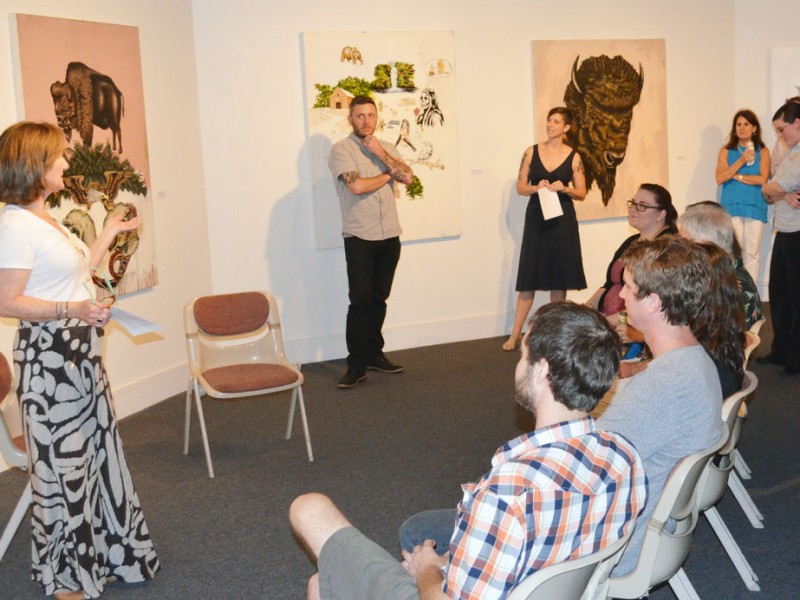
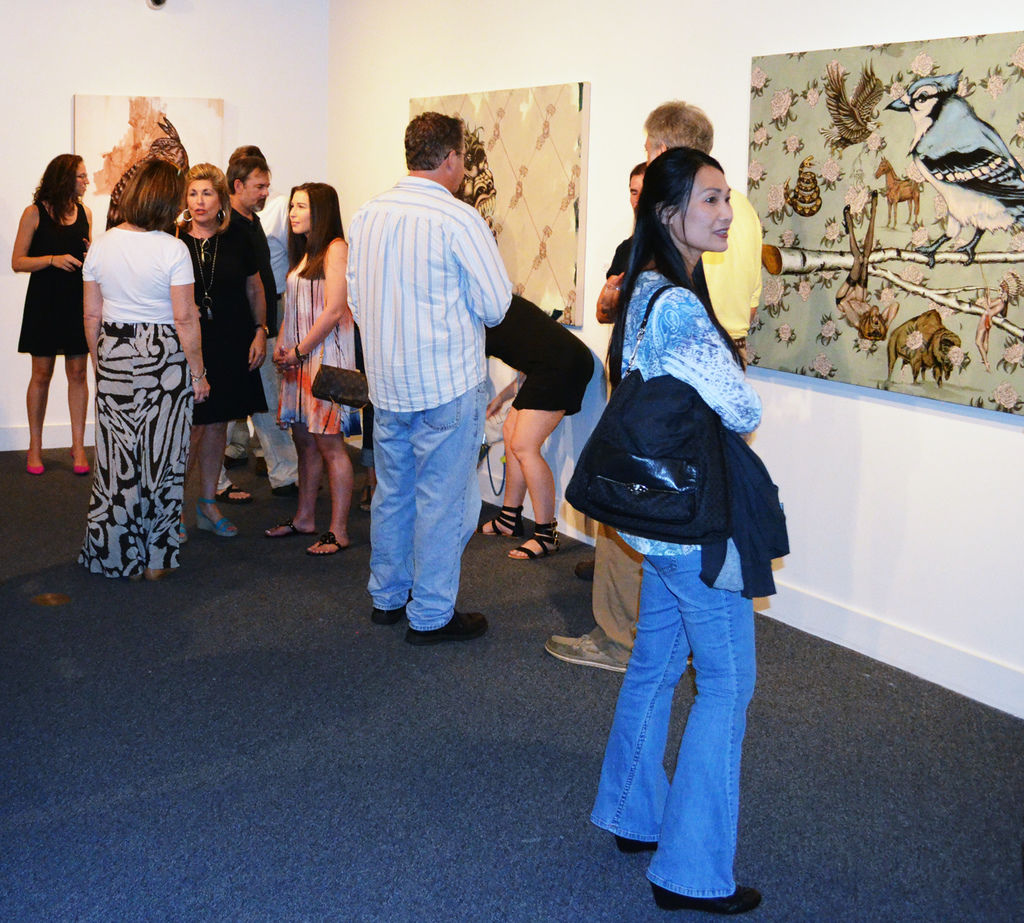
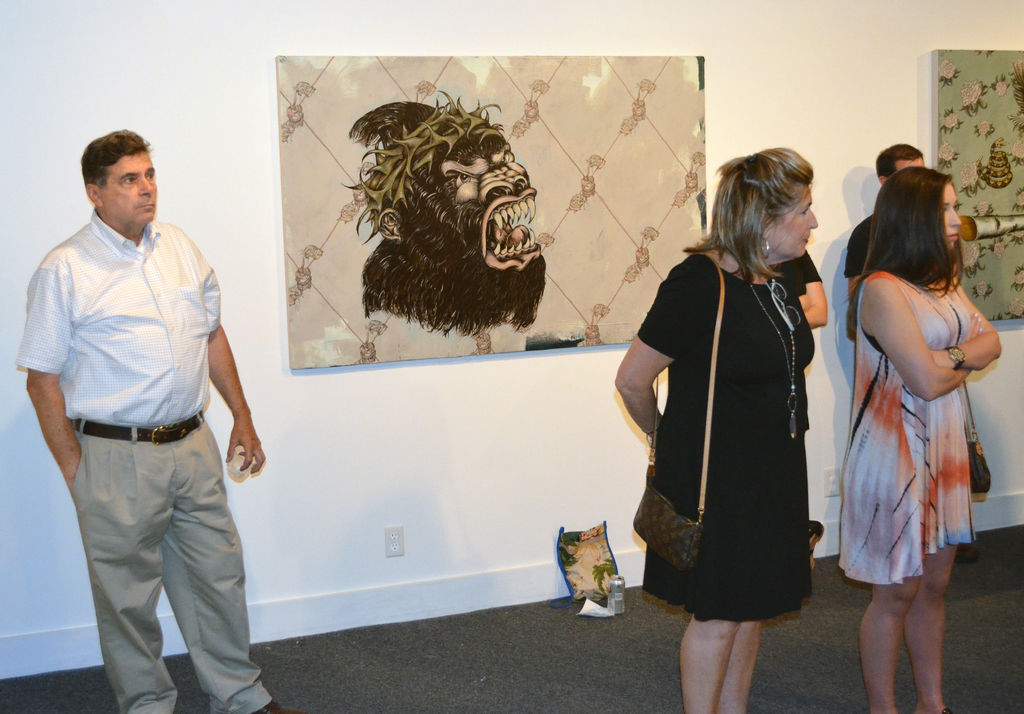
ALBANY — The latest exhibit at the Albany Museum of Art is one that may have some viewers rethinking what constitutes fine art. And that appears be what the artist, Nicholas Rande Schutsky, is intending.
Speaking Thursday at the opening reception for his show, “Geographical Solution” that will be on exhibit through Sept. 25, Schutsky, an art teacher at the upper school of Montclair Kimberley Academy in Montclair, N.J., said making the viewer uncomfortable was central to his work.
“An important part of the role of the artist is to be a provocateur, meaning to provoke a response,” he said during his gallery talk in the Evans Gallery. “I don’t believe that should be the end-all. But I think, ideally, that an art-maker is causing a degree of discomfort in the viewer. It could be the most beautiful painting you’ve ever seen and that could cause you a degree of discomfort. … It disrupts you.”
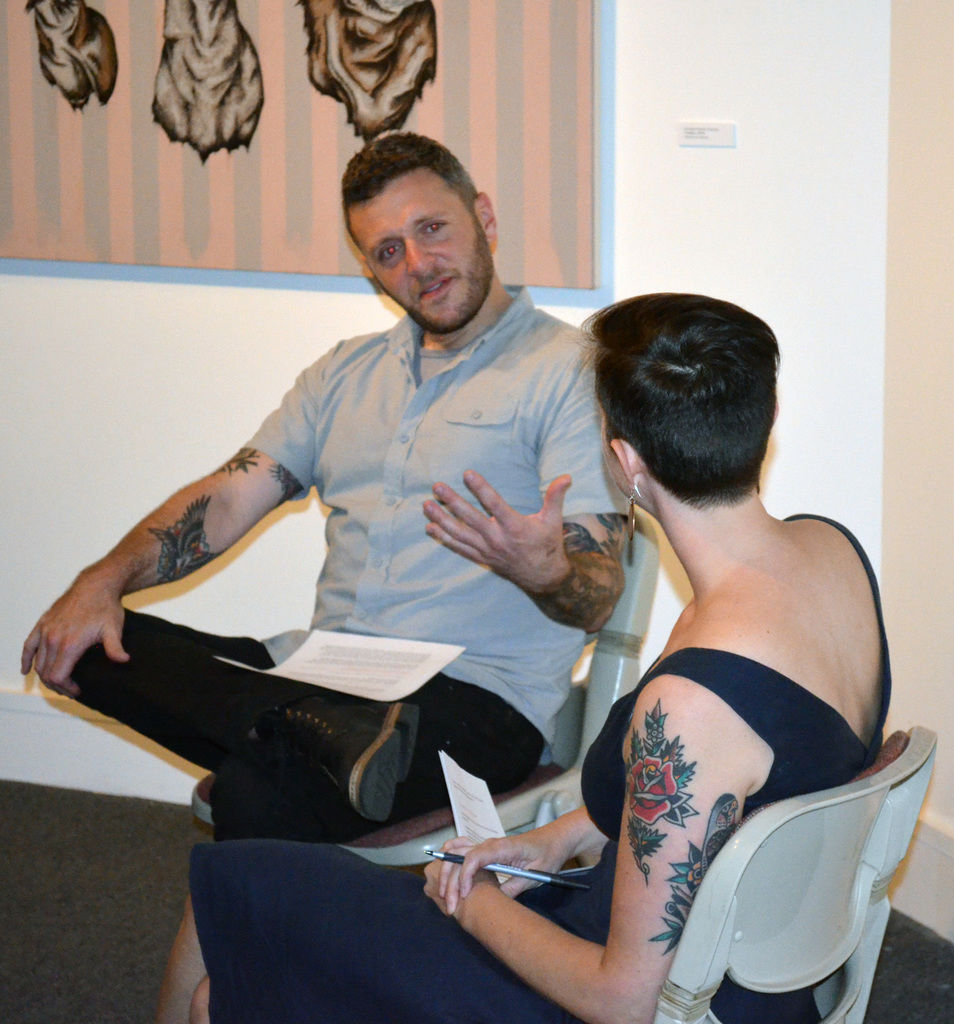
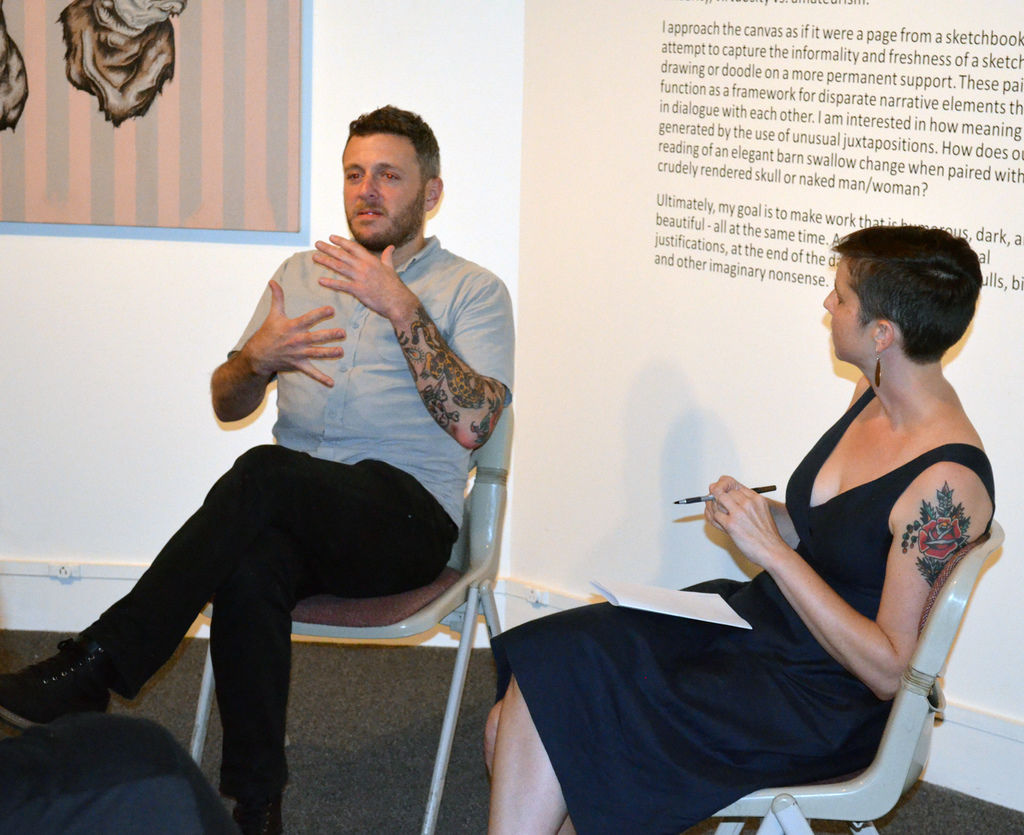
His unusual approach to art was reflected in his gallery talk, which was conducted as his responses to questions posed by his wife, Natalie, who has a Ph.D. in religion and society specializing in ethics from Drew College. Schutsky, who also fielded questions from patrons at the talk, has a master of fine arts from the University of Delaware.
In his artist’s statement, Schutsky points to the apparent contradictions of his work, which merges imagery of subject matter often considered to be “low art” — sports, tattoos, pin-up girls and wildlife — with traditional painting techniques. In addition, he frequently uses a sketchbook-like composition to his work. He says his goal is to produce work that is simultaneously “humorous, dark and beautiful.”
“I’ve been looking at his work for quite some time and I’m thrilled that we could bring it here to the museum,” Albany Museum of Art Executive Director Paula Bacon Williams said, noting that he has exhibited in locations including Switzerland, New York and the United Kingdom.
One of the areas of focus in the gallery talk was censorship. Schutsky has been awarded a grant to study the ethics of art and censorship, writing for the grant after an event in his class. One of his assignments for his students is for them to take a prompt and create art based on it. This time, the prompt was the word “history.”
“I had a student that took an actual American flag and stitched all these things that, basically, he thought America had done wrong in its history, things like slavery, gun violence, Hiroshima … things of that nature. It was a real powerful and terrific piece,” he said. “One day … we came in and we noticed that it had been taken down and replaced with a brand-new, clean American flag.”
Two students who said they were offended by the sight took that action. While he said the school’s response to the event was less than satisfactory in his opinion, the two students were required to return the original piece.
“That really got me thinking,” he said, “why are people offended by certain images and ideas and stuff like that?”
As for his goal for using the grant, he said, “The most important thing is to initiate a dialogue or conversation, trying … to create a community that fosters open-mindedness …”
Censorship, he noted, is a “slippery slope” and that society should have a climate in which everybody “can have their say.”
Later, Williams noted that censorship of a sort had played at role in the Albany show through the selection of the pieces that are being exhibited. “We’re kind of pushing it for us in Albany a little bit,” Williams said. “We just don’t do much of this in the Bible belt.”
The works contain imagery of animals, skulls, birds, nudity and imaginary creatures, such as the grim reaper. In one painting titled “In Other News …,” for instance, includes a small landscape, an octopus attempting to grab the grim reaper’s boat, two cats breaking a rock with picks, a pin-up girl and another grim reaper thinking about a lion cooking a wiener over an open flame among the images.
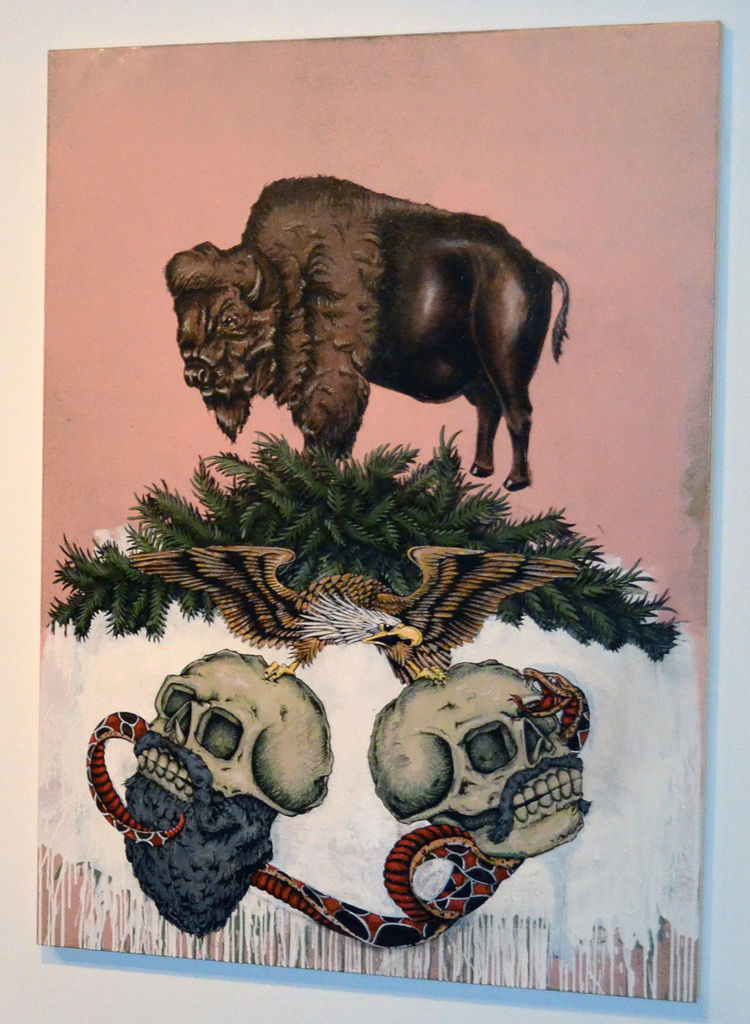
Another piece, “Geographical Solution to an Emotional Problem,” has a buffalo standing above an eagle that is straddling two skulls — one bearded and the other mustachioed — that are connected by a rattlesnake, the snake and eagle looking poised to battle.
His approach to each of his works, he said, was determined to a degree by the work itself.
“Some of them … I sort of had the idea in my head and do it and it works in one shot,” Schutsky said. “Other paintings in the room have five or six paintings under it because I’ll do a painting and I’ll go, ‘It’s terrible, but maybe I’ll keep this part’”. And everything gets painted over.”
He said he will “build out” from an initial image on the ones that have multiple images on them, making aesthetic and narrative decisions that tie together images that are “talking to each other.”
What those and his other works are saying, however, is something he leaves to the observer.
“I don’t want to steer people’s interpretations,” he said. “I make things and I do things and people may look at it and have some kind of opinion or reaction to it, and I don’t want to be influencing that. …”
“I don’t necessarily think there’s a wrong interpretation. I think that as long as someone is giving the work a certain amount of time and thinking about it, there’s no wrong answer.”
Many of the animals in his works mimic human activities.
“My whole life I was sort of interested in and liked animals,” he said, noting he watched nature documentaries and went to zoos. He said he feels animals behave according to nature and “can’t really do anything wrong.”
“The animals I feel like are very innocent as opposed to humans in a lot of ways,” Schutsky said. “To make animals then do things that are less innocent is a way of sort of showing the absurdity of that.”
An image of a kangaroo jumping rope, he said, would be less interesting if it were an image of “some dude” doing it.
Similarly, he said, he doesn’t shy away from sex in his work.
“That’s just sort of another aspect of life,” he said, noting nature documentaries show animals engaged in sexual activity. “That’s just what they do.”
But he says art shouldn’t be simply for shock value.
“It’s not enough for it to just be provocative,” he said. “There has to be some kind of meaning in addition to that.”
In response to an audience question, Schutsky agreed that today’s threshold for “shocking” is higher than in the past, and he also said that people may not appreciate the freedom of expression they have in America compared to other parts of the world where government control is stricter.
“In terms of a global/international type thing, I think in some ways we take what we have and where we are for granted when you think about things that are going on,” he said.
But what is missing too often is the spark of creativity.
“In a lot of ways, the idea of creativity, we’re sort of trained out of that,” he said. “You’ll meet many people who will say, ‘I’m not creative, I can’t do that.’ In teaching and in my own art-making, I’ve found that I think everyone has creative and imaginative ideas.”
The problem is getting someone to use that internal inspiration rather than suppress it.
“I think people get bogged down in the idea, ‘Oh, I can’t do that really well.’ And, over time, … ‘Well, if I can’t do it really well, I probably just shouldn’t do it at all. … I don’t know whether creativity in and of itself can be taught, but sort of opening up the restrictions of everyone who has creativity, that’s the thing I think is important.”
Asked about influences, Schutsky said, “The thing I really enjoy is folk art, particularly Western kind of themes, on a basic level cowboys and Indians … simplistic type stuff. I’m also interested in tattoo imagery. I wouldn’t say I have a particular list of illustrators I look to.”
The Albany Museum of Art is located at 311 Meadowlark Drive off Gillionville Road. The AMA is open 10 a.m.-5 p.m. Tuesdays-Saturdays. Admission is free. Contact the museum at (229) 439-8400 or visit www.albanymuseum.com.
Related Articles
Southwest Georgia artists recognized at packed opening of exhibition
The annual juried exhibition, one of the region’s largest showcases of visual art, features approximately 46 artists and nearly 90 works spanning painting, sculpture, ceramics, photography and mixed media.

Albany Area Arts Council to host reception for ‘A Room of Her Own’ exhibit
A reception for “A Room of Her Own,” an exhibit celebrating female empowerment, is scheduled at the Albany Area Arts Council.
Albany museum’s fall exhibits enter final weeks
ALBANY ─ As 2024 reaches its final weeks, so do the fall exhibitions at the Albany Museum of Art. Jan. 4
