
A stroll down memory lane with Strollin’ Nolan
Staff Photo: Tom Seegmueller
Staff Photo; Tom Seegmueller
Staff Photo: Tom Seegmueller
By Tom Seegmueller
[email protected]
ALBANY — In the 1970s, most young men wanting to borrow someone’s car gave the owner profuse assurances that they would be careful. However, at 17, Jerry Nolan called the promoter at the Albany Speedway and told them if they loaned him a car, he would flip it to add some excitement to the night’s race card. From that day forward Nolan has led a life Walter Mitty would envy … daredevil, stuntman, bodyguard, outdoors TV host, chainsaw carver, and friend to many.
“I had just gone to the Joey Chitwood Thrill Show and decided that’s how I wanted to earn my living,” Nolan said. “They asked me what I would charge, and I told them $150, which was a lot of money in my 17-year-old mind. I went to the track and flipped that car over a couple of times. They really enjoyed it. But I didn’t!
“It wasn’t what I thought it would be like; you clean out that car really good and make sure there’s no trash in it to fly around and hit you. When I started flipping that car, there was a lot more trash in there than I thought”.
It wasn’t long before Nolan went from flipping cars to jumping them on a Harley Davidson.
“Randy Bannister, a NASCAR driver, gave me my first show to jump some cars,” he said during a conversation at his home. While driving to the show, Nolan said he heard this on his radio: “See the greatest thing since Evel Knievel tonight at Patmos Speedway in Pavo, Georgia. See Madman Jerry Nolan defeat death!”
“I decided that was a name I was going to keep,” Nolan said. “I still have people shout at me, ‘Hey Madman, I had your poster on my bedroom wall when I was a kid.’ I will die, but that name will not. I was one of those attention-grabbers and I wanted to be famous.”
Death has been in the back of Nolan’s mind since a show in Cairo, during which he was attempting to jump 15 cars. He laughingly explained he didn’t really attempt to jump 15 cars because not enough people in the audience would volunteer their cars for the jump.
“They were afraid I would turn their new cars into convertibles,” he said.
Those fears would turn out to be well-founded.
“I approached the ramp at full throttle, and I was feeling good,” he recalls. “When I hit the ramp, the engine died. I don’t know what happened. Car 5, I took out the windshield. Car 6, I got on top of that one. Cars 9 and 10, I took the windshield out of. I cleared the rest of the cars, landing with the engine now running wide open. I think it jump-started when I hit number 5.”
During his career as a daredevil, Nolan joined up with “The Masters of Disaster” and Dave Rigsby, the Flying Frenchman, who took him across the country and deep into Canada, where he would eventually prove that even with a jet engine and wings a Lincoln Continental can’t fly very far. The end for Nolan as a daredevil came when a promoter he knew invited him to Daytona International Speedway, offering him the opportunity to break the 24-car jump record.
“I looked at 24 cars parked side by side in a parking lot and decided breaking world records wasn’t on my bucket list,” he said. “Breaking records is a good way to die, and I wanted to live. Things change as you get older.
“I’ve got enough scars on my body. I broke 13 major bones in a jump at Lake Charles, Louisiana, and these teeth are real ’cause I bought ’em after I learned you can’t really trust dynamite.”
With this in mind, Nolan started looking for a career change. With his skill set, becoming a stuntman in the movies was a logical path.
His timing could not have been better, as Burt Reynolds was creating the Georgia film industry at the same time. Nolan would also work in a number Reynolds’ films, including “Gator” and “Sharky’s Machine.” During the filming of the latter film, he recalls a conversation between Burt Reynolds and Dar Robinson, who would attempt what is still the record for the highest free-fall stunt from a building. Robinson jumped from the Atlanta Hyatt Regency at the height of 220 feet.
Prior to the shot, Reynolds asked him if he slept well. Robinson acknowledged that he had. Reynolds responded, “That’s good, I didn’t.”
Nolan and two of his brothers, Jesse and Allen, would act in “The Long Riders,” which was filmed in Parrott, some 32 miles west of Albany.
As the scars, aches and pains mounted, Nolan concluded being a stuntman wasn’t far removed from being a daredevil, so he decided to look for a more relaxed career. Most people would not consider the role of bodyguard to be that choice. But Nolan easily made the transition, spending a number of years protecting the famous and infamous from their detractors and attackers.
Around this time, Nolan decided to seek a more relaxing role in front of the camera. Having met Wayne Pearson, Bill Dance, Sonny Shroyer, Jimmy Houston and others in the growing niche of Outdoor programs, he “decided I wanted to run my own show, so I went to Fox and talked to Many Cantu, and we came up with a plan. He asked me what I was going to name the show? I told him, ‘Strollin’ with Nolan.'”
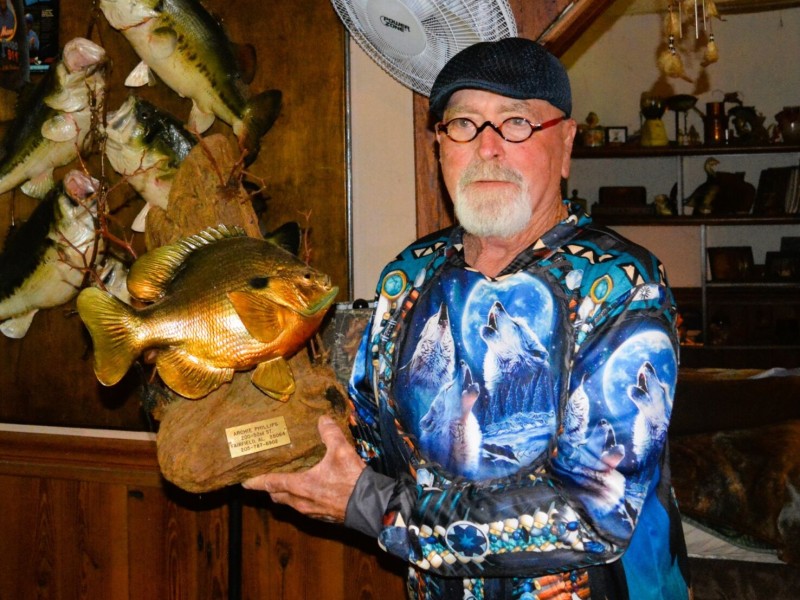
This is the persona for which Nolan is best known. As fate would have it, he decided to go to Fish World in Eufaula, Ala., to film one of his first episodes of the show. The attraction was the creation of Tom Mann, a pioneer in the bass fishing industry and inventor of numerous fishing lures, including the “Little George” and the “Jelly Worm.” He also was responsible for the Hummingbird fish finder. It featured a 38,000-gallon freshwater aquarium, home to Mann’s pet bass, “LeRoy Brown.” As with most things having to do with the outdoors, Mann was ahead of his time with the creation of a Bass Pro-like super store.
While filming, Mann’s secretary approached Nolan and asked if he would like for Mann to be part of the show he was taping.
“I said, ‘Sure,’ and we did the interview,” Nolan said. “We got to talking, and he asked us to go eat lunch with him. After that I left, and I hadn’t been home 30 minutes when the phone rang and it was Mann’s secretary who asked if I have a sponsor.”
Nolan told her a local tackle shop, the Happy Sportsman, was his sponsor. Needless to say, when she told him Mann wanted to be a sponsor, he jumped back in his car and headed back to Alabama.
A deep friendship quickly developed between the two men. While exhibiting at the Fisharama, Mann advised Nolan to go to a variety of the vendors and seek product sponsorship. When Nolan returned without much success, Mann took him over to meet Roger Scott, a major outdoor retailer. With introductions made, Scott handed Nolan his massive catalog.
“You pick out what you want and send me a list,” Scott said.
When Scott received the list, he called Nolan back and asked why he had not requested more.
“I said, ‘Mr. Scott I picked out what I needed,’” Nolan said. Scott said he appreciated that but, “He wanted me to pick out what the public could afford and fish with that.” This became an underlying part of Nolan’s fishing philosophy on the show and at trade shows, and one supported by Mann as well.
“We would be on stage, and Tom would ask the audience for a show of hands on who had spent $200 for a reel; who had spent $150 for a rod. You know why you did that,” Nolan asked. “So you can tell your buddies how much you paid. Come out here and tell ’em something Strollin’.”
Nolan would tell audiences he could take his $29.95 Eagle Claw and “whip you with this one rod and reel and then go home and spank your neighbor’s dog with it.”
“I was telling them the truth; it’s all in your presentation that fish don’t know what rod you’re throwing,” he said. “Just set the drag right.”
Although Mann invented many lures, including the groundbreaking “Jelly Worm,” Nolan said he was always honest that it wasn’t as much about the bait as your presentation, and with “aggravation presentation” you can throw anything, and they will hit it.
Nolan said that he learned a lot from Mann.
“I was using bait casters, and Tom talked me away from that,” Nolan said. “He told me he wasn’t cutting my reels down. But I could use that lure a hundred times better using a spinning rig.”
When Nolan was nervous the night before he and Mann would fish in a major celebrity tournament, he said Mann told him, “Go to sleep; those fish don’t know who’s throwing that bait.”
Although he was one of the leading manufacturers of fishing equipment, Nolan said it was not uncommon for Mann to fish with one rod and a bag of lures.
When Mann died in 2005, Nolan was asked by his family to give the eulogy at man for the he had come to consider a second father.
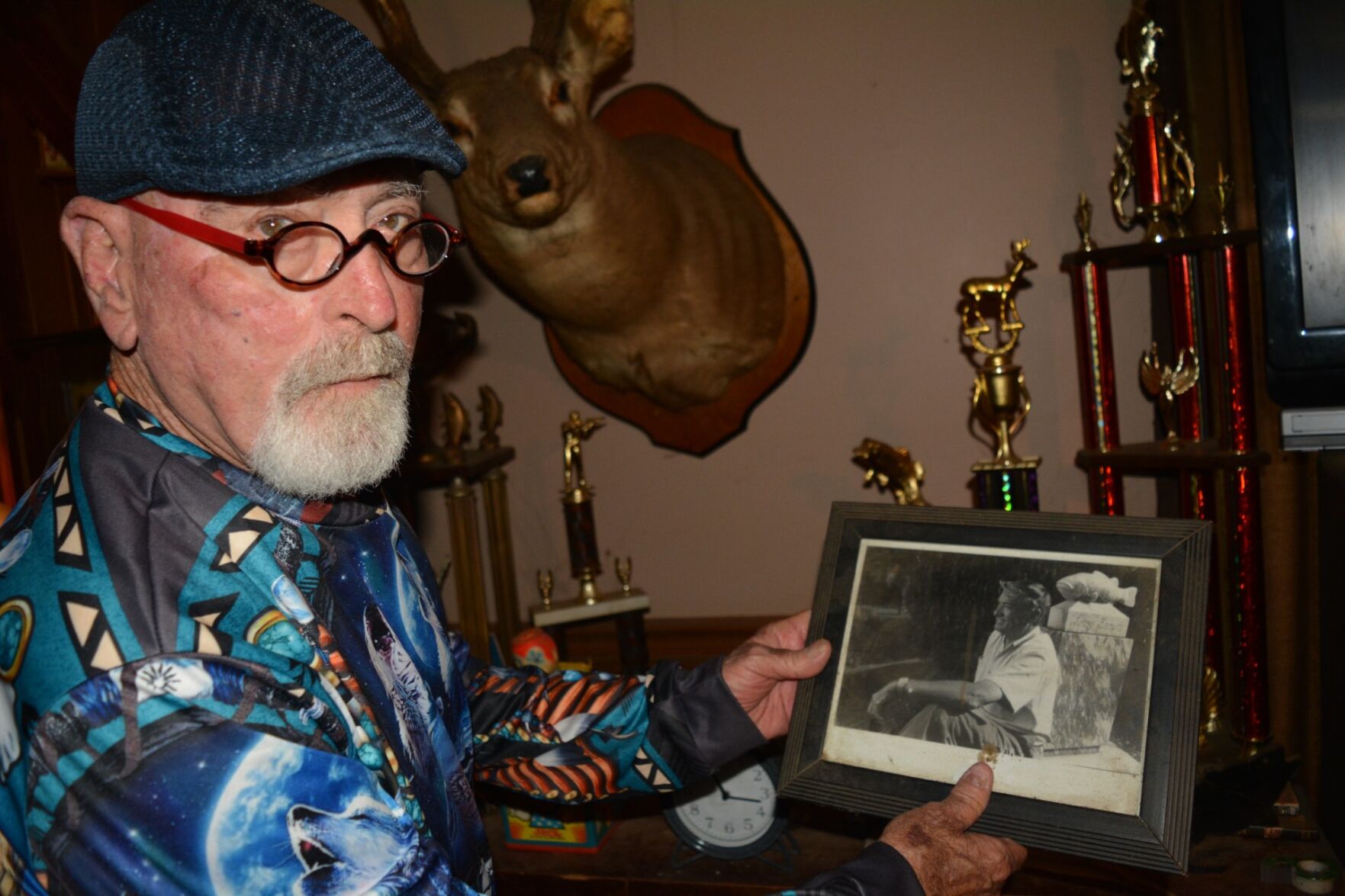
Today Nolan has many items of memorabilia from the times they shared. During our conversation I asked Nolan how he would like to be remembered as death had been an underlying factor during my interview with him.
“That I was a good ole fella,” he responded with a smile.
Author
Related Articles
From cotton to cloud: In the data center debate, is rural Georgia once again being asked to carry the cost?
Across much of rural Georgia, the abandoned cotton warehouses and shrinking tax bases remain — enduring reminders that industries built to serve distant markets do not necessarily stay rooted in the communities that first sustained them.
My Grandpa Was Killed in World War II. I Met Him Through His Letters Home
Gina Wolf’s grandfather died before she was born. His letters sent to her grandmother from Europe during World War II made it possible to know what kind of man he was.
‘Sounds Like a Mutiny.’ Secret Recording Exposes Claims of Toxic Leadership After a Marine’s Suicide
This week’s War Horse story follows the systemic failures before and after the death of Cpl. Drew Mobley who was the third in two years at Marine Corps Base Quantico to die by suicide.
