
AMA 1,000 Words — ‘King David: A Picture, A Country,’ Fei Liu, 3rd place
2nd annual Albany Museum of Art A Picture is Worth 1,000 Words essay contest
By Fei Liu
Georgia Southwestern State University
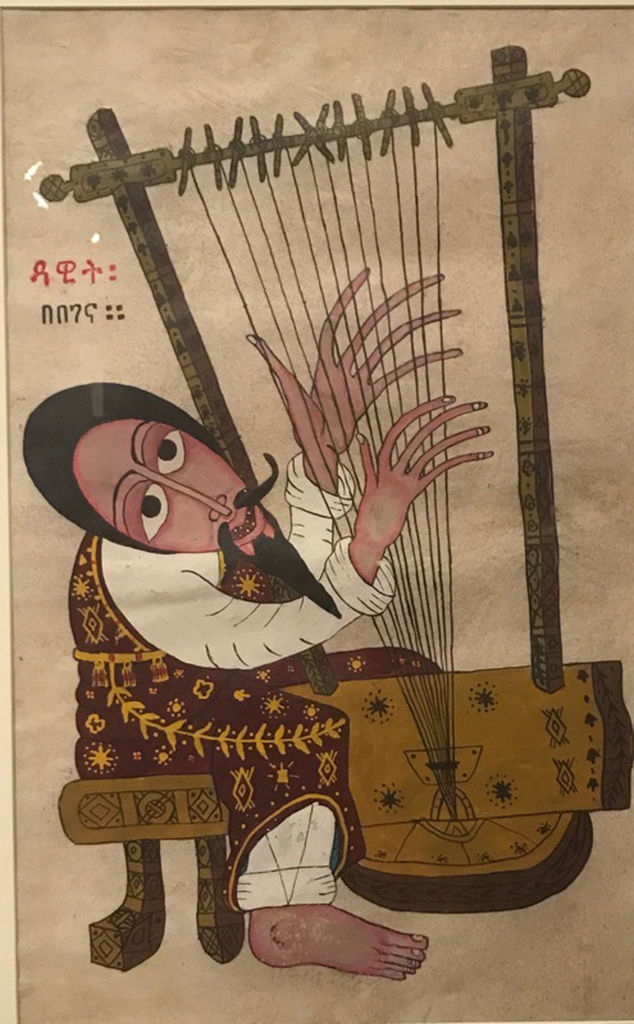
Ethiopia is a country with a long civilized history located in East Africa with numerous Christians. Its art occupies an important position in African art. Ethiopian painting is characterized by bright colors, two-dimensional figures, and exaggerated big eyes. The subjects of Ethiopian traditional paintings are mainly about historical events, folktales, and Bible stories. Additionally, Ethiopian paintings are usually drawn on stretched parchments. The Portrait of King David is a typically traditional painting based on these features.
There is some Ethiopian language — Amharic on the upper left side of this portrait: the letters in red mean “David” in Amharic; the letters in black refer to the Ethiopian traditional harp—Begena, which is exactly the one David is playing in this painting. Therefore, according to these letters, The Portrait of King David can also be called King David and the Harp.
King David in Ethiopia
In the Bible, King David was chosen to be the king of Israel by the Lord when he was fifteen. From then on, David began to show greatness because God was with him—he became a handsome and agreeable person; he could play the harp and sang very well; he was strong and brave enough to beat the Giant, Goliath. He was a good king after King Saul died, but he also made mistakes. In order to marry the beautiful woman, Bathsheba, he sent her husband to the front of the war to let him died. Even though David succeeded in marrying Bathsheba, he realized his sins and prayed to God a lot for forgiveness. Therefore, David may not be a righteous king, but he was identified as a king who tried to listen to and follow God’s will.
King David plays an important role in Ethiopian culture. It is well-known that Christianity has a long history in Ethiopia, and it can even date back to the fourth century in Ethiopian history. According to 2007 Ethiopian census, 62.8% Ethiopians are Ethiopian Orthodox Christian (Habesha Adventures). Hence, it is not surprising that Bible stories are classic topics in Ethiopian paintings.
The Combination of Ethiopian Culture and Christianity
There are two typical features on this painting showing the combination of Ethiopian culture and Christianity. On one hand, in the Bible, King David plays the harp, which is totally different from the instrument on this painting—Begena. Begena is an Ethiopian traditional instrument with ten strings but David’s Begena has 12 strings, which is exactly the one on the painting. On the other hand, King David is in biblical clothing with the Ethiopian feature: the traditional Ethiopian costume has white as the primary color and uses other bright colors to embellish. In this painting, the white and red costume illustrates Ethiopian traditional costume features. Furthermore, the usage of geometric patterns in decoration is also an outstanding feature in Ethiopian as well as African art histories. These patterns usually take up a great part of painting in distinct colors to have a decorative effect. Like in this painting, the yellow patterns make a strong contrast to the red background. Besides the geometric patterns, there is a stem with leaves on David’s clothes, revealing the importance of agriculture in Ethiopia. The meaning of these patterns may not be accurately interpreted, but it remains a beauty of mystery.
Artistic Expression of Character by Exaggeration
Another feature of this painting is that it isn’t based on perspective in graphic art, which means that the composition of character is out of proportion. For example, the eyes of the character are exaggerated big. The wide, almond-shape eyes in Ethiopian painting are called “reversal gaze” by art historians, which means not only viewers are looking at the paintings, but also the characters in the painting are looking at the viewers (About Ethiopian Art). Also, the foot of character is in regular size while the hands are twice as big as the foot. Thus, it can be conjectured that the artist is good at the realistic paintings and the reason for him to exaggerate the hands aims to emphasize the sense of movement of the hands, showing the author’s creativity. In additional, the rule, “Everything looks smaller in a distance and looks bigger on the contrary”, is well-known. However, in this painting, the left hand is much bigger than the right hand, which reflects that the expression of art in this painting is bold rather than limited by the artistic rules.
In conclusion, The Portrait of King is a typical painting with Ethiopian features. Its composition is simple but it reveals a lot of information about Ethiopia, such as the religion, the traditional instrument, and their expression of art. Poet William Blake says, “To see a world in a grain of sand, and a heaven in a wild flower.” Why not see a country in a picture?
Related Articles

‘Sounds Like a Mutiny.’ Secret Recording Exposes Claims of Toxic Leadership After a Marine’s Suicide
This week’s War Horse story follows the systemic failures before and after the death of Cpl. Drew Mobley who was the third in two years at Marine Corps Base Quantico to die by suicide.
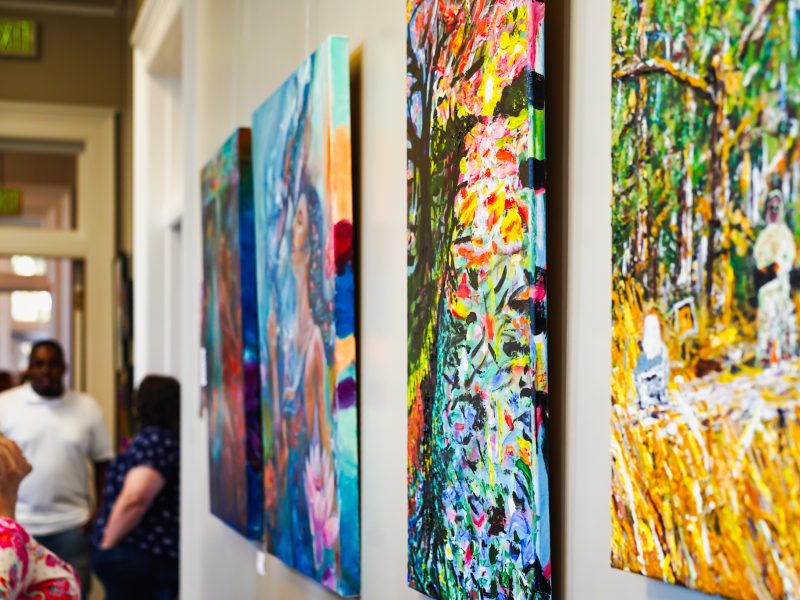
Southwest Georgia artists recognized at packed opening of exhibition
The annual juried exhibition, one of the region’s largest showcases of visual art, features approximately 46 artists and nearly 90 works spanning painting, sculpture, ceramics, photography and mixed media.
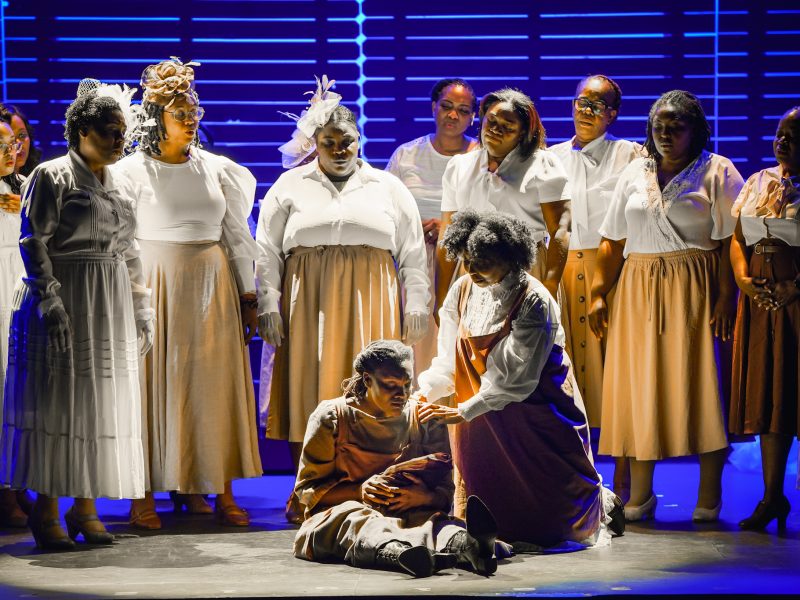
Powerful performances drive Theatre Albany’s ‘The Color Purple’
From the street, strands of purple ribbon wind around the white columns of the historic theater, hinting at the story waiting beyond its doors. Inside the foyer, a carefully curated slideshow flickers across a large screen, cycling through the faces of the cast. Some are seasoned performers. Others are stepping onto a stage for the very first time. Teachers stand alongside former students. Parents perform beside their children. People who worship in different churches, work different jobs and come from different corners of Southwest Georgia gather beneath the same lights to tell the same story.
