
CREEDE HINSHAW: Book outlines search for American utopia
By Creede Hinshaw
[email protected]
I just finished reading Chris Jennings’ “Paradise Now: The Story of American Utopianism” (Random House 2016). What a fascinating read about the various strands of this 19th-century movement that appealed to so many religious (and secular) Americans.
Stretching from the slums of Manchester, England, to the forests of Indiana, the eastern plains of Texas, and the rolling farmland of Western New York, this account will fascinate the reader, leading one to ask whether it is possible to create the perfect society.
Jennings’ history includes the New England Transcendentalists Emerson and Hawthorne, the newspaper publisher Horace Greeley, the brilliant and successful industrialist Robert Owen, and the charismatic John Henry Noyes. Most of these movements were dependent upon a highly successful, compelling male leader, except for the Shakers, whose vision of a perfect society was founded upon the visions of Ann Lee.
It is hard to know what to make of these 19th-century pioneers who were convicted that they could create a perfect community so appealing that the rest of the world would flock to their outpost in order to remake the entire globe into the Eden God first intended for us.
These movements took place in the mid-1800s when the world was still identifying the United States as the place where our world would finally be re-born. Many of these adherents believed the end of the world was near; that Christ was soon to return, and that their movement would usher in the Kingdom of God. Others believed the same thing from a secular standpoint; although they would not use religious language, they believed the Enlightenment idea of progress would come to final fruition through their efforts.
Most of these communities will be somewhat familiar to the reader: the Shakers, the community at New Harmony, Ind., the Brook Farm experiment in Massachusetts and the Oneida community in New York. But I had never heard of the Icarians or the Fourier movements, and frankly, the only thing I knew about Oneida was silverware.
One looks back on the history of these conscientious, sincere, ardent believers through 21st-century eyes and wonders how they could have possibly believed they could create the perfect community in the wilderness. Jennings does not mock them or belittle their efforts, but acknowledges throughout the book the failings of both the founders, the naivete of the followers and the mistaken assumptions of the sacred and secular philosophies.
Although none of these communities survived, they introduced women’s equality, free education, universal health care and the goal of a life dominated by pleasure, joy and loving human relationships. Each of these aspirations continues to be worth seeking.
Jennings, in a concluding chapter, speculates we modern folk have gone too far in the other direction. Few of us have any positive hope for the future. Whereas our ancestors may have naively thought they could create a perfect society, most of our future scenarios are dystopian rather than utopian. Jennings wonders – and I tend to agree — if we are the worse off for the pessimism.
Related Articles

‘Sounds Like a Mutiny.’ Secret Recording Exposes Claims of Toxic Leadership After a Marine’s Suicide
This week’s War Horse story follows the systemic failures before and after the death of Cpl. Drew Mobley who was the third in two years at Marine Corps Base Quantico to die by suicide.

Southwest Georgia artists recognized at packed opening of exhibition
The annual juried exhibition, one of the region’s largest showcases of visual art, features approximately 46 artists and nearly 90 works spanning painting, sculpture, ceramics, photography and mixed media.
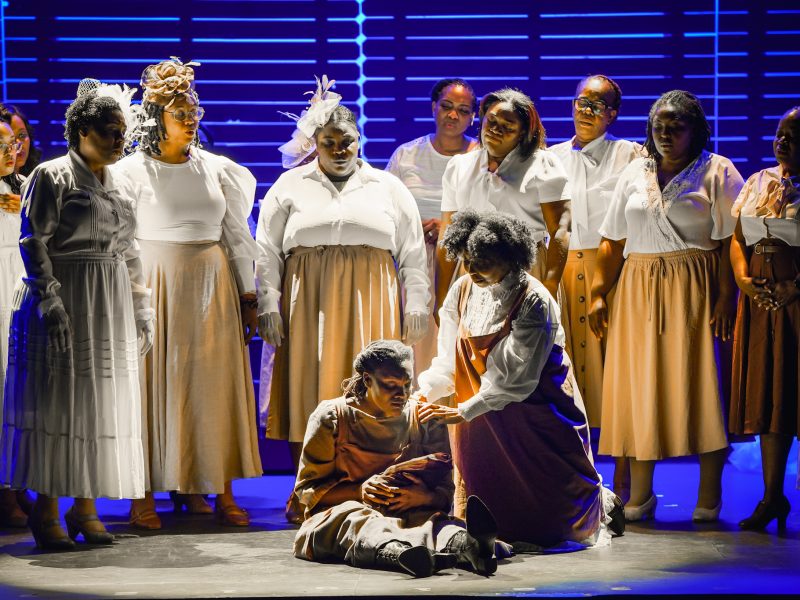
Powerful performances drive Theatre Albany’s ‘The Color Purple’
From the street, strands of purple ribbon wind around the white columns of the historic theater, hinting at the story waiting beyond its doors. Inside the foyer, a carefully curated slideshow flickers across a large screen, cycling through the faces of the cast. Some are seasoned performers. Others are stepping onto a stage for the very first time. Teachers stand alongside former students. Parents perform beside their children. People who worship in different churches, work different jobs and come from different corners of Southwest Georgia gather beneath the same lights to tell the same story.
