
Cuthbert historians work to preserve history in southwest Georgia cemeteries
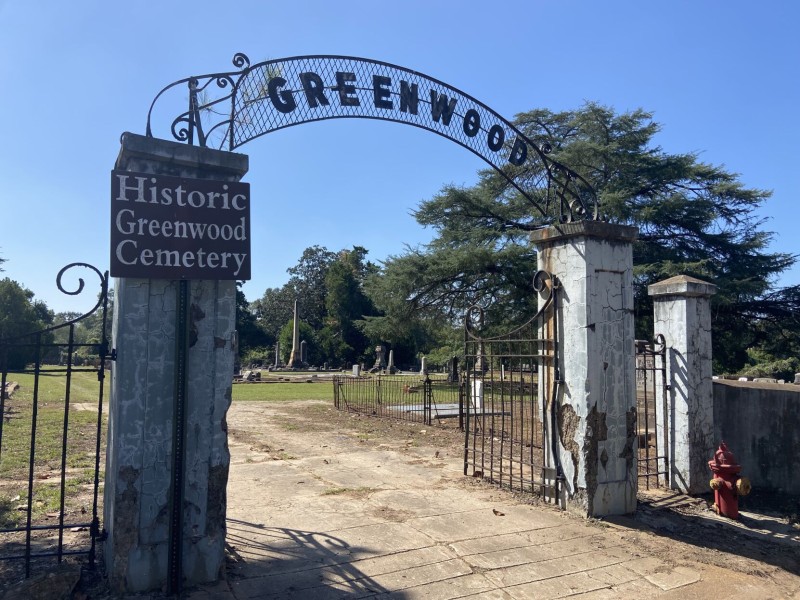
Staff Photo: Lucille Lannigan
By Lucille Lannigan
[email protected]
CUTHBERT — The empty, grassy gap in the center of Greenwood Cemetery here had raised questions for years from researchers and history buffs alike.
The cemetery dates back to 1843 and was the site of the First Methodist Church of Cuthbert. During the Civil War, it became one of the burial grounds for Confederate soldiers who died at Hood Hospital, which was housed in Andrew College — an all-girls college at the time.
Karan Pittman and Lela B. Phillips, both professors at Andrew College, researched Confederate Hospitals in Cuthbert extensively. Twenty-four Confederate graves were marked at Greenwood Cemetery — some named and some unnamed. The two historians would later discover that the majority of these people died of smallpox in December 1864 and January 1865.
Smallpox was a common enemy during the war with a death rate of 23% among white troops and 35% for black troops, according to the National Museum of Civil War Medicine.
“It was so contagious,” Pittman said. “And then it hit us — this cannot be all the graves. There were some days that almost 800 people came into Cuthbert … when the battles were really raging. So 800 people — you had more than 24 people die.”
So the two historians did some digging (figuratively). Using ground-penetrating radar from Omega Mapping Services, which is a nondestructive and noninvasive method that maps an underground area. They soon unearthed 157 soldiers buried under the empty space at Greenwood Cemetery.
It made sense, Phillips said. Many of the soldiers that came into Cuthbert were already dead. Train tracks ran right next to the cemetery, and often bodies were transported by train car, rolled off and buried in trenches right in the cemetery.
“The location of the cemetery was very handy to the railroad and very handy to the hospital,” Phillips said.
Hood Hospital is just a couple blocks away from the cemetery.
Pittman and Phillips said that the soldiers needed to be honored in some way. Records like death certificates were hard to come by during that period due to a lack of paper and minimal publishing from newspapers, so the soldiers remain unnamed.
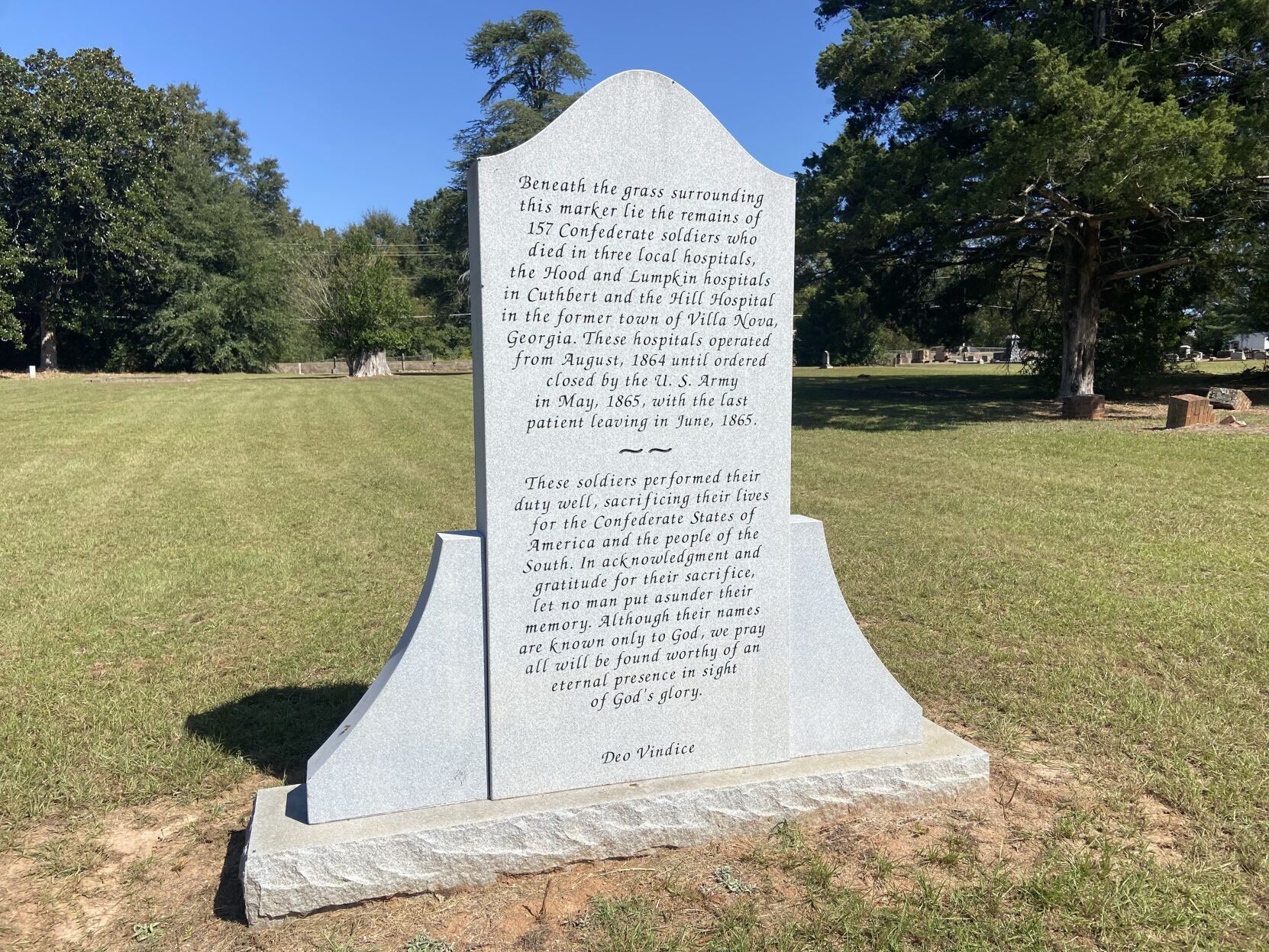
They settled on a tall, stone marker to be placed in the center of the empty space. With funding from the Georgia Civil War Committee and local chapters of the Sons of Confederate Veterans, the marker was erected and a rededication ceremony was held.
“These soldiers performed their duty well, sacrificing their lives for the Confederate States of America and the people of the South,” the sign reads. “In acknowledgement and gratitude for their sacrifice, let no man put asunder their memory.”
The two recognize the painful part of Confederate history. Pittman said she believes effort should be put forth in recognizing everyone’s history.
“All of it made us who we are,” she said. “All of it got us to this point. No matter how you feel about one side or the other of the Civil War, they were still young boys and many of them were far from home and maybe their parents never knew what happened to them.”
Phillips and Pittman are hard at work preserving all sides of history throughout Cuthbert and Randolph County as a whole, where many other historic cemeteries are scattered throughout.
A project they plan to take on this fall is restoring and resurrecting an African American Cemetery named McDonald Woods Cemetery in Randolph County.
Pittman said she believes there is renewed interest in honoring and cleaning up cemeteries in Randolph County.
“We have some truly remarkable cemeteries in this city and county, and I think that people are starting to realize that it’s going to take a lot of work to maintain them as families move away,” Pittman said.
There have been efforts in the past to identify veteran graves dating back to the Revolutionary War and War of 1812 as well, she said.
Glenn Sinquefield, a member of the Calhoun Chapter of the Sons of Confederate Veterans, said the organization has been involved in cleaning up cemeteries for years.
“It’s been one of our main missions,” he said. “We’ve put up a lot of headstones, and we’ve gone in and cleaned up a lot of old cemeteries that were more or less lost and forgotten.”
The organization, he said, is interested in helping fund the recognition of any veteran.
“Black, white, whoever they are,” Sinquefield said. “They’re all American veterans.”
David Dixon, the Flint Riverkeeper board president and self-proclaimed history buff, attended the Greenwood Cemetery’s rededication ceremony. He remembers about 40 people gathering under the shady oak tree at the cemetery to honor the found soldiers.
“It’s part of our history down here, and it was completely lost,” he said. “So that’s why it intrigued me.”
Dixon has helped with finding lost cemeteries in Lee County.
“They’re everywhere in the woods,” he said.
One that has sparked particular interest is on the edge of Terrell and Lee counties. Dixon said he believes it was an old slave cemetery. The cemetery was unveiled partially when the Department of Transportation began cutting up State Route 32.
“People started seeing bones and everything popping up, and the Department of Transportation was called,” Dixon said.
That was last year, and the DOT knows about it, but he said he hasn’t heard more on the subject.
Dixon is also currently working on researching a monument in Dawson for enslaved people who fought for the Confederacy.
Preserving this history is about respecting the dead, he said.
“It’s all a part of our history,” Dixon said. “We can’t change it, and we want to have respect and honor for the people that are buried there. No matter who they are, what color they are.”
Author

Related Articles
‘Sounds Like a Mutiny.’ Secret Recording Exposes Claims of Toxic Leadership After a Marine’s Suicide
This week’s War Horse story follows the systemic failures before and after the death of Cpl. Drew Mobley who was the third in two years at Marine Corps Base Quantico to die by suicide.
Southwest Georgia artists recognized at packed opening of exhibition
The annual juried exhibition, one of the region’s largest showcases of visual art, features approximately 46 artists and nearly 90 works spanning painting, sculpture, ceramics, photography and mixed media.
Powerful performances drive Theatre Albany’s ‘The Color Purple’
From the street, strands of purple ribbon wind around the white columns of the historic theater, hinting at the story waiting beyond its doors. Inside the foyer, a carefully curated slideshow flickers across a large screen, cycling through the faces of the cast. Some are seasoned performers. Others are stepping onto a stage for the very first time. Teachers stand alongside former students. Parents perform beside their children. People who worship in different churches, work different jobs and come from different corners of Southwest Georgia gather beneath the same lights to tell the same story.
