
Col. William ‘Earl’ Cooper, former Albany resident killed in Vietnam War, buried with honors at Arlington Cemetery
Brad McEwen
ALBANY — More than four decades after his plane was hit by surface-to-air missiles near a tiny village in North Vietnam, former Albany resident and decorated Air Force Pilot Col. William “Earl” Cooper was finally laid to rest Thursday at Arlington National Cemetery, giving peace to family who had believed they’d never receive closure.
Cooper’s family had long known that he had been lost on a mission during the Vietnam War in 1966 and that the Air Force had officially declared him killed in action in 1978. It came as a surprise when family members were contacted a few months ago and told that his body had been recovered.
According to Cooper’s eldest daughter, Marianne Brand, members of the family were notified last year that Cooper’s remains had been identified, which brought a sense of finality to those who had dealt with Cooper’s loss for so long.
“Around December of last year they notified the family that his remains had been identified, that they were 98 percent sure,” said Brand. “That was an emotional time. It brought up all over again, the grief and emotions that had been pushed down. It brought all that back again.”
Brand, who was in her early 20s when her father went missing, said that for her it brought back a lot of memories of her father and what the family had gone through over the years.
“When I found out that he had been shot down, I was pregnant with my first child and it was hard to comprehend,” said Brand, who had grown up away from her father after her parents divorced when she was a child. “I had hope that he wasn’t killed. I think (when the family was notified in 1978 that Cooper’s status was killed in action) that I had already made peace with the situation.”
After making peace with the loss all those years ago, when those emotions came rushing back they were met with other emotions as the story of bringing Cooper home was made fully clear.
The story of recovering Cooper’s remains began on April 24, 1966, when fellow pilots flying with Cooper on a mission reported the pilot’s F-105D Thunderchief fighter/bomber had been hit by enemy fire during a mission in the Hiep Hoa District, Ha Bac Province, Vietnam.
According to documents provided by the Joint POW/MIA Accounting Command (J-PAC), a Department of Defense unit that handles the search for service men and women listed as prisoner of war, missing in action or killed in action, Cooper, who at the time of his disappearance was a lieutenant colonel, was the squadron commander of the 469th Tactical Fighter Squadron of the 388th Tactical Fighter Wing stationed out of Korat Airbase in Thailand.
As the story goes, Cooper was flying the lead aircraft in a flight of four F-105Ds during a daytime strike mission as part of Operation Rolling Thunder, a controversial U.S. aerial bombardment campaign that saw nearly 1,100 U.S. servicemen either killed, captured or missing and nearly 950 U.S. aircraft lost during a three-year period.
Reports indicate that Cooper’s group of four planes (all code named Oak) was on a strike mission to destroy the Bac Giang Bridge, a highway-railroad bridge located 35 miles northeast of Hanoi, that connected to the Thai Nguyen Industrial Complex and provided a vital link between North Vietnam and China.
When the squadron dropped below 9,000 feet to visually recognize the target, it was met with skies full of anti-aircraft flak just below them. Despite having lost two aircraft on a strike mission toward the target the previous day, Cooper and his squadron bore down on the bridge, intent on carrying out their mission.
Descriptions from other pilots involved in that day’s flight indicated Cooper held course toward the target, to make certain the rest of the squadron could stay on course, despite the heavy fire.
That’s when, the pilots said, Cooper’s plane torn in half by an enemy surface-to-air missile (SAM). On pilot, who had narrowly avoid being struck himself moments before Cooper’s plane was hit, said he not only saw the SAM hit Cooper’s plane, but that the canopy of Cooper’s plane never opened as it descended.
J-PAC information indicates that, due to the “hostile threat” in the area, search and rescue efforts were precluded. With no attempt to immediately locate and investigate the suspected crash site, there was no way to know whether Cooper had survived, been captured or perished. He was lost. In 1978, his Air Force was amended to declare Cooper KIA.
Despite this classification, the search for answers about what had happened to Cooper didn’t stop. What many close to the situation didn’t know is that the members of J-PAC, a task force that operated almost like a separate branch of the military, were charged with accounting for every American service member lost, captured or killed in all wars and conflicts.
As Marvin Mixon, commander of Albany’s American Legion Post 30 and a fellow Vietnam veteran, put it recently, simply returning home from conflict was something all veterans of conflict hoped for when being deployed.
“When I went over, I really didn’t expect to come home in an upright position,” Mixon said. “I was expecting to come home one way or another. As young soldiers, we had been told when we went out that if we got into a combat situation our odds of returning from the mission were slim. That was always in the back of your mind, but it was comforting to think that one way or another we’d get to go home.”
That hope is what has driven members of J-PAC, many of which are veterans themselves, to continue investigating the disappearance of Cooper but others who are missing.
The efforts that were put into finding Cooper were extensive and often aided — and spurred on — by chance. As it turns out, in 1989 the U.S. Army Central Identification Laboratory (CIL) at Joint Base Pearl Harbor in Hawaii received the remains of a service member who could not be positively identified, but were tentatively believed to be Cooper’s.
“On 31 July, 1989 the Socialist Republic of Vietnam (S.R.V.) repatriated to the United States a box that it alleged contained the remains of ‘COOPER, WILLIAM EARL,’” reads a J-PAC document presented in Cooper’s file. “The remains, which were accessioned at the CIL on 1 January 1989 as CILHI 0175-89, could not be verified as the remains of William E. COOPER, and the case was placed in a hold status pending future case developments.”
In 1993, a joint U.S./Vietnamese team investigating the alleged site of Cooper’s crash led them to a Vietnamese villager named Le Xuan Bien.
Bien had lived most of his life in the Hoang Thanh village and witnessed a crash that is believed to be Cooper’s. Bien told the field unit that he had commanded the local militia and had been one of the first to arrive at the the crash site.
Bien recalled that he and his unit secured the crash area, still ablaze because of live ammunition on the plane. When the flames subsided, Bien said he took human remains from the plane and buried them nearby, close to a stream.
“Bien stated that after the crash he and other militia members visited the crash site, where they observed the pilot’s partial charred remains,” the J-PAC report states. “Due to the impending darkness, they hurriedly gathered and buried the partial remains knee-deep in an undeveloped section of a stream bank, 60 meters southeast of the crash site.”
Bien went on to tell the field team that he returned two or three days later and exhumed the remains and reburied them in a second location alongside the stream. That burial site was short-lived, however, as Bien stated that a group from the Hiep Hoa District Office arrived a year after that and moved the remains to another site about 110 meters from the second burial site.
Hiep Hoa District military representatives exhumed the remains in 1975 for the final time, and they were sent to the United States in 1989. Cooper’s remains had finally been returned home, but it would be more than two decades before the identity could be verified.
During the intervening years, Cooper’s unconfirmed remains were housed at the J-PAC lab in Hawaii, where they were subjected to various tests as researchers tried to determine identity. With the consisting of just a few bone fragments, testing was difficult.
Over the years, several DNA tests were conducted on the bone fragments, but all were inconclusive. In May 2014, however, a test using mitochondrial DNA matched the remains to DNA that had been obtained from Cooper’s sister.
After reviewing the test results, along with mountains of other circumstantial evidence related to things collected at the alleged crash site in Vietnam and the accounts by the U.S. pilots and Bien, J-PAC officials formally declared Col. Cooper found and notified the family.
Brand said that when she and other family members learned how much time and effort had been expended to find and identify her father, she was overwhelmed.
“I was amazed,” she said. “I said, ‘Wow, they really don’t leave anybody behind.’ They do everything they can to bring closure to these families. They never stop looking. They are still looking for veterans from World War I and World War II and even the Cold War. It really is amazing. I have such a great appreciation for all the people who have dedicated their lives to this.”
Brand said the family is also greatly appreciative to the military for honoring her father with a burial with full military honors, including a 21-gun salute, at Arlington National Cemetery.
As is typically the case, the military offered Cooper’s family the option of burial at Arlington rather than his remains being buried near family, and Brand said that family ultimately decided to give her father the honor of an Arlington resting place.
“The family decided that’s what they wanted to do because it would really honor his life and his service to this country,” she said. “He loved this country and was proud to serve. He joined when he was very, very young, and that was a big part of his identity, how he saw himself.”
Indeed, Cooper, a native of Dothan, Ala., who grew up in Albany, spent most of his adult life in service to the country. According to his service record, Cooper enlisted in the U.S. Army at the age of 19 in 1939 and after graduating from Infantry Officer Candidate School in 1942. He was transferred to the Army Air Forces and completed pilot training in 1944.
After flying B-24 “Liberator” bombers in China and the Pacific Theater until the end of World War II, he left active duty in 1946, but returned to duty in 1951, where he remained until his disappearance.
Cooper was posthumously presented with the Air Force Cross, which is for extraordinary heroism while engaged in an action against an enemy of the United States.
After years spent hidden away in a remote part of a faraway country and sitting in box in a storage facility in the middle of the Pacific Ocean, the remains of Col. William Cooper are laid to rest in field reserved for the nation’s heroes. Brand said there were four generations of Cooper’s family at the service, including his sister, Betty Daniel, and some of his great=grandchildren.
“It was a beautiful service and very well attended,” Brand said. “It was a great reunion for everybody and way for everybody to get together and share their memories. It was really special. There was certainly a lot of sadness that this great man was gone, but at the same time it felt good to honor him and what he did for his country.”
Related Articles

Albany police make arrests in murder, robbery cases
Officials with the Albany Police Department have announced a number of arrests in cases that involved a homicide and a pair of thefts.
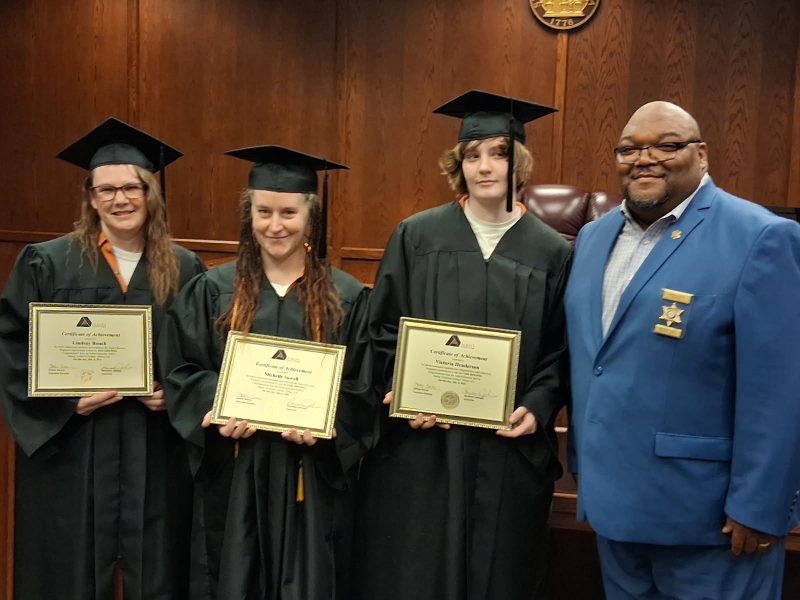
Dougherty Jail graduates first class of female GED recipients
“It was an escape. I can say this has been challenging. I want to express my gratitude for being able to attend this program.”

From cotton to cloud: In the data center debate, is rural Georgia once again being asked to carry the cost?
Across much of rural Georgia, the abandoned cotton warehouses and shrinking tax bases remain — enduring reminders that industries built to serve distant markets do not necessarily stay rooted in the communities that first sustained them.
