
Georgia-Pacific showcases its new Albany mill
By Tom Seegmueller
[email protected]
ALBANY – The conversion of logs to lumber is nothing new to southwest Georgia. However, the Georgia-Pacific mill currently under construction in southwest Dougherty County is taking the process into the 21st century in a big way.
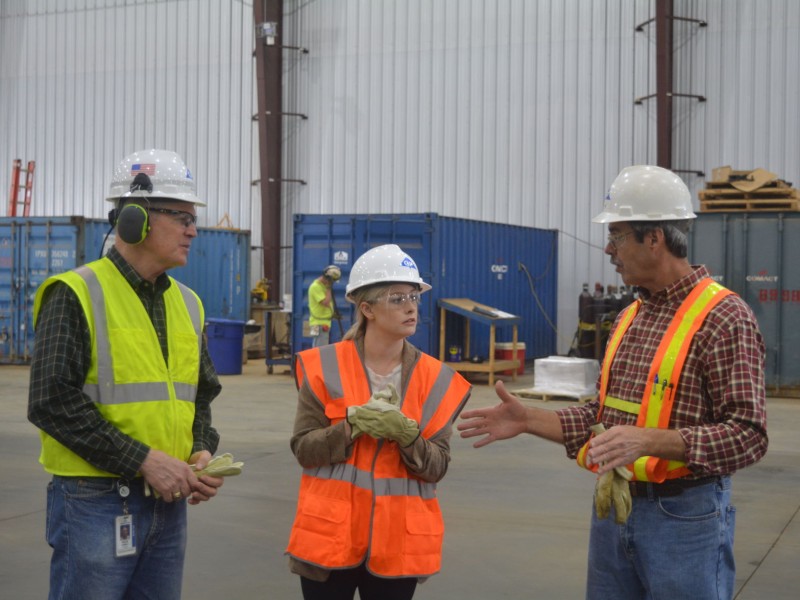
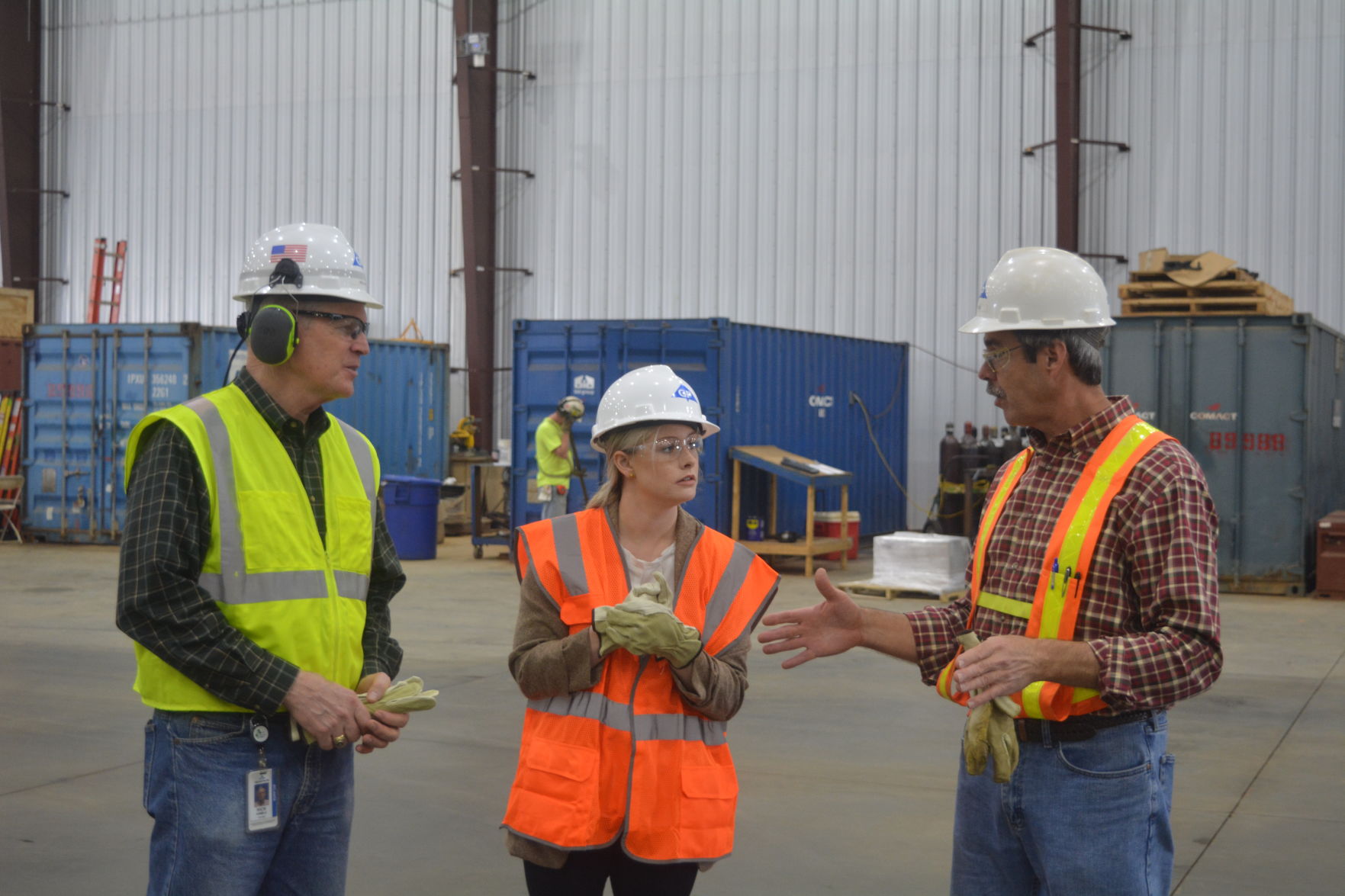
A recent tour of the site with Georgia-Pacific Project Manager Dan Briggs and other corporate representatives quickly put the size and scope of the Mill into perspective.
“This is a 225-acre site,” Briggs noted. “We did the first pour (of concrete) on Feb. 6, 2019, and we ran the first log through during the first week of December the same year.”
During the construction process, which is still under way, 4,700 loads of concrete were poured and 800 truckloads of building material were delivered to the job site. The concrete covers 20 truckloads of rebar.
The planning, layout and technology of the state-of-the-art facility allow it to turn out 300 million board feet of lumber annually. In the process, tons of residual material, including bark, chips and dust, are also processed and shipped out to be used at other Georgia-Pacific plants. There, they are used in the production of landscaping and construction products. From the earliest stages of planning, safety and efficiency were the underlying principles.
To better understand these principles in action, one would need to follow a log through the site.
When a log truck arrives at the mill with a load, it is directed to the right hand side of the site, where it passes over an automated scale that weighs the load. The driver pulls his trailer into a safety rack, which prevents any logs from falling from the trailer when the 42-ton load is unstrapped.
“The mill is currently receiving 200 truckloads of logs a day and shipping out an equal amount of residuals,” Briggs said.”One side of the mill is for logs, the other for lumber.”
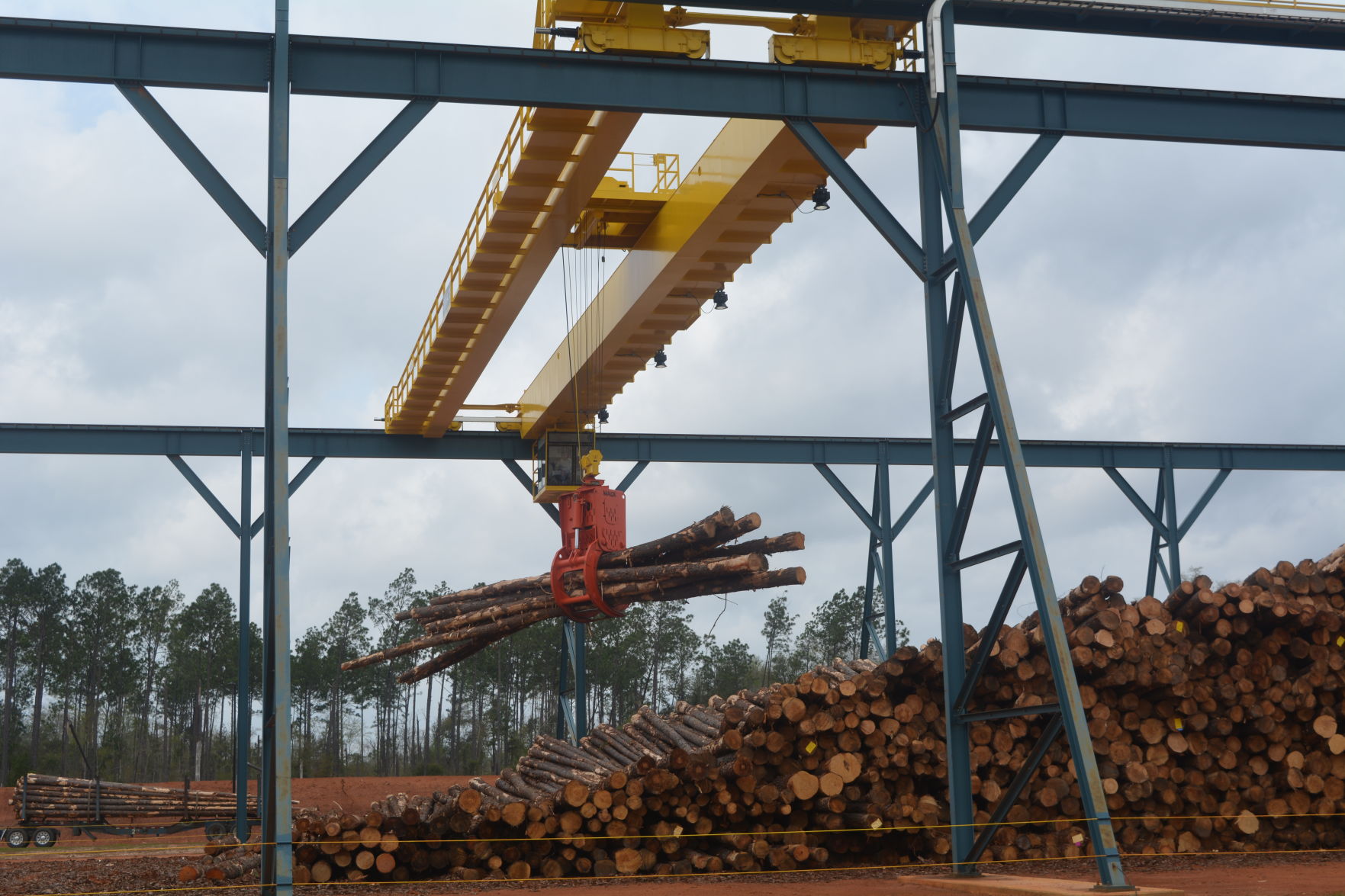
Leaving the scales, the driver pulls his trailer under an elevated crane mounted on a pair of 1,000-footlong rails spaced 125 feet apart. This allows full-length logs to be unloaded and stacked outside the mill. However, before any attempt is made to unload the trailer, the driver must leave the cab of his truck and enter one of two steel safety cages located at either end of the crane’s gantry. The crane’s grappling claw is able to unload each trailer with two 21-ton lifts, a process that takes mere minutes. Any oversized logs are set aside for sale to other sites.
Logs meeting the mill’s specifications are stacked in front of the debarking station, where they become part of a perpetual first-in, first-out process. After debarking, each log enters the mill, where it is digitally scanned. This creates a three-dimensional image of the log, which is then processed by “the merchandiser.”
This system immediately determines how best to saw that log for maximum value using current market prices for finished lumber. If 8-foot 1x1s are bring more than an 8 foot 4×4, the mill cuts the 1x1s. The system also determines how each log can be cut with the least waste.
Explaining the process in action, Fritz Mason, head of Georgia-Pacific’s Timber Division, said, “The entire scanning and evaluation happens within a quarter of second.”
The actual milling of the lumber uses a single saw line that runs the length of the 600-footlong building. During the process, logs and lumber are running in two directions, similar to a highway, utilizing a minimum of space inside the mill.
“When we have to turn it off, there is obviously a lot at stake,” Mason said. “We use an almost NASCAR approach to repairs and maintenance: A lot of planning goes into the effort, and we do all we can as quickly and safely as we can do it.”
As the green lumber leaves the mill, it is carried by rail into a series of kilns, where the wood’s moisture level is reduced, creating a superior building product.
“Green lumber is fed into both ends of the kiln, once again in the same manner that traffic flows on a highway,” Briggs said. “This allows the temperatures in the core of the kilns to be maintained in a more efficient manner, saving time and energy. Cooler green wood is met by warmer drying wood. The wood flows into the kiln at a rate of 4 feet an hour.”
The project manager explained how the moisture in the kiln is drawn into condensers and converted to water, which then goes to a holding pond that is patterned after ones that are used in Colorado mining operations.
“You don’t see the massive steam plumes going up outside the mills anymore,” Briggs said.
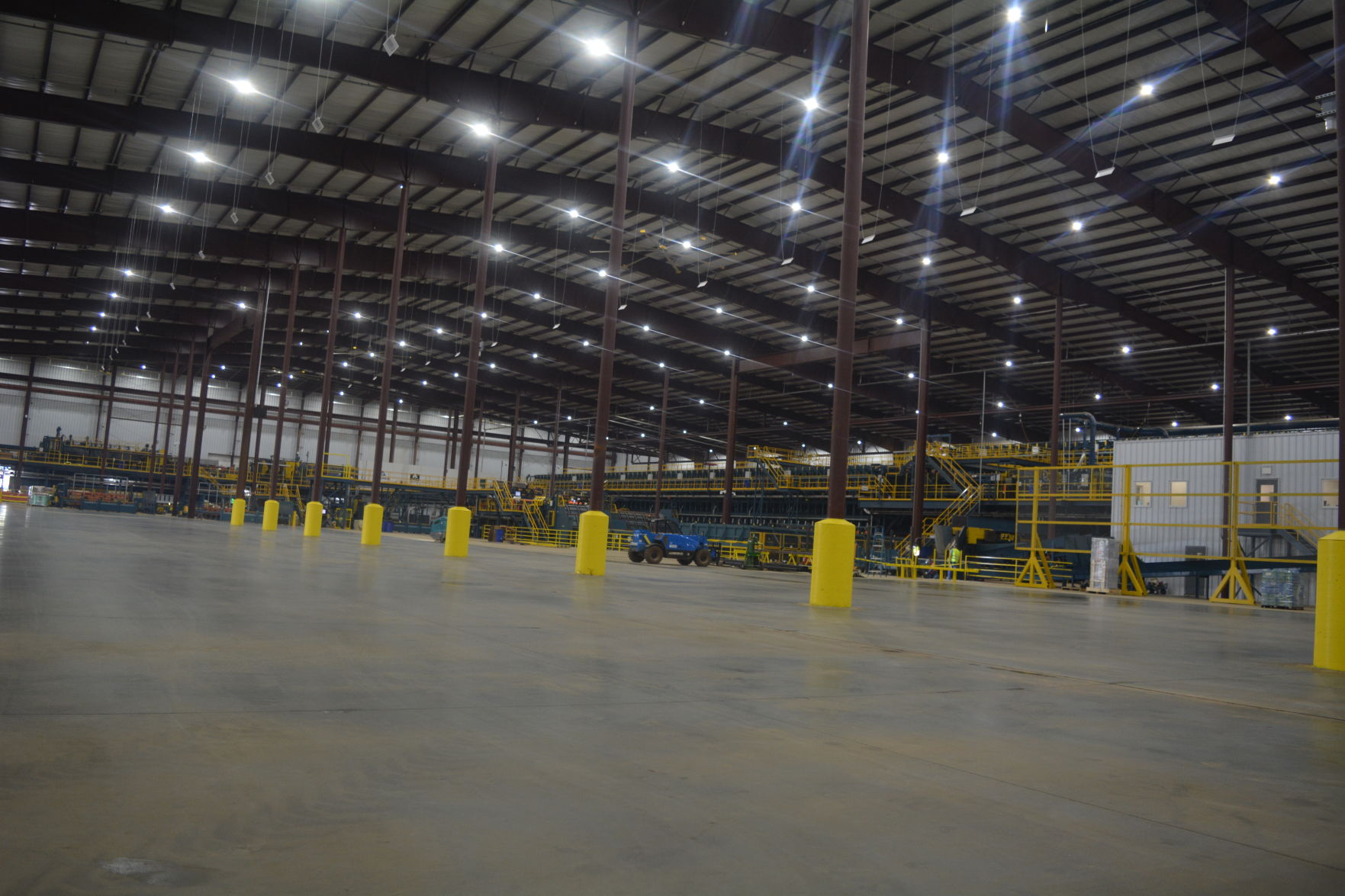
Once the lumber is dried, it goes back inside the mill, where it is sorted and stacked for shipment by rail or by truck. The mill has the capacity inside the more than 180,000-square-foot, 60-foot high structure to hold between 9 million and 10 million board feet of lumber at one time. The lumber is stacked in a bar-coded queue to facilitate rapid loading.
The mill has the capability to load five rail cars and nine trucks simultaneously under covered conditions, where the loads are tarped or bagged to keep the lumber dry while it is being transported. The tarps and covers are installed using an automated system, with speed and safety once again a primary consideration. The forklifts used in the loading process are equipped with scales to ensure the loads do not exceed transportation restrictions. Trucks leaving the mill pass over another set of scales, ensuring the weights are accurate, safe and legal.
The massive facility is operated with a work force consisting of 140 to 150 employees.
“There is a multiplier of 3 to 4 times that number of people being employed in support of the mill,” Briggs said, emphasizing Georgia-Pacific’s need for a qualified work force in these areas as well. “With over 400 trucks serving the mill on a daily basis, there is a high demand for independent truckers. If we can get them in and out quickly, it is good for us and profitable for them.”
Rick Kimble Sr., Georgia-Pacific’s manager of business communications and public affairs added, “Time is money. Our goal is to get a truck in and back on the road with a 15-minute turnaround. This makes a big difference for our suppliers. If we turn them around that quick, they can haul another load, which makes a big difference for them.
“The 140 employees we are using today are putting out three times the lumber a mill produced 20 years ago with a far larger work force. We are doing what many other industries are currently doing. It is not so much an issue of trying to reduce the number of employees as it is an issue of having a harder time finding people that want to work in this industry. But to be competitive, you have to do more with less.”
A tour of the mill makes it evident that even though it is putting out a massive amount of lumber, the facility is not yet complete and running at full capacity.
“We have been very well-received by the community,” Briggs said. “We have used a lot of local contractors. The main office was constructed by LRA (Constructors). Part of my job is to work with the community to build a network to carry out the projects we need. I’ve worked with Georgia Power to have new service lines run. We hooked up with Georgia-Florida Railroad to run a spur line in to our shipping area. Other local companies are on site completing projects.”
Author

Related Articles

Albany police investigate suspicious Sunday death
A 21-year-old Turner Job Corps student who was found unresponsive on Sunday evening was later pronounced dead at Phoebe Putney Memorial Hospital. The death is under investigation.
Unexplained checks, missing records, benefit errors surface in Terrell schools audit
A payroll performance review commissioned by the Terrell County School System found widespread documentation deficiencies, unexplained payroll discrepancies, inconsistent employee benefit deductions and weaknesses in internal controls, while also crediting district leadership for taking steps to improve oversight after significant staff turnover.

Terrell schools project $1.36 million revenue decline in proposed FY ’27 budget
The Terrell County Board of Education is scheduled to receive Superintendent Dr. Shereca R. Harvey’s monthly report and review budget information during its regular meeting at 7 p.m. tonight, Monday, June 22, with agenda materials outlining the district’s current financial position, fiscal year 2027 projections, a new grant award, state policy updates and enrollment trends.
