
Lack of combat service impacts WWII veteran
Ethan Fowler
ALBANY — His face couldn’t hide his true emotions.
Joe Weintraub was trying his best to mask the bitter disappointment that comes when he talks about his World War II service. Despite his best efforts, there was no escaping the sense of frustration the 84-year-old Albanian has regarding his seldom discussed military career.
Although he’s been married 57 years to his wife, Frances; has three grown children, and worked 28 years in the food brokerage business, Weintraub makes it clear to a visitor how he perceives himself.
“Let me start off by telling you I’m no hero,” he said.
Weintraub was in the Georgia Tech freshman class with future President Carter before enlisting in the U.S. Naval Reserve on Jan. 8, 1943. He stayed in school an additional four months before being shipped off to a naval training unit in Birmingham, Ala., in late 1943. He later was transferred to Plattsburgh, N.Y., to clean up an old World War I Army base on Lake Champlain.
“Even though we cleaned up the camp, our training never stopped,” Weintraub said. “One of the things I remember we had to do was swim out fully clothed, and swim out 100-150 yards out. You had to hang on to that rope for 30 minutes and that was part of our training. That was to weed out the weaklings.”
It was at that Army base that Weintraub came face-to-face with intimidating German soldiers.
“That was the first time I saw German POWs,” he said. “All of a sudden, we saw this battalion of soldiers marching toward us. They had their uniforms on and they looked like giants. They were bred for the African corps. They were bronze, muscular and they were bred to fight. We just looked at them and said, ‘Wow, look at those brutes.’ But they were young and docile. They were captured by little guys like me. If they got us mad, we just kicked them in the butt. But we never did that much. They helped us with farming and helped in the fields and were paid for it.”
Following his Plattsburgh experience, Weintraub participated in one of the most pivotal assignments of his training. He was sent temporarily to New York Harbor to serve on a 45-foot minesweeper boat with 24 other men. The duty was dangerous because German spies had successfully placed acoustic magnetic mines in the harbor to sink troop transport ships based on the pitch of a ship’s propellers.
At its peak in March 1943, the harbor had 543 ships anchored and 425 seagoing vessels at one of the 750 piers or docks, according to www.totallyexplained.com.
“The Germans mined the harbor,” Weintraub said. “They sank a lot of ships in New York Harbor. It was blocked. They had moored mines and acoustic magnetic mines. Acoustic magnetic mines lie on the sea floor and moored mines just below the surface. They were hanging from the bottom attached to a cable. It was very busy. They brought the Queen Mary in there.”
The boat Weintraub was on towed a paravane that would cut the bomb’s cable and force the moored mines to pop up to the surface. The diaphragm was 25 feet round and had big arms on it, said Weintraub.
“It was loud and it pinged constantly,” he said. “It covered the entire spectrum of beats and propellers of all ships, and it just disarmed them. Scientists came up with it. It drove us crazy because it went all day long.”
After his New York Harbor duty, Weintraub was transferred to Midshipmen’s School at the University of Notre Dame in Indiana.
“It was the toughest school that I had ever done in my life,” he said. “We started at daybreak and we had to clear the building in two minutes, have (exercises) and then go to class. We were learning to be midshipmen. We learned dead reckoning, seamanship, taught how to identify enemy German and Japanese big ships and airplanes. They would flash them on the screen really quick. Out of my class we had 97 and I think only 25 ended up graduating on Feb. 8, 1945.”
Weintraub’s final test was a vision test and, unfortunately, he failed it.
“During all this studying my eyes went bad, I guess,” he said. “I could’ve memorized the eye chart, but I didn’t. My conscience wouldn’t let me. It was the saddest day of my life. I went to my graduation, but they wouldn’t swear me in as an ensign.”
As a result of Weintraub not being commissioned, he and four others who failed the vision test were sent to a training facility near Chicago to begin their Navy training all over again.
“I don’t know why they didn’t throw me out,” he said. “They trained me as an ordinary sailor. We weren’t liked much because we were a lot smarter than most.”
After the three-month course, Weintraub was sent to a storekeeper school at the Sampson, N.Y., Naval Training Base. He trained 16 weeks to learn how to keep track of everything that a ship would need, such as medicine, food, supplies and clothing.
“And, then Germany surrendered when I was on leave,” Weintraub said. “I bought a fifth of liquor and held it in my pea coat. I held the bottle in my arm and we all celebrated and had a drink.”
After Japan surrendered in August 1945, Weintraub was sent to Demobilization School in Bainbridge, Md.
“While everyone was being discharged, I was discharging them,” he said. “And, I discharged myself, finally, on May 16, 1946. I served three years, four months and nine days.”
Although he’s thankful he was never under enemy fire, Weintraub still feels to this day an inadequecy about his military service. Not even the fact that he might not even be here today if he had been commissioned from his Midshipmen’s School class can impact his psyche.
Weintraub had learned while in Baltimore one day from a friend that of the 25 men that were commissioned from his Midshipmen’s School class, 22 lost their lives shortly before the war ended. The soldiers “were shot to pieces in Okinawa” as part of an ill-fated landcraft infantry assault.
“If I had passed the eye test, I probably would’ve been killed,” Weintraub said.
“I never really got over it,” he said, lowering his eyes. “My wife knows it. I’ve had two bypass heart surgeries. I’m inadequate. I had a reason to fight because of the Germans and the Holocaust. I did what the Navy told me to do.
“I would’ve preferred to be on a more active status than what I did. And I feel a lot of these guys did a much greater sacrifice than I did. If I had it over again, I would want a lot more active duty. I feel like I didn’t serve my country enough. I really do. I was just one of the lucky ones.
“I would’ve died for my country,” he continued. “But God saw fit to keep me here longer. I just feel inadequate. I look at my friends and what they went through …”
After pausing for a short time, Weintraub’s expression starts to change. He looks around the nicely decorated front room of his home for the past 45 years. He sees framed pictures dotting the room of his smiling grandchildren.
“My wife said I shouldn’t really think about it,” Weintraub said of his military experience. “My sons call me the ‘Miracle Man.’ I look at myself and I’m very thankful I’m still around and seeing all my grandchildren in college. I’m lucky. I’m fortunate and thankful. People don’t realize how fortunate they are to live in America.”
Even if he doesn’t see himself as a hero and rarely talks about his military years, Frances Weintraub said her husband has earned such a title.
“He did the job that was given to him, no matter what it was,” said Frances, whose Albany family ties go back to 1846. “He’s a hero. He doesn’t give up. He’s very tough on himself, but he’s not going to be quitter. He trusts God.”
Joe Weintraub agreed with his wife’s assessment.
“I never quit. I never will,” he said. “Not until the good Lord takes me because I know I’m a favored son.”
Related Articles
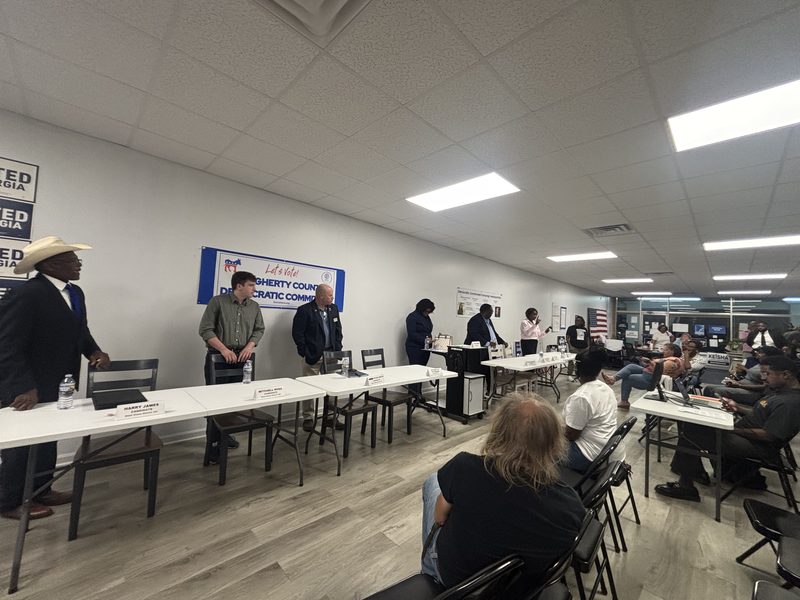
Candidates debate health care, development, rural investment at Albany forum
Candidates seeking to represent Southwest Georgia called for greater investment in health care, education and infrastructure during an Oct. 1 forum, but differed over data centers, economic development and how to work across party lines.

Former Dougherty Commissioner Harry James challenges ‘dean of legislature,’ Gerald Greene
Georgia voters go to the polls on Nov. 3.Among the state House races on the ballot in southwest Georgia is District 154, where incumbent Republican Gerald Greene will face Democratic nominee Harry James.

County approves 198-foot Gillionville Road cell tower; no speakers at public hearing
Dougherty County commissioners unanimously approved a 198-foot cell tower behind a church on Gillionville Road, with no one speaking for or against it at the public hearing.
