
Albany Utility to offer $50 storm-assistance credits
Albany’s city manager explains utility billing practices after rash of recent complaints
By Jon Gosa
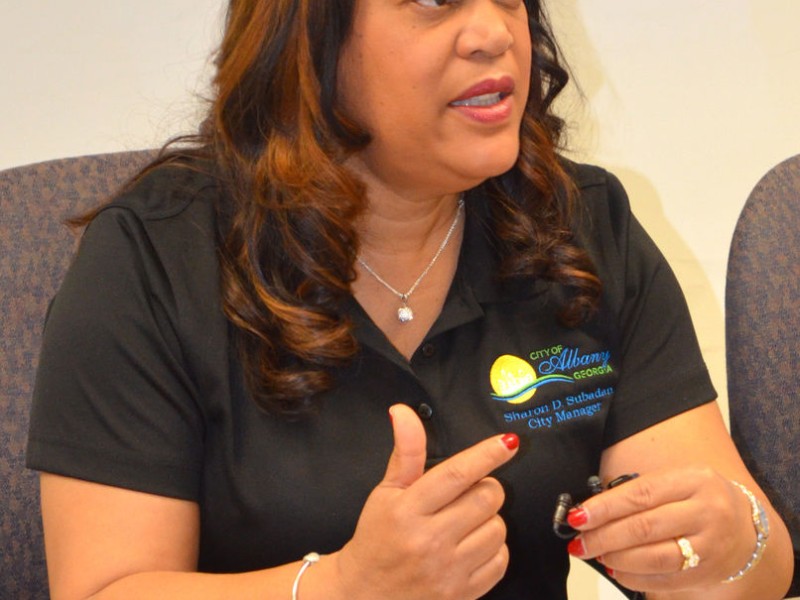
ALBANY — Albany City Manager Sharon Subadan told The Albany Herald Tuesday that customers’ January utility bills that were based on estimated usage would be “trued up” in the utility’s February billing cycle.
“What I wanted to share is how this works with estimated billing,” said Subadan. “It seems like there was some confusion with levelized billing, and now people think we do estimations over a 12-month period. Which is not true. The meter is like the odometer on your car, which is a reading in time. So in January, because of the storm, there were meters that we were unable to read, maybe because the street was blocked or the other part of it is, quite honestly, because we put people to work doing other storm-related duties. If they couldn’t read meters, we had them engaged in other work.”
Responding to complaints by customers, Subadan explained that in those situations, a three-month billing history was examined and an estimation was made based on that history.
“We looked at their three-month history, and we took an average of that,” the city manager said. “In February, when we go and actually read their meter and see what is on the odometer, going back to the car analogy, we are not going to go back and try to ascertain what your meter reading is, for example, today, because there is no way for us to do that. Just like on your car, the meter keeps running. When we read the meter a month from now, it will be the actual reading on the meter at that time, and then we’ll do a true-up.”
Subadan explained the “true-up” would yield one of two results: Either a customer’s next bill would be more or less, depending on the difference in the estimated amount charged in January and the actual amount read in February.
“What I want people to understand is that it’s not voodoo magic,” she said. “It really is: ‘Here is what your meter read before and here is what your meter reads after you get billed for the amount used.’ What we charged you, based on your three-month average, is one part of that, and the difference is the rest. I am the one who told (assistant city manager, utilities) Stephen Collier to be careful of saying things like ‘You are going to get a credit,’ because in reality, you are going to pay for the net difference of what’s used.”
Many Albany citizens posted on social media or made phone calls to The Albany Herald expressing concern that their meter was simply not read and that they were not charged for actual usage, especially those Albany Utilities customers who did not have storm damage.
Subadan explained that using estimations is not a new process, but is, in fact, a common one.
“The other thing that I don’t think is well-understood is doing a three-month estimate on meters is something, periodically, that we have to do,” she said. “This isn’t a practice we started with the storm. There are times, for various reasons, we can’t read a meter. We have a drive-by system (in which employees) drive by and read meters. If there is something physically blocking the path of the signal from the meter — let’s say somebody parks a big box truck in front of the meter — and (employees) drive by and don’t get a reading, they pull over and they walk up. But if the gate’s locked or there is a dangerous dog and we cannot physically get to the meter there, we estimate the meter reading. It’s not a frequent occurrence, but it is our policy. It is what we do. It’s not something we dreamed up for the storm.”
Asked if an attempt to contact a customer is made in such a circumstance, Subadan explained that sometimes utilities employees leave a door hanger or possibly send a letter.
“They have done that,” she said, “especially when there’s like a dangerous dog or the thing is chained up or they can’t get to it. Sometimes they leave a door hanger. Other times they will send a letter saying that we had to estimate your reading.”
Subadan also produced a short letter that she said every customer was sent with their January bill. The letter explained that actual usage was not reflected on the January bill and that an average of the last three months was used to generate the total charges, which would be reconciled the next month.
“We did send out a notice to everybody that was in the billing cycle that was affected,” the city manager said. “They went out with the bills, these went to everybody.”
When informed that no one The Herald had spoken with about the billing concerns, including actual employees of The Herald, received such a letter, Subadan said she would look into possible reasons those letters did not go out.
“We’ll find out (why the letters did not go out) from the billing company, because we don’t print the bill,” Subadan said. “That letter was sent to them on the fifth of January, and they were told to put it in every bill that goes out.”
In an effort to prevent future complications, such as those experienced after the January storm, plans are in the works to upgrade to smarter grid technology, which would increase efficiency and accuracy, according to Subadan.
“We are operating on technology that’s like flip-phone technology,” said the city manager. “We have the drive-by (system) that we use, but that’s like a flip-phone. There is new software. In fact, we’ve been working with a consultant on automated meter data systems, and we really need to do that. It gives us instant outages. It allows people to log in and see their usage. They will be able to set up alerts if their usage goes over a certain amount, and you can get a text message or email, which gives the customers more tools and gives us more tools. So automated meter data management is something that we are actively working towards.”
According to Subadan, investing in the new technology would give the utility better tools when dealing with an emergency, like the January storms, but there would be a considerable cost.
“Newer technology will give us better tools,” she said. “One of the frustrations that I had during the storm is, well, how many customers are still out? We physically had to go circuit by circuit, estimate by estimate, street by street to kind of figure that out, because we don’t have an automated system that feeds us enough information. It tells us a big picture, but I want to know how many accounts are out.
“There will be a cost. We’ll present different ways of how it will be paid for.”
When asked directly if the cost of such an investment would mean higher bills for customers, Subadan answered, “It’s hard to tell at this point, but potentially. The utility board has to make some decisions.”
According to Subadan, Albany Utility would like to make a goodwill gesture for victims of the storm who were without power for three or more days.
“The other thing that we are trying to do is offer a storm-assistance credit,” she said. “We know there were people who were affected by the storm, and we can’t make it right for everybody. But what we do want to do is issue a negative $50 on people’s bill, if they apply for it. If they were out of power for three or more days, they come to the utility — and we will probably figure out a way to put this online as well — and all they have to do is demonstrate that they were in a storm-affected area and that their power was out for three or more days.
“Just as an act of support for the community, in my view, because I know people have been through a lot of stuff, we want to go ahead and issue a storm-assistance credit for $50.”
Related Articles
Dougherty Commission considers $104 million budget for 2026-2027 budget year
“The other side of the coin is you could have higher revenues than projected. We’re very conservative in budgeting revenues. That also reduces the need to use fund balance”

Albany police investigate suspicious Sunday death
A 21-year-old Turner Job Corps student who was found unresponsive on Sunday evening was later pronounced dead at Phoebe Putney Memorial Hospital. The death is under investigation.

James Rubino installed in new role at Marine Corps Logistics Command in Albany
James L. Rubino recently assumed the role as executive deputy of Marine Corps Logistics Command in Albany. In his new role he will oversee integrated logistics support.
