
Darton State College facilities focus of recreation concept
Retired tennis enthusiast Tinsely Dozier proposes radical use of SPLOST recreation funds
By Carlton Fletcher
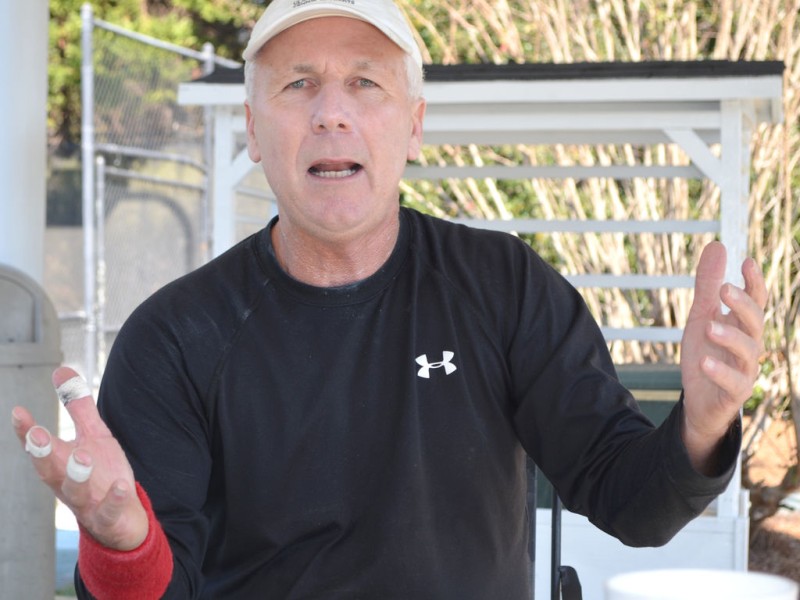
ALBANY — He’s retired now, but Tinsley Dozier’s love for tennis, a sport he coached on the high school level for 22 years, has not diminished.
On a recent Friday morning, as he awaited the arrival of a visitor who wanted to talk with him about his radical — but intriguing — plan for a community tennis/recreation center, Dozier sent volley after volley across the net, the thwok of his shots echoing in the quiet of the cool fall morning.
“I’ve been reading in the paper about the city and county planning a recreation complex with a tennis center at Paul Eames (Sports Complex),” Dozier said. “I’m so glad that the county is finally looking to use that SPLOST money that was allocated more than 20 years ago for a tennis center, but I don’t know if this plan they’re talking about now is the best one we could come up with.
“I understand that that land is available, but to really have a tennis center that could impact the community, the facility needs to be built somewhere where there is ‘tennis traffic.’ What they’re talking about doing, if they don’t have someone to monitor the courts, what you’ll end up with is weeds growing through the surface and skateboarders tearing it up.”
Dozier and a group of between 50 and 75 local tennis enthusiasts play regularly on the USTA (U.S. Tennis Association) circuit, traveling throughout the region to compete in sanctioned tournaments. A couple of weekends ago, 40 or so went to Columbus to play in a USTA event that attracted around 500 players. The economic value of such events is not lost on Dozier or his tennis-playing friends.
“They went big with tennis in Columbus and did it right,” Dozier said. “The city, Muscogee County, Columbus State University and private citizens there pooled their resources and ideas and came up with a plan to build a tennis center that meets all USTA requirements for tournament play. When they finished 22 new courts recently, that made 52 courts in a central location.
“Now they have 12,000 people playing in their programs, and they have tournaments that draw more than 1,000 people from all over the South. That brings a lot of money into their community.”
Unlike many who use their dissatisfaction with a particular plan to simply air grievances, Dozier has come up with a counter plan that he says makes much more sense than the one being considered by city and county officials.

“With the merger of Darton (State College) and Albany State (University), the new college will have duplicate athletic facilities when the merger is completed Jan. 1,” Dozier said. “And you’re talking about facilities that are already underutilized. There is a great opportunity now for Albany and Dougherty County to have a recreation center like they’ve never had before.”
Dozier’s plan is simple: Albany State can either sell or donate the Darton athletic facilities to the city. The city would then have a centralized complex that would open the door for never before considered recreational opportunities.
“I can see 60 to 80 men at the (Darton) gyms playing basketball during their lunch break,” Dozier said. “I can see buses from every school in Dougherty County dropping kids off for after-school programs every day: swimming, tennis, soccer, baseball, football.
“And there’s no reason the facilities — the gyms, the pool, the tennis courts, the baseball and softball fields — couldn’t still be used by Albany State athletic teams if they need them. It becomes a matter of scheduling.”
Albany and Dougherty County officials are aware of Dozier’s plan. While they have not yet discussed it seriously, they admit that the concept is intriguing.
“Any decision of this nature would eventually be made by the City Commission, and we haven’t discussed this with them,” Albany City Manager Sharon Subadan said. “But if it became their preference, it’s certainly within our purview.
“The concept needs more conversation, and it might be challenging. That property is not owned by Darton or Albany State. It’s owned by the University System of Georgia, and the decision (on what to do with it) would ultimately be made by them. But if supporters convince our elected officials that this is the way to go, we certainly could pursue it.”
Dougherty County Administrator Richard Crowdis said management of such a recreation complex would be an “800-pound gorilla” that would eventually be tackled by the city. Voters approved $1 million in SPLOST III funding for a tennis complex in 1994 and an additional $2.7 million in SPLOST V recreational funding were earmarked for such a center. And while efforts to build the complex have bogged down over the ensuing years, with each potential location shot down by one group or another, most of that money has remained on the county’s ledger.
The opportunity to fulfill the requirements of SPLOST by building a tennis complex and then turning that complex over to the city to run as part of an overall recreational facility appealed to county officials who are anxious to “get this off our plate,” one commissioner said.
Crowdis said he and Subadan planned to meet this week to discuss the recreation issue. He also said he expects Dozier’s plan to be discussed.
“The reality is that building any kind of facility in northwest Albany was pretty much taken off the table when SPLOST III first passed,” Crowdis said, a reality that speaks volumes of the political climate at that time. “Things have changed in the community enough that I believe (Dozier’s plan) is worth considering.

“The dynamics of the community have changed, and I believe any viable idea should be worth talking about. There’s nothing set in stone, by any means.”
Indeed, Subadan said Dozier’s plan would not hinder the city’s plans for the Eames Complex.
“We saw (building a tennis center) as an opportunity to enhance the overall complex at Eames, but moving the center (to Darton or elsewhere) wouldn’t alter our plans out there,” the city manager said. “Baseball is really where we want to go at Eames. The possibilities for expansion are incredible there, from adding amenities to building more fields, so (Dozier’s plan) would not negatively impact our plans there at all.”
City Recreation and Parks Director Joel Holmes agreed that the possibilities for expansion of programs at a centralized complex that would allow for usage of the Darton facilities makes for intriguing conversation.
“Obviously, that concept is in the early stages of discussion, so I don’t think I should really get too deep into it,” Holmes said. “But I believe we have an obligation to look at every possibility to come up with the best plan. From what I’ve heard, this warrants looking into.”
ASU President Art Dunning was in Atlanta for much of the past week and was unavailable for comment on Dozier’s plan.
“I just think it would be a waste for the county to put one and a half million dollars into a tennis complex that no one would use,” Dozier said. “I don’t know what it would take for Albany State to sign off on selling or giving the facilities at Darton to the city and county, but you want to talk about creating some goodwill in the community, that would do it.
“If it’s too much to ‘gift’ the land and facilities, well, there’s at least a million and a half dollars available in SPLOST funds. And if everything was given to the community as a gesture of goodwill, the county could build eight more courts at the Darton facility and we’d have enough centralized courts to host USTA events.”
The retired coach/administrator and Albany native said the time has come for the county and city to meet their responsibilities of SPLOST allocation.
“They couldn’t decide on a location when they first passed the SPLOST III referendum back in ‘94, and the idea just gradually faded away,” Dozier said. “Heck, if they’d gone ahead and made a decision, a million dollars back then probably could have built the center. But now our city and county leaders and a new university that’s looking to be more a part of the community can accomplish what no one’s been able to do.
“I hope — and a lot of other people who play tennis in our community hope — they go with an idea that makes the most sense for the people who play tennis. It’s time to take politics out of the equation and do what should have already been done.”
Author

Related Articles
‘It’s time to listen to us’: Lee County school tax proposal draws fire
A longtime Lee County resident urged the school board to reject a proposed property tax increase during its first public hearing Oct. 8, questioning spending priorities and warning about the burden on families and older residents.

Incumbent Bill Yearta, newcomer Mitchell Rosa vie for state House District 152 seat
The Georgia House District 152 race features Republican incumbent Bill Yearta and Democrat Mitchell Rosa, who is making his first run at political office. The two candidates will be on the ballot for voters in Lee and Worth counties and southeastern Dougherty County on Nov. 3.
Value of Dougherty’s tax-exempt worship property more than doubles
The assessed value of property in Dougherty County’s religious-worship exemption category more than doubled over a decade, reaching $38.2 million in 2025 while the county’s net taxable value grew about 2%.
