
Flu shots for 2018-19 season now available in southwest Georgia
Several Albany physicians promote getting this year’s flu vaccine
By Jennifer Parks
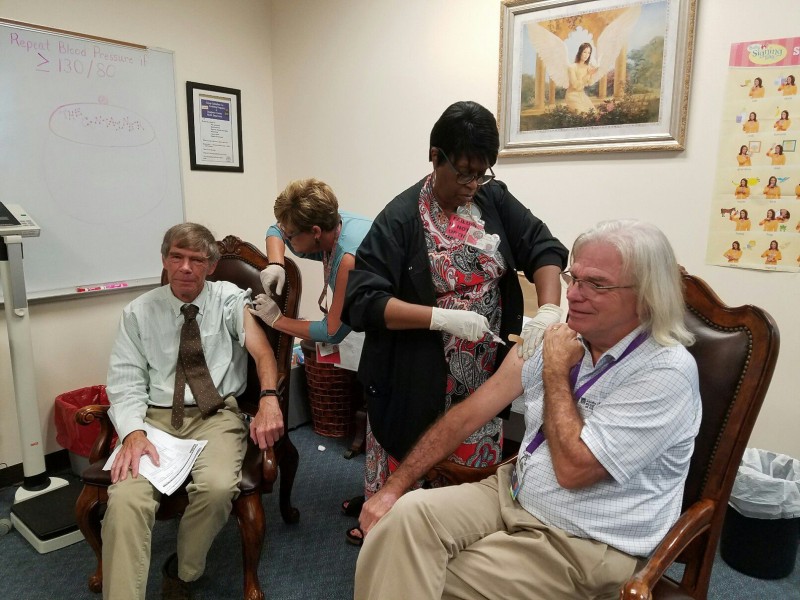
ALBANY — Six Albany physicians rolled up their sleeves at the Dougherty County Health Department Tuesday to get their flu shots, in turn encouraging the public to get protected against seasonal flu.
The six medical message-bringers were Phoebe Putney Memorial Hospital Chief Medical Officer Dr. Steve Kitchen, Dr. Bernard Scoggins of Albany Area Primary Health Care, Phoebe Women’s Health Medical Director Dr. William Sewell, Medical College of Georgia Southwest Campus Associate Dean Dr. Doug Patten, Southwest Public Health District Director Dr. Charles Ruis and Dr. Phillip Roberts, former head of the Phoebe Cancer Center who now leads the health department’s adult free clinic.
Beverly Reid, general clinic supervisor and immunization coordinator for Dougherty’s health department, said flu season is on now, but that the illness is present year-‘round and that certain populations such as pregnant women, the elderly, young children and those with chronic conditions are the most prone to serious complications.
“The flu still kills,” she said. “Every year, the flu does kill people, and it is for the most part the elderly and babies (who are most at risk).”
Reid said that the health department got its shipment of this year’s vaccine two weeks ago. The last flu season was a severe one due to the influenza A H3N2 strain, which often brings more serious flu cases and deaths — and results in the vaccine for that year being less effective.
“Even though it may not have been as effective, it was successful,” Reid said.
Kitchen said that while there are risks to the vaccine, the benefits outweigh those risks — so he would strongly urge the public to get it. He added that the H3N2 strain is not going to be prominent every year, and there are years in which the vaccine is less effective — but that should not deter people from getting it.
“It’s been shown repeatedly that (the vaccine) is the most effective way (of preventing) the flu,” he said.
Both trivalent, which contains three strains, and quadrivalent, which has four strains, vaccines are available this year. There is a high-dose vaccine available for those ages 65 and older.
The Centers for Disease Control and Prevention said flu vaccines cause antibodies to develop in the body about two weeks after vaccination. These antibodies provide protection against infection from the viruses that are in the vaccine, and the vaccine protects against the influenza viruses that research indicates will be most common during the upcoming season.
The vaccine is available for everyone 6 months and older. The body’s immune response from vaccination declines over time, so an annual vaccine is needed for optimal protection, and flu viruses are constantly changing, so the formulation of the flu vaccine is reviewed each year and updated as needed, the CDC said.
Some people who get vaccinated may still get sick, but flu vaccination has been shown in some studies to reduce severity of illness in people who get vaccinated but still get sick. During the 2016-17 flu season, flu vaccination prevented an estimated 5.3 million influenza illnesses, 2.6 million influenza-associated medical visits and 85,000 influenza-associated hospitalizations, the CDC said.
The CDC also said that in seasons when the vaccine viruses match circulating viruses, the flu vaccine has been shown to reduce the risk of having to go to the doctor with flu by 40-60 percent. Flu vaccination can reduce the risk of flu-associated hospitalization for children, working-age adults and older adults. During 2016-17, flu vaccination prevented an estimated 85,000 flu-related hospitalizations.
A 2014 study showed that flu vaccine reduced children’s risk of flu-related pediatric intensive care unit admission by 74 percent during flu seasons from 2010 to 2012. In recent years, flu vaccines have reduced the risk of flu-associated hospitalizations among adults on average by about 40 percent, and a study this year showed that from 2012 to 2015, flu vaccination among adults reduced the risk of being admitted to an ICU with flu by 82 percent, the CDC said.
The CDC said a study from this year showed that among adults hospitalized with flu, vaccinated patients were 59 percent less likely to be admitted to the ICU than those who had not been vaccinated. Among adults in the ICU with flu, vaccinated patients on average spent four fewer days in the hospital than those who were not vaccinated.
The viruses in the flu shot are killed, so a person cannot get the flu from the shot. Some minor side effects that may occur are soreness, redness, swelling where the shot was given, low-grade fever and aches. In addition to health departments, the flu shot is also available at pharmacies and doctor’s offices.
For more information on the flu, visit www.cdc.gov/flu.
Related Articles

Small actions can help save big on utility bills
The high temperatures of July and August can bring scorching utility bills as air conditioners hum to keep houses cool. Albany Utilities Residential Conservation Auditor Willie Jackson offered some tips on making summer cooling bills more manageable.

Bigger budget will mean improvements at Dougherty County’s landfill
“It’s certainly an opportunity where we can grow and make this very beneficial for years to the community. It’s a service that we provide for the community and I want to prolong that resource for the community. It’s not just fill it up and close it.”

Putting on the Ritz: The rise, fall and renewal of Albany’s Harlem District
On July 7, the Albany City Commission unanimously approved final construction drawings for a comprehensive restoration of the Ritz Theatre and Cultural Center, clearing the way for the project to move into competitive bidding after years of planning and preservation efforts. The decision marks the latest chapter in a decades-long effort to preserve one of Southwest Georgia’s most significant African American landmarks.
