
Health care landscape to see changes in Southwest Georgia this year
January storms, Albany State/Darton merger likely to impact growth at Phoebe
By Jennifer Parks
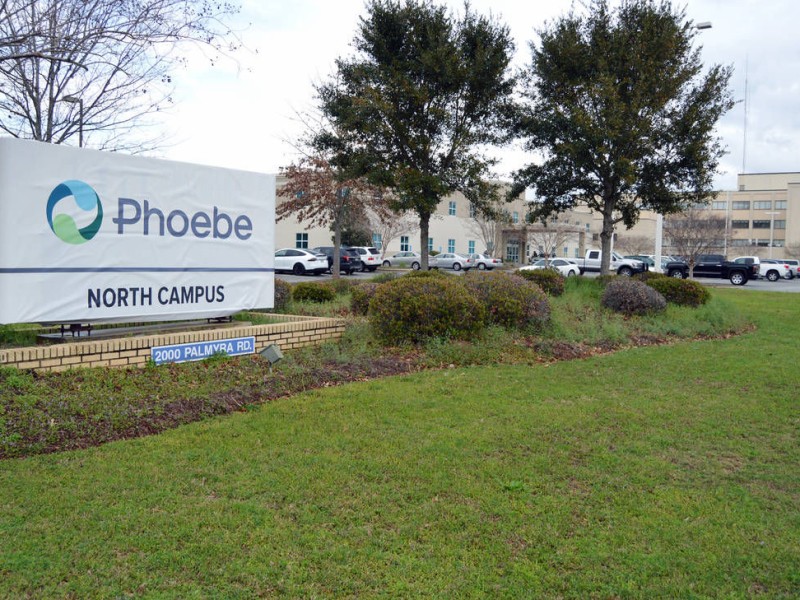
ALBANY — The storms in January that affected Phoebe Putney Health System will likely play a role in altering the health care landscape in Southwest Georgia over the next several months, including what the future may have in store for the Phoebe North campus.
The Southwest Georgia Medical Student Housing Complex is expected to be ready to receive occupants this summer and is anticipated to fill up its first phase fast. The Phoebe Family Medicine Residency, meanwhile, is expected to grow in ranks from 18 to 24 slots.
A key factor in continuing physician recruiting efforts is Phoebe maintaining its relationship with the Medical College of Georgia, which has a satellite campus based at Phoebe Putney Memorial Hospital, and the Georgia South Family Medicine Residency program based at Colquitt Regional Medical Center in Moultrie. Phoebe is taking part in the latter program by contributing to the residents’ education during their first year.
“That is an important stepping stone for recruiting future physicians in this part of the state,” Phoebe President and CEO Joel Wernick said. “Medical manpower is an important part of what we are doing and continue to do.”
Another recent development expected to have an increased impact on the Southwest Georgia health care landscape is the merger of Albany State University and Darton State College. The former Darton, now ASU West, is home to the ASU health degree programs.
While efforts to enhance medical education opportunities in Southwest Georgia are ongoing, a severe storm on Jan. 2 caused damage to dozens of Phoebe properties. As evaluation of the storm impact has continued in the weeks that followed, the devastation sustained caused officials to rethink how they use Phoebe resources.
“We are evaluating alternative uses for properties around the (Phoebe Putney Memorial Hospital) campus that (suffered) damage with Storm 1,” Wernick said.
Storm 2, which spawned an EF3 tornado that hit southeast Albany on Jan. 22, had minimal impact on Phoebe’s facilities.
Phoebe’s finance building at West Second Avenue and North Monroe Street was among those most severely impacted on Jan. 2. A tree fell on the building, damaging not only the roof but cutting a water line that flooded the building and destroyed much of what was inside the structure.
What could be saved from the building, and the employees who normally work there, were relocated to Phoebe North. Assessments have indicated that there are several Phoebe buildings needing to be torn down, which may mean some displaced departments could be relocating to Phoebe North — a facility on Palmyra Road that still has ample space.
“The storm changed a little bit about what we were thinking about doing,” Wernick said.
Officials had announced shortly after Phoebe North’s acquisition that the campus would eventually be transitioned into a women’s and children’s center. While that option is still on the table, that is a scenario Wernick indicated is becoming less likely.
“There are fewer births,” he said. “While (the drop) is not dramatic, we have continued to have (a lower number of) babies being born.”
Phoebe is also recovering from flooding on the behavioral health floor of the main campus due to a patient damaging a sprinkler late last year. Repair to the damage is ongoing, but Wernick told The Herald that the service line might potentially be relocated.
While storm recovery remains a priority, another issue weighing heavily on the minds of Phoebe officials is the proposed Lee County hospital on the former Grand Island Golf Course property. The hospital is anticipated to be built in a county for which Phoebe provides $9 million of charity care, and the proposal has caused frustration for officials at Phoebe due to the limited amount of information they have been able to obtain about it.
On the general lack of information from Lee County officials for the planned hospital, which is now likely to have up to 80 beds and provide some level of indigent care, Wernick expressed some of that frustration at a recent Hospital Authority of Albany-Dougherty County meeting.
“If that is the case, and the plan is to step forward and provide that care, then we could spend that $9 million on other things,” the CEO said last month.
Phoebe Putney Health System has 300 providers, including more than 30 primary care providers. There are still a significant number of people in Southwest Georgia without primary care providers, and Phoebe recently added five in Albany alone.
“We look at primary care providers as vital to fulfilling our mission of making sure we are relevant to our community,” said Phoebe Physician Group President Dr. Suresh Lakhanpal.
The idea, Lakhanpal said, is to put the doctors where the patients are, prompting proactive steps in expanding access to primary care. Online doctor office appointment scheduling has been piloted at Phoebe as a way to encourage wider access by making it easier for patients to plan a physician visit.
“We are trying to find ways to increase access,” he said.
Specialties such as gastroenterology and neurology are also expansion priorities. Cardiology was a particular area of focus last year, and that specialty is still being refined while plans are in the works to bring a new gastroenterologist to the area in the next year.
“We see patients willing to come from other parts of Southwest Georgia,” Lakhanpal said. “We are keeping people from having to leave the region.”
Outside of Albany, a cardiologist was added in the last year at Phoebe Sumter Medical Center in Americus. Several specialists in pulmonary disease have been added in Southwest Georgia over the last year, and there may be more manpower added in the coming months.
“We see that practice (of pulmonary disease) expanding rapidly,” Lakhanpal said. “The high-intensity ICU, they are part of that also.
“There are physicians at each ICU for at least 12 hours a day. They are eyes-on, hands-on in taking care of patients.”
Lakhanpal said Phoebe Sumter is expected to add a urology service line to its resources while expanding on its primary care base. The health system is also looking to implement growth of its hospitalist program.
Officials said one of the best ways to improve on less-than-ideal hospital ratings, including the “C” grades Phoebe Putney Memorial Hospital has gotten from Leapfrog, is to establish a renewed focus on quality measures. Hospital officials said they have 20 such measures they track as part of a constant process that involves reporting back and forth between physicians.
“The values (come) down to quality and to cost,” Lakhanpal said. “(The goal is) as the cost goes down, we bring the quality up.”
While re-emphasizing the goal of access, the physician group president said: “What we are trying to do is provide a network so patients don’t have to leave the region. We think we are close to realizing that.
“There are people in rural areas who can’t drive in; we are trying to determine access points. We see that as a significant component of what we will be doing in the future. We, like the rest of the state, are trying to determine (how we can) ensure patient access.”
A big development for the Phoebe system as a whole is the establishment of the electronic medical records system known as Meditech, which is meant to take away some of the burden of communication between health care facilities and decrease errors in patient care.
Phoebe is constructing primary care centers in Ellaville and Camilla, both of which are expected to come online this year. Growth at Phoebe Sumter has demonstrated a need for additional office space, which is in the initial stages of being brought to reality, Wernick said.
For Albany Area Primary Health Care, the year 2016 saw the opening of its Behavioral Wellness Center, relocation of the Mirian Worthy Women’s Health Center into a larger space, the opening of the Hotz Scoggins Family Medical Center in the former Mirian Worthy building, along with the expansion of its school-based health center presence.
Growing at a tremendous pace last year in order to improve access to care, the focus of AAPHC in regards to expansion this year will be to take a breather over the next few months and see where the opportunities lead.
“We want to make sure we get our feet grounded good before we continue to spread,” said AAPHC CEO Shelley Spires.
On a national scale, U.S. Health and Human Services Secretary Tom Price has a background in medicine and as a member of the U.S. House of Representatives — facts that offer some sense of comfort for hospital officials in the state, including at Phoebe, that the needs specific to health care facilities in Georgia may be advocated for.
“This is someone who understands not just medicine, but Georgia medicine,” Wernick said.
As for the threatened repeal of the Affordable Care Act, there remain many unknowns. One of the options being discussed is replacing or modifying the elements that don’t work while keeping the ones that do. But there are many moving parts — including the potential impact on Medicaid expansion opportunities.
“It will take a while before anything happens,” Wernick said. “I don’t know that the state can do much until the federal government decides what it is going to do.”
The tax credit program for rural Georgia hospitals was implemented last year as a means to fill some funding gaps. House Bill 54 was proposed to the General Assembly to increase the tax credit from 70 to 90 percent for individuals and corporations that donate money to rural hospitals
The bill failed to make it to the state House for a vote by Crossover Day, but the Atlanta Journal-Constitution has reported an avenue may be pursued by state Rep. Geoff Duncan, R-Cumming, who proposed the measure, to revive the proposal by tacking it onto legislation sponsored by state Sen. Dean Burke, R-Bainbridge, involving rural hospital rules.
Related Articles
Small actions can help save big on utility bills
The high temperatures of July and August can bring scorching utility bills as air conditioners hum to keep houses cool. Albany Utilities Residential Conservation Auditor Willie Jackson offered some tips on making summer cooling bills more manageable.

Bigger budget will mean improvements at Dougherty County’s landfill
“It’s certainly an opportunity where we can grow and make this very beneficial for years to the community. It’s a service that we provide for the community and I want to prolong that resource for the community. It’s not just fill it up and close it.”

Putting on the Ritz: The rise, fall and renewal of Albany’s Harlem District
On July 7, the Albany City Commission unanimously approved final construction drawings for a comprehensive restoration of the Ritz Theatre and Cultural Center, clearing the way for the project to move into competitive bidding after years of planning and preservation efforts. The decision marks the latest chapter in a decades-long effort to preserve one of Southwest Georgia’s most significant African American landmarks.
