
Little known ‘ghost town’ exists right up the road from Albany
The once-thriving community of Palmyra in Lee County is now a ghost town
By Jon Gosa
ALBANY — The term “ghost-town” conjures up images of the high tundra from the Old West, snow-capped mountains in the distance and tumbleweeds blowing down the muddy main street of a one-horse town long since forgotten after the gold panned out. But a ghost town actually exists only a few miles up the road from Albany in Lee County.
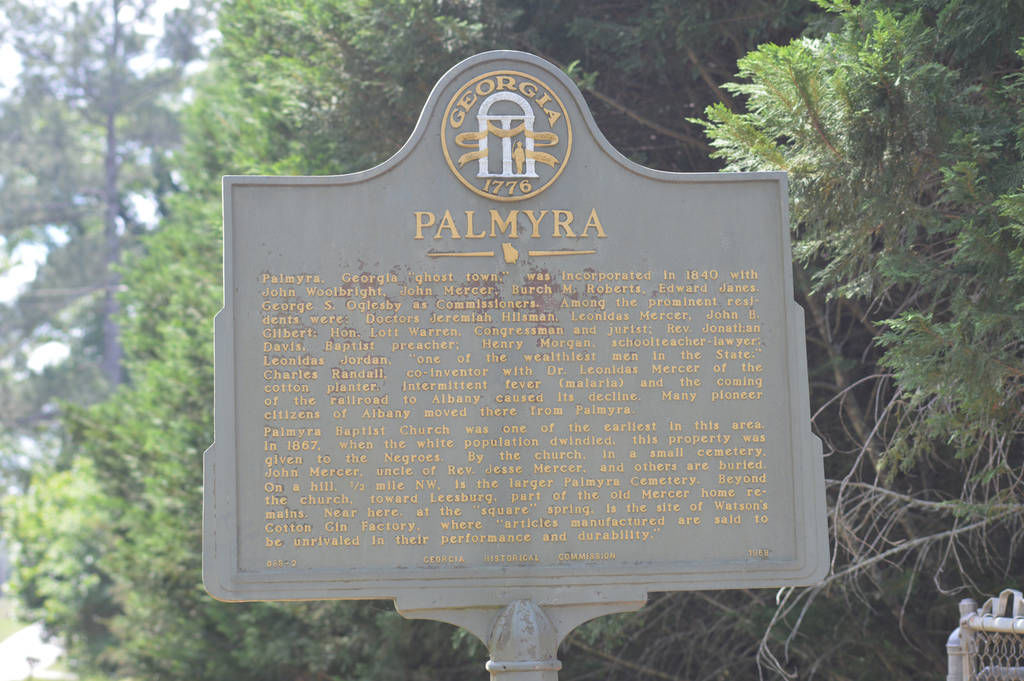
There are no extensive ruins and only a few scattered remains. A cemetery, now on private property, several grave markers on county land, a historical marker on the side of the road and the stone foundation of a mill are all that is left of the once thriving village of Palmyra in Lee County.
According to several histories, Palmyra was a bustling settlement before Albany was founded in 1836. The bustling community had a church, a school, a post office, a doctor’s office, a general store, a blacksmith shop, a grist mill, a warehouse and several other businesses, including Watson’s Cotton Gin Factory.
Lee County Marshal/Code Enforcement Director and amateur historian/archaeologist Jim Wright, who has studied the area for years, agreed to show The Albany Herald some of the forgotten sites under the strict agreement that precise locations not be mentioned.
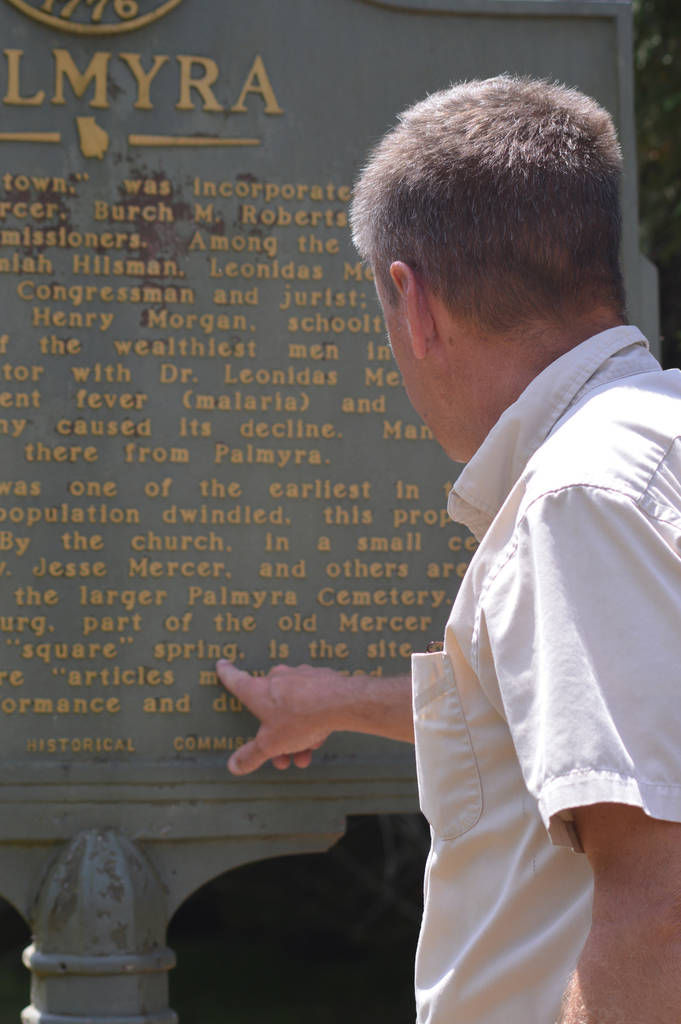
Wright, standing on the side of Palmyra Road, points to the simple and unassuming historical marker and explains the history of the community.
“Lee County has several ghost towns, and Palmyra is one of them,” Wright said. “Just after Lee County was created in 1825, people began to move into this fertile area along the intersection of the Kinchafoonee Creek and Fowltown Creek. It was considered one of the most beautiful spots in this part of the country. The area had high banks with giant oaks covered with Spanish moss, and it was well above the flood waters of both creeks. Early settlers, coming from all parts of the state, built their homes, schools and churches here.”
At one time in history, according to Wright, Palmyra was the social hub of the area.
“Palmyra, for a while, was the center of wealth, refinement and aristocracy in this section of Georgia,” he said. “The town was known for its hospitality and social gatherings. One of the town’s most famous residents was Charles Randall, co-inventor of the cotton planter. Dr. Jeremiah Hilsman, Dr. John B. Gilbert and Dr. Leonidas B. Mercer lived and practiced in town. Congressman Lott Warren was listed in the U.S. Congressional records as a resident of Palmyra.”
Wright explained that the name Palmyra has a history of its own.
“It is interesting how Palmyra got its name,” he said. “According to historical records at Mercer University, the Rev. Jonathan Davis built and founded the first Baptist church in Southwest Georgia in Palmyra in 1836. Based on minutes from the church, on Feb. 26, 1837, after a prayer, a committee resolved to call the church Palmyra in honor of the ancient and beautiful city of Syria built by King Solomon. Just a few years later, in 1840, the town of Palmyra was incorporated.”
According to the Lee County Historical Society’s 1983 book “History of Lee County,” “True sons and daughters of the Revolution had the courage to establish their way of life in a wilderness not far removed from savagery. Palmyra was named after the ancient city of Syria, and located similarly, northeast of Damascus. The original Palmyra, according to tradition, was founded by Solomon, and in the Bible it is called Tadmor.
“No invading armies plundered Georgia’s Palmyra, nor pillaged it’s structures, but hordes of mosquitoes did attack its citizens, striking down their loved ones, even babes in arms with a dreaded disease, then known as intermittent fever, later known as malaria, and thought to have been caused by bad air.”
Wright confirmed that both the insect-borne disease and the growth of surrounding communities spelled doom for Palmyra.
“It was malaria that was partly responsible for the disappearance of Palmyra,” the Lee Code Enforcement director said. “This area was, and is, infested with mosquitoes. But, also, Albany became the major industrial and social center for the area, and Palmyra began to decline. When the railroad between Macon and Albany was completed in 1857, employment and populations in the area began to shift to the larger city. Some old historical documents note that the town (of Palmyra) moved to Albany.”
Further down the road, Wright pointed to a driveway leading back off the road and disappearing among the scrub pine, hickory and oak. No house was visible, but the mailbox was somewhat new, and the street numbers could be clearly seen.
“On this property right here is where the original cemetery is located,” said Wright. “Unfortunately, it is on private property, and the owner will not give us permission to examine the site. But that is where the original residents were buried.”
A description of the cemetery can be found in the “History of Lee County.” It reads, “Among the few traces of its former existence is a pitifully neglected cemetery, almost obscured by a tangled thicket of vines and trees which make it difficult to distinguish the monuments from the gray of the Spanish moss and the silvery trunks of the hickory trees which have draped and shielded it for many years.”
Wright gets into his car and drives to another nearby site, again insisting that the location be kept confidential.
“We want to protect the sites,” he said. “The property owner gives us permission to come here and study the area, but we don’t want people knowing where it’s located to prevent it from being abused.”
After a short drive through what Wright described as the center of Palmyra — but what looked like a two-lane blacktop through a South Georgia forest — he turned down a tight, overgrown dirt road that was rarely used, if ever. Bumping and scraping along, Wright maneuvered his car into a small clearing in the otherwise wooded area.
“From here we walk,” said Wright.
There was a trail, but for some reason Wright didn’t use it. Instead, he set off down the hill through the underbrush. High above the canopy of the larger oak, hickory and cedar trees blocked much of the sun, allowing only occasional splotches of light to hit the ground.
The short hike is well worth the effort, Wright explained, and within minutes the non-path leads to a true natural wonder.
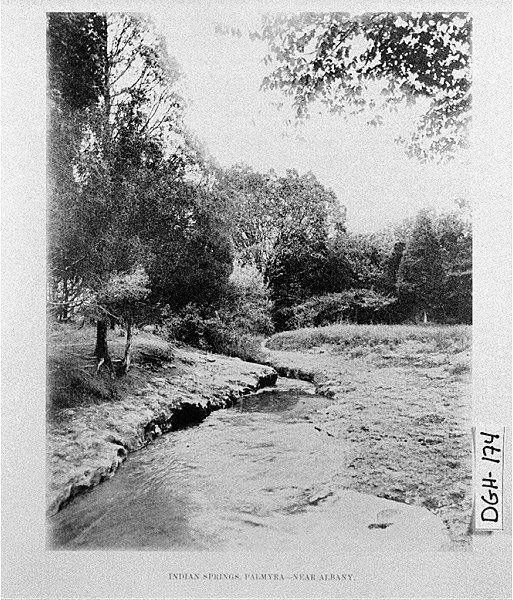
“This place was called Indian Springs,” he said. “It used to be a popular picnic spot during the mid-1800s. Of course, it didn’t used to look like this. It was not as overgrown.”
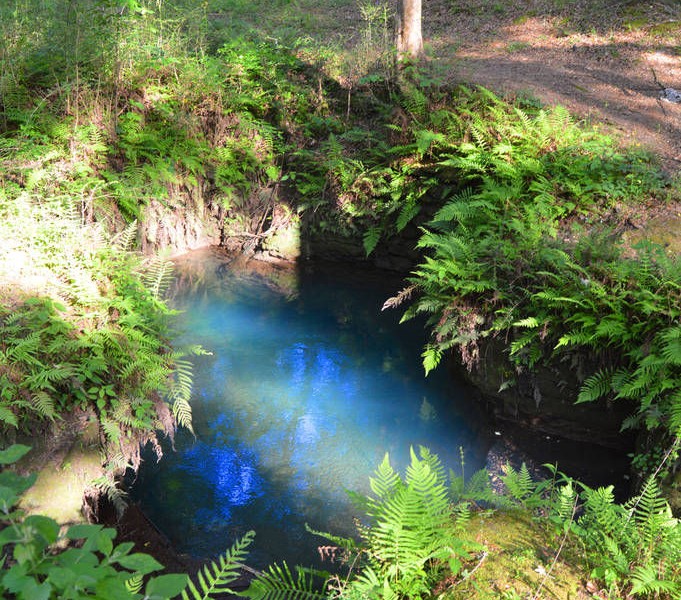
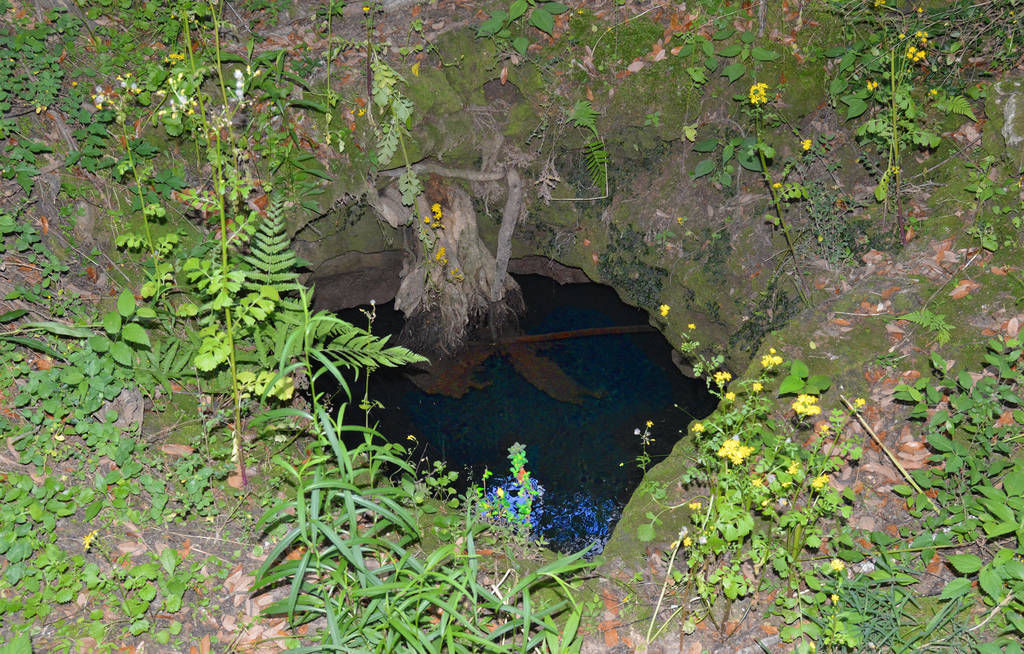
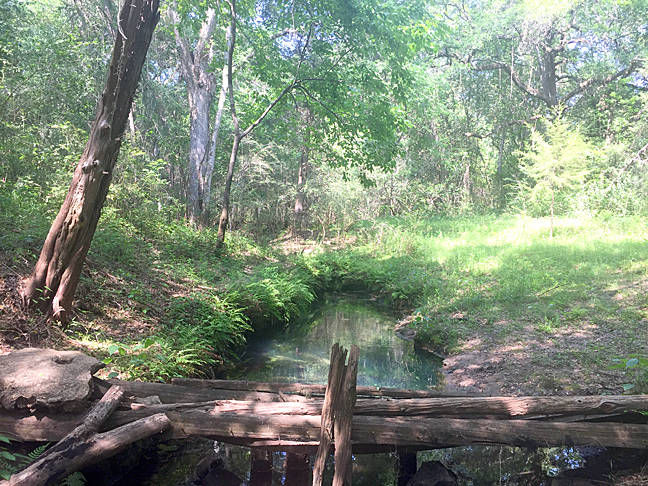
At the bottom of a gently sloping hill in the heavily wooded area is a natural spring, or “blue hole.” The water is clear and cold, emerging from a cave some 6 feet below the surface. Small bream and bass can be seen swimming in the spring.
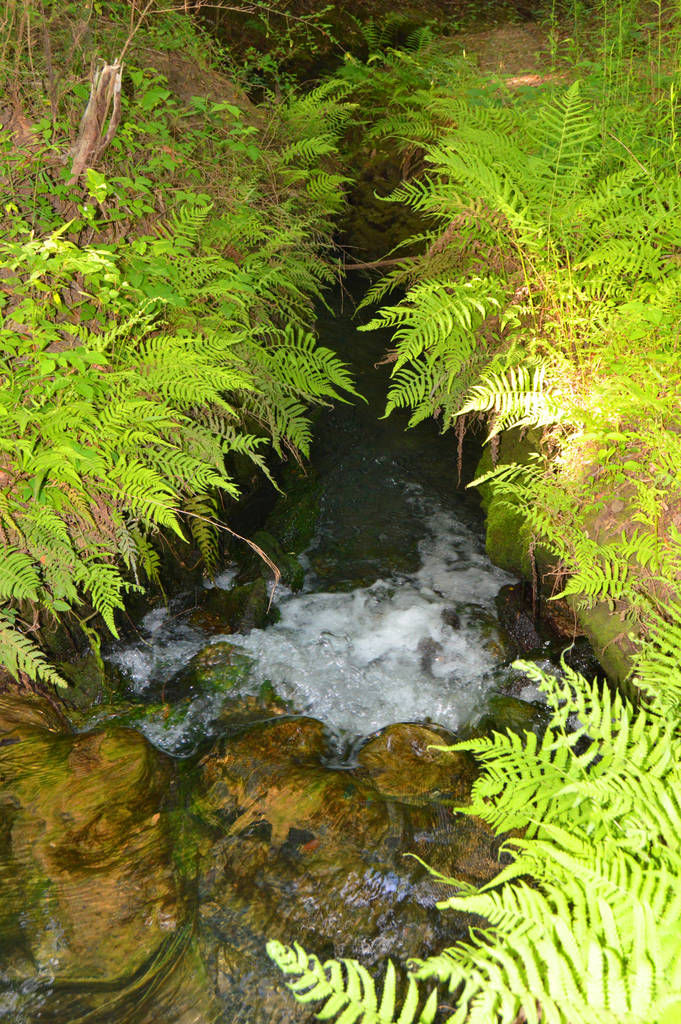
The spring’s water emerges from beneath the earth, rolling to the surface and cascading around the translucent pool momentarily before setting off downhill over a rocky shoal toward the Kinchafoonee Creek.
Over time, the water has carved a narrow ravine through the limestone several feet deep and wide. It snakes along for about 100 yards before abruptly ending.
“It goes back underground right here,” said Wright, pointing over the steep ridge.
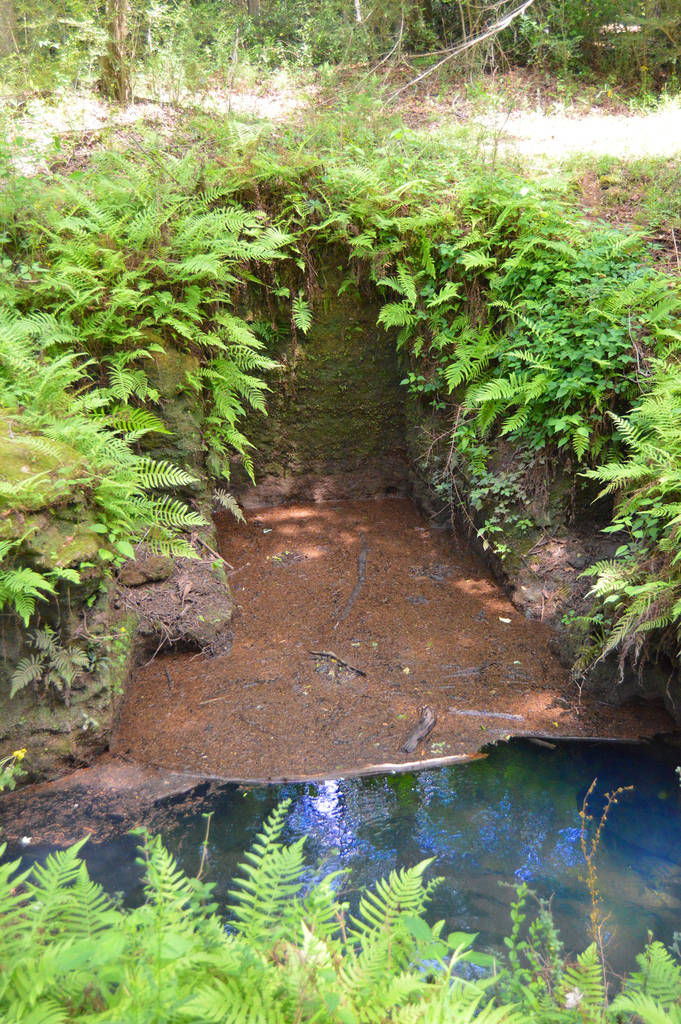
The water can be seen stirring around at the base of a wall of rock and leaves about 10 feet high.
“We have to go a little ways further to see where it comes back up,” Wright said as he turned and walked deeper into the woods.
After maneuvering among vines and around a shallow depression, the landscape changed and Wright emerged knee-deep in a grassy meadow under a sparse canopy of red oak. In the center of that meadow, the water emerges again in a larger spring.
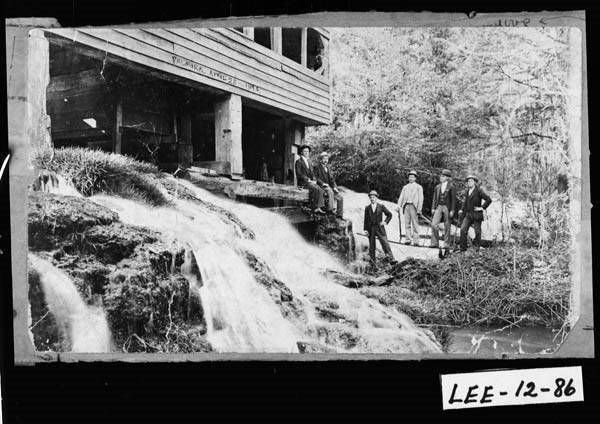
“This was Watson’s Mill, well at least the powerhouse,” said Wright. “It’s kind of hard to tell, but if you look at the wall, you can see the square shape of the masonry. In that groove is where the waterwheel turned, which powered the factory.”
The spring itself is kidney-shaped and about 10 by 15 feet across. The bedrock, now densely covered with ferns and a fuzzy layer of green moss, appears to have been both eroded by time and excavated by man down to the water level. The afternoon sun, shining in among a break in the trees, illuminates the natural spring, imbuing the water with a radiant blue color.
“The water is so clear that you can’t really tell, but it’s about 7 or 8 feet deep,” Wright said.
The surface of the water churns and bubbles, revealing a current strong enough to, at one time, turn a waterwheel and power a factory.
Watson’s Mill was described by writer George White in his 1854 “Historical Collections:” “The machinery is propelled by water power taken from the subterranean stream which runs at this place from 12 to 15 feet below the surface of the earth. The limestone has been excavated down to the stream, and a head of water raised sufficient to run the machinery for the gin factory and the grist mill.”
The Mill was also described in an advertisement in the Albany Patriot in December of 1853: “J.B. Watson makes Cotton Gins at Palmyra powered by the water of a natural spring.”
The factory itself was built about 300 yards away on the Kinchafoonee.
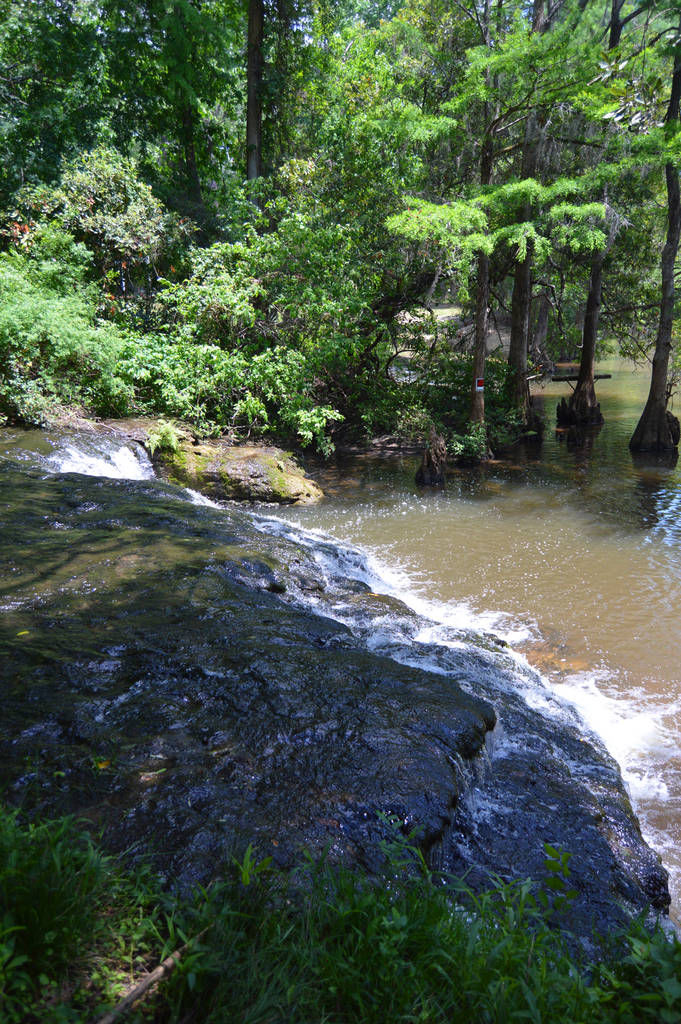
“The factory was actually built across Fowltown Creek at the falls,” Wright noted. “The waterwheel was at the spring. The factory building was literally built above the creek, where it spills into the Kinchafoonee. I found several broken millstones right there. The falls are the only true waterfalls in Lee County.
“At this time in history, cotton was king and there were immensely wealthy planters that lived in Palmyra. Col. Leonidas Jordan owned thousands of acres of land in the area. He was one of the wealthiest men and largest planters in Georgia. There is so much history here.
“Even before this place was Palmyra, it was Creek Indian land. That is where the spring gets its name. The landscape has completely changed. What was once open land is now a forest. This used to be a thriving community. Now, there is nothing left but a ghost town.”
Related Articles

Albany, Dougherty County plan Juneteenth celebration
Albany’s sixth annual Juneteenth celebration is set for 1 p.m.-6 p.m. on June 20 at the Albany Civic Center. The event will include entertainment, food and activities for youngsters.
Dougherty Environmental Control Division on front lines of mosquito war
“It usually takes about five to seven days to complete a quadrant, depending on the weather. Running four, we can get to all four quadrants to make sure we get to citizens in a timely manner. Mosquitoes can carry diseases and they are a nuisance.”
CWC Alliance brings substance-abuse training to southwest Georgia
“We train youth and young adults across the state on substance-use prevention. It’s been incredible to partner with NAMI Albany. Through this training they will become youth prevention mentors.”

