
ON THE JOB: Cutting edge technology takes flight with Thrush Aircraft
The company now produces three types of planes based on the Thrush airframe
By Terry Lewis
ALBANY — After spending nearly 13 years years in the agricultural aviation industry, Thrush Aircraft Vice President Erick Rojek has seen the business, and the company’s aircraft, evolve from crop dusters to all-purpose airplanes.
“Survival in an industry depends on how you adapt to changing conditions,” Rojek said. “Over the years the biggest change in the industry has been the amount of technology that goes into every single flight. Every single ag airplane now is GPS guided with all-glass cockpit technology. The enhancements and precision in ag aviation has changed tremendously since 2005.
The day of precision Ag aviation is upon us, and the days of pilots flying by the seat of their pants are dimming.
“The technology which goes into an ag mission today, and what goes into a flight, has really made our industry better,” Rojek said. “First of all, it’s made us safer and we are providing better applications to fields with better aircraft and the growers are seeing it.
“We are required now to cover more acreage that ever before, but now we have the technology to do it.”
The rise in technology has also allowed Thrush to expand its line of aircraft beyond the spraying aircraft. Just last month the company sold two “Switch Back” 510P planes to the Georgia Forestry Commission to be used for wildfire suppression. Each plane has a 500-gallon hopper and can dump its entire payload in less than two seconds
The Switch Back can also be used to spray traditional fields of crops.
Buoyed by the success of the 510, Thrush is working on a 710P Switch Back, which will add 200 more gallons to the aircraft’s hopper. Rojek said the company hopes to have that airplane on the market by the end of the year.
“Our bread and butter is the agricultural industry, but we all know in ag we have peaks and valleys, commodity prices and weather conditions to deal with,” Rojek said. “By expanding our product line, we’re kind of hedging our bet a little bit in regard to the exposure and risk which is agriculture.
“And that’s a big thing for us, because we have 260 employees to support and they are all skilled laborers. We just can’t ramp up and ramp down to these needs. We have to keep feeding the animal, which is production, and keep the flow going.”
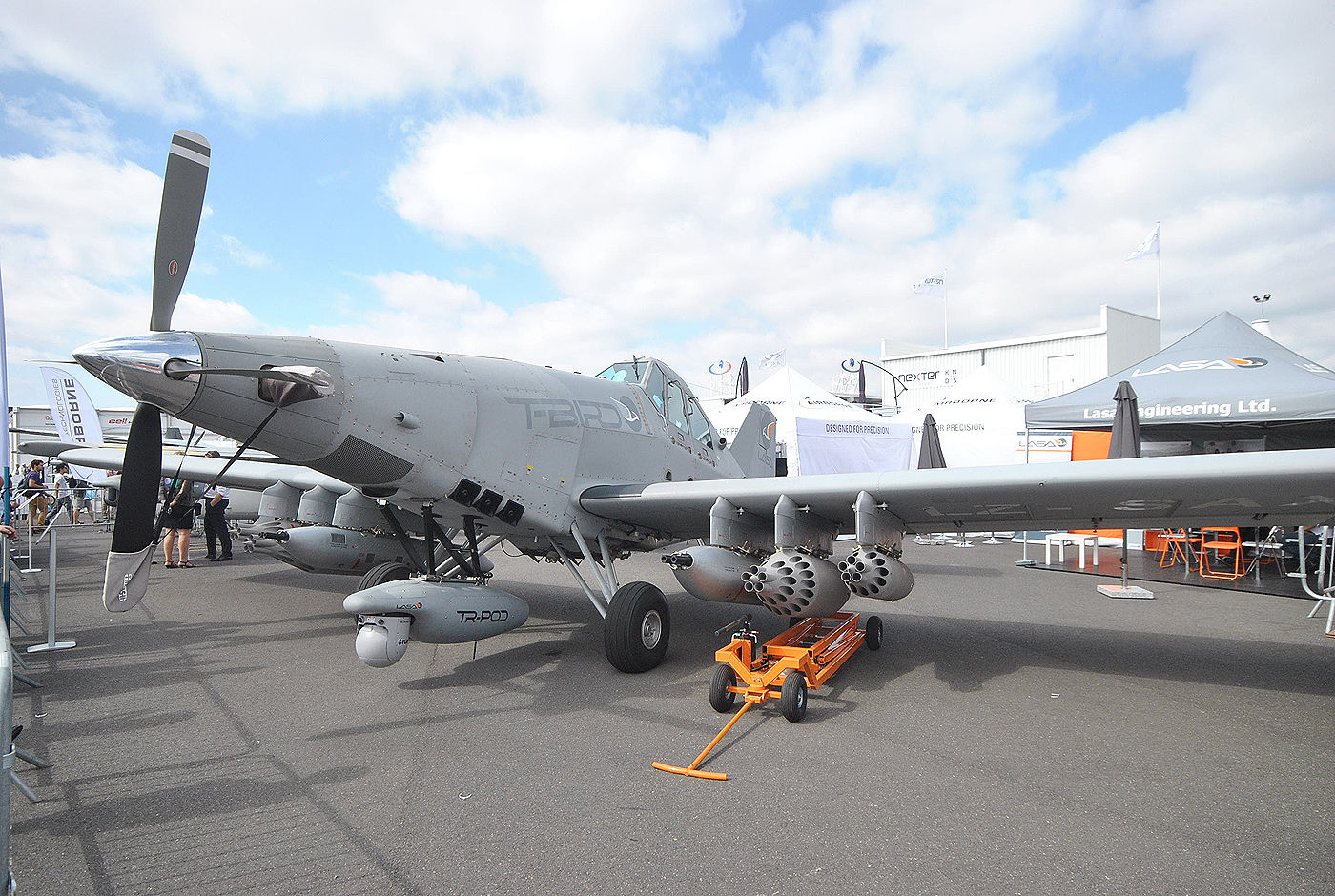
To illustrate that point, Thrush has recently partnered with IOMAX to for 24 710P aircraft with the United Arab Emirates. The planes will be converted military aircraft and be used for border patrol and close ground support. The plane, once converted, is called the Archangel.
“So now we also have military portfolio to help us out. The big thing about the military is there is always a beginning and a gap,” Rojek said. “But diversifying into the military side helps us offset some of the risk I was talking about earlier.”
Rojek added that diversification also extends across the globe.
“Most people don’t realize we are 70 percent international, and we are always looking for the next emerging market,” Rojek said. “More and more countries are realizing they have to produce their own food to feed their people instead of importing food.”
There are just two manufacturers of turbine-powered ag aircraft in the world: Thrush and AirTractor out of Plano, Texas.
“Competition makes everybody better. To have a viable business, you have to have competition, Home Depot needs Lowe’s and competition is healthy,” Rojek said. “I think we are going to see more technology in the future. I think we will also see bigger airplanes.
“In ag aviation, we are starting to see pilots using NV (night vision) goggles. The advantage of flying at night is there are more bugs out to eradicate, there are no workers in the fields, wind conditions are less at night, and we are always looking for better ways to get the application onto the crops.”


Related Articles

Police seek identity of man killed in early morning shooting Wednesday
Albany Police Department officers responded at 2:45 a.m. Wednesday to an incident at 216 E. Oghetlorpe in which two men were shot, one fatally. The case remains under investigation.

Albany Commission will revisit downtown park project at October retreat
“Right now it’s a sea of asphalt there. It doesn’t encourage gathering. Parks and green spaces encourage gathering.”

Judge denies residency challenge; Edward Brown to claim Senate District 12 seat
An email ruling issue this week paves the way for Albany businessman Edward Brown to enter the Georgia Senate next year. A Superior Court judge denied candidate Corey B. Morgan’s challenge to Brown’s residency in the District 12 race.
