
Quest for Change is altering the approach to sexual education in Terrell County
Program geared toward sexual education in Terrell County bring in parents on discussion
By Jennifer Parks
DAWSON — Traditional approaches to educating youth on human reproduction have been found to not be comprehensive. In a part of Southwest Georgia where youth have been hit hard by the consequences, an effort is gaining ground to open up conversations about the sensitive topic.
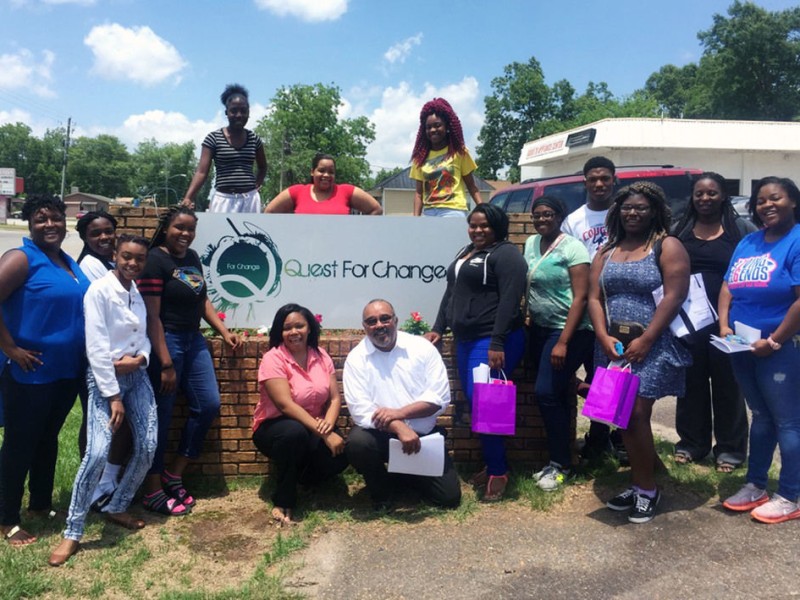
In Dougherty County, efforts of a task force are ongoing to combat the problem. In Terrell County, there is a program known as Quest for Change, which is aiming to taking a family-oriented approach.
Quest for Change determined that youngsters likely knew the consequences of sexual behavior when it comes to pregnancy, but not about what else might happen aside from having a baby. It was also found that parents may not be involved in the conversation.
Program Director Shaunae Motley said Quest for Change was established in 2001 as a non-profit behavioral health program. Feedback regarding youth outreach started to come in, and there was a shift in focus. The STD rate, particularly in Terrell, became a great concern.
“What that told us was that we had to change our approach,” she said.
The program strives to go into schools, the home and the community. At the schools in Terrell, there is an evidence-based program lasting 6-8 weeks that includes goal-setting, consequences of sex, puberty, and refusal skills.
The initial approach was strictly based on abstinence, but the Terrell County Board of Education’s recent approval of a new curriculum is meant to serve as a more in-depth and proactive approach.
“Abstinence is still the standard, but we will be offering more,” Motley said.
The program director said Quest for Change officials also are hoping to take the curriculum to Terrell Academy.
The Family Cafe is used as a workshop to get parents involved in the discussion. As the mother of a 10-year-old, Motley said she understands the importance of helping parents navigate a sensitive topic with their children.
“All it takes is one negative (decision) to not let them realize their full potential,” she said.
Dating violence, sex trafficking and levels of intimacy are among the issues explored in the Family Cafe. Some of the mothers and fathers in the program had their children at a young age, before their parents had the same conversation with them.
OPENING DIALOGUE
Opening up the dialogue makes a world of difference.
“We really should see a difference in their numbers,” Motley said.
Aletha Armour has a child who is currently a junior at Terrell County High School, where she works as a paraprofessional. Quest for Change got her attention when a presentation was made at the school.
The message was a refreshing one, she said. She was particularly grateful for the focus on parents, since she was having trouble with the subject in her home.
“I didn’t know how to approach that subject with my son,” Armour said. “Sometimes their friends give them wrong information, and you don’t want that.”
Armour recognizes that teenagers are likely to have sex and sees a benefit in encouraging prevention of STDs and pregnancies.
“People think it is OK to let males do what they do,” she said. “I didn’t know what to say to (the boys) other than to bring a condom.”
The mother also said she was thankful that the program offers an environment in which there is no such thing as a taboo or dumb question. She said it stands out in a big way from other programs with similar messaging.
“Most others are strictly abstinence,” Armour said. “It gives the abstinence message, but gives them (choices).”
Armour said the new path seems to be working because children are talking.
“Conversations are taking place that I don’t believe I’ve heard before,” she said. “I feel fortunate that we have access to a program like that in Terrell County.
“It is making a difference in where I feel a difference needs to be made. The kids and staff are at ease, and they are welcome.”
She said it has seen a difference as a staff member of the high school, where the students appear to be making different choices.
“I hope to see a decrease in teen pregnancy, a decrease in STDs and I’d like to see more conversations taking place,” Armour said. “I’d like to see the (school) district embrace it, just totally embrace it.”
Quest for Change also serves Calhoun County and Randolph County. In each of the three counties, there are 12 youth leaders who plan workshop events — while earning a stipend — for middle-schoolers and high-schoolers in order to engage healthy conversations.
TALKING THE ISSUES
Alexis Law, a junior at Terrell County High, is one of the youth leaders. She got involved with the program earlier this year after an adviser came to the school and persuaded her to join. In her position, she has been able to address some of the myths in a language the youth understands.
“I’ve learned that the students are very curious,” she said.
Law said she has noticed that hearing the information from a youth leader can influence a child to listen better, since it does not feel as if a middle-aged adult is telling them what to do.
“I feel like we are very hands-on,” she said. “We want to tell them the truth and not sugarcoat it. We want to listen to them and get their opinion.
“(Quest for Change) is working a lot better than most. We can hear the difference in the students’ conversations. I think it will do better long-term, especially in middle school.”
In the course of getting involved as a youth leader, Law and her mother have opened up more about the topic. Over time, the expectation is that other family units will become stronger.
“I do feel like conversations will get easier,” she said.
On the community level, networks are in the works to spread the message. Partnerships with faith-based organizations and business are being sought out as avenues to further educate youth.
As the program gains ground, teens have been instilled with the reality that they are not invincible, and that abstinence might be a realistic option for them.
“They are empowered to have these conversations,” Motley said.
Motley has experience working with youth in both urban and rural areas. She went as far as to say those in the rural areas have outperformed their urban peers.
“We have definitely seen a change in their confidence,” she said.
Some are not on board with the comprehensive approach for fear it might encourage risky behavior, but Motley defended the program’s method by saying that was not the case.
“If we can get this idea out to adults, if they can embrace it as a part of normal adolescent development, we will see more gains,” she said. “Most parents are afraid. It helps parents having these conversations.
“The key is normalizing these conversations and these topics.”
The Georgia Department of Public Health Office of Health Indicators for Planning (OHIP) shows there were 1,059 cases of sexually transmitted diseases — with the exception of congenital syphilis — in individuals ages 10-19 in the Southwest Public Health District in 2015. Among them were 48 cases in Terrell County.
In 2014, there were a total of 1,063 STD cases in the health district in the same age group, including 44 in Terrell.
Data from OHIP also shows there were 135 births among girls ages 10-17 in the district in 2015, including three in Terrell. The prior year, there were 158 among girls the same age, including eight in Terrell.
For more information on the program and community resources, visit questforchange.org, call (229) 449-6666 or email [email protected].
Related Articles

Albany, Dougherty County plan Juneteenth celebration
Albany’s sixth annual Juneteenth celebration is set for 1 p.m.-6 p.m. on June 20 at the Albany Civic Center. The event will include entertainment, food and activities for youngsters.
Dougherty Environmental Control Division on front lines of mosquito war
“It usually takes about five to seven days to complete a quadrant, depending on the weather. Running four, we can get to all four quadrants to make sure we get to citizens in a timely manner. Mosquitoes can carry diseases and they are a nuisance.”
CWC Alliance brings substance-abuse training to southwest Georgia
“We train youth and young adults across the state on substance-use prevention. It’s been incredible to partner with NAMI Albany. Through this training they will become youth prevention mentors.”

