
UGA Economic Outlook series returning to Albany
Annual Economic Outlook forum looks at local and state economy for coming year
By Brad McEwen
ALBANY — Experts from the University of Georgia’s Terry College of Business will share their predictions concerning national, state and local economies for the coming year with Albany area leaders when the annual Georgia Economic Outlook series makes a stop in Albany in late January.
The Jan. 24 presentation, one of a series of eight similar forums that will be held throughout the state, will take place at the Hilton Garden Inn in downtown Albany and will feature a presentation of the annual economic forecast prepared by the Selig Center for Economic Growth.
The forum will also include remarks from Mark Masters, director of the Georgia Water Planning and Policy Center at Albany State University; Alicia J. Jackson, dean of the College of Business at ASU, and Benjamin Ayers, dean of the Terry College of Business.
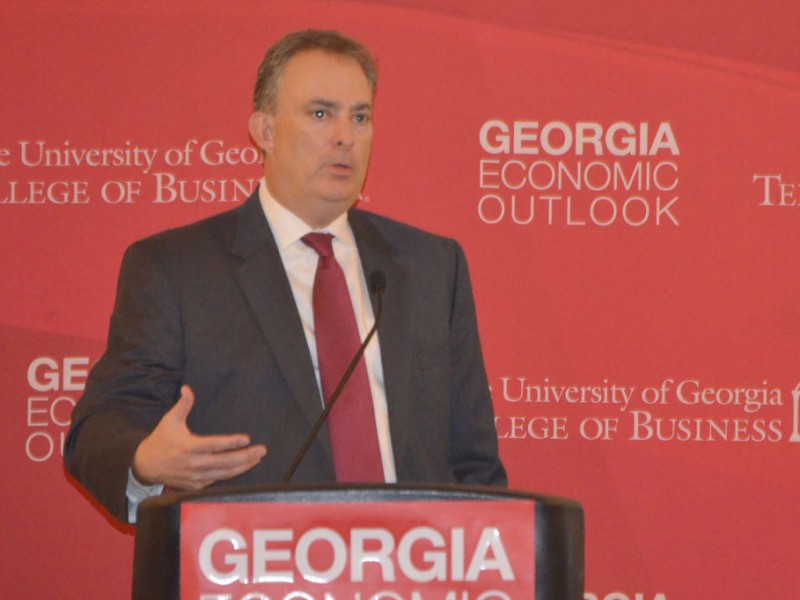
Much of what Ayers is expected to share in Albany will mirror what he presented to a crowd at the outlook series’ first stop at the Marriott Marquis in Atlanta in December, including the fact that Georgia’s economy is expected to grow for the foreseeable future, despite an increased chance that the country could enter a recession.
According to a press release from Terry College of Business Public Relations Coordinator Matt Weeks, Ayers delivered a relatively positive picture of the state’s economic future, pointing out that Georgia’s economy is expected to grow 3.2 percent in 2017, outpacing the nation’s 2.6 percent GDP growth rate. Additionally, personal income will likely increase 5 percent and non-farm employment should climb 2.1 percent, all of which is driven by four major economic factors.
“Many of the same forces that contributed specifically to Georgia’s growth in the past two years will be even stronger in 2017,” Ayers said in the press release. “First, Georgia has even more projects in its economic development pipeline. Second, Georgia’s economy will get more leverage from the housing recovery than the national economy. Third, Georgia’s manufacturers will continue to do better than U.S. manufacturers. Fourth, Georgia will see faster population growth.”
Despite the good news, the economic outlook does include caution that the state could face some potential challenges arising from a strong U.S. dollar, weak foreign currencies and possible Federal Reserve interest rake hikes.
Additionally, Ayers said the risk of a U.S. recession now stands at 35 percent, which is slightly higher than the 25 percent recession probability estimated this time last year. That high risk, according to the 2017 Outlook, mainly reflects concerns about inflated asset prices.
In his Atlanta presentation, Ayers also touched on the financial uncertainly that always comes with a transition in leadership in the White House, saying that “there will be more economic policy uncertainty,” which could cause some business leaders to put certain decisions on hold. That uncertainty could also delay decisions to hire or expand, added Ayers.
“But it also brings an opportunity to implement policies that will improve economic growth through tax reform, regulatory relief and spending on productivity-enhancing infrastructure,” Ayers added. “If leaders get it right, the country will benefit substantially.”
Albany area residents can get a more in-depth look at the national economy, as well as what’s in store for the state and Southwest Georgia, by attending the Outlook forum on Jan. 24. Interested parties can register for the Albany stop by visiting www.terry.uga.edu/events/details/6644.
Seats to the event, which starts at 11:30 a.m. with registration and check-in, followed by the luncheon and presentation from 10 a.m.-1:30 p.m., are $65. Tables of 10 can be reserved for $600.
The Georgia Economic Outlook Series is considered the premier forecasting event in the state, with future stops scheduled for Jan. 12 in Augusta, Jan. 18 in Savannah, Jan. 19 on Jekyll Island, Jan. 20 in Swainsboro, Jan. 23 in Columbus, Feb. 1 in Athens and Feb. 7 in Macon.
Related Articles

Albany police investigate suspicious Sunday death
A 21-year-old Turner Job Corps student who was found unresponsive on Sunday evening was later pronounced dead at Phoebe Putney Memorial Hospital. The death is under investigation.

James Rubino installed in new role at Marine Corps Logistics Command in Albany
James L. Rubino recently assumed the role as executive deputy of Marine Corps Logistics Command in Albany. In his new role he will oversee integrated logistics support.

Rain depresses voter turnout in Dougherty County
“A lot of people don’t vote when it’s raining. People don’t do a lot of things when it’s raining.”
