
State Election Board to ask for review funding
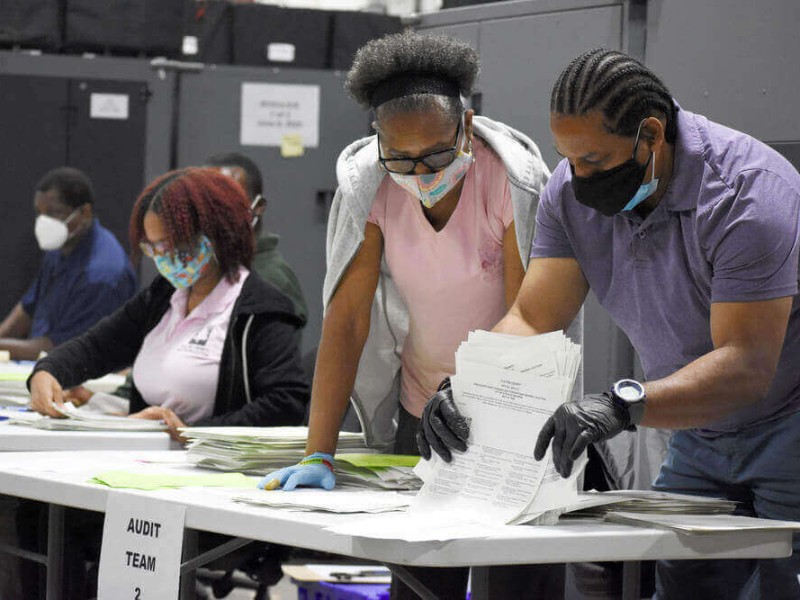
An independent panel and State Election Board members discussed the need for changes and more resources to the local takeover review process that Georgia lawmakers approved in a 2021 voting law overhaul.
Stephen Fowler/GPB via Georgia RecorderBy Stanley Dunlap
Georgia Recorder
ATLANTA — Georgia’s State Election Board is considering recommending to state lawmakers that the local election board inspection process be changed into a periodic review that will cover all 159 counties to develop best practices and shore up areas of weakness.
The future of the state’s independent election review panel was a topic of discussion at Tuesday’s State Election Board meeting, the first meeting since the independent review panel recommended in January that the state should not take over Fulton County elections board following an extensive year-and-a-half assessment. It is unlikely to be feasible to continue the time-consuming process of reviewing local elections boards that are deemed to be troubling without more financial support from the state, board members said.
In response to the closely contested 2020 presidential election in which Republican Donald Trump lost to Democrat Joe Biden, Georgia Republican lawmakers added a state takeover process as part of 2021’s election law overhaul.
According to the report, Fulton has successfully run several elections since 2020, implemented new procedures, and changed leadership, so the state did not need to replace the election board.
According to Fulton review panelist Steven Day, a Gwinnett County election board member, the state election board, the secretary of state’s office, and the Georgia Association of Voter Registration Election Officials should consider a new periodic performance review that provides metrics about best ways to manage voting.
This is preferable to waiting until a county has problems and trying to intervene in a potentially hostile situation, he said.
“It is better to be a partner than an adversary, better to improve systems before dysfunction rather than trying to fix them after the fact,” Day said.
Any review process, however, needs more support from state lawmakers who control the budget of the Secretary of State’s office and the statewide board, and can determine which rules that local elections offices must follow, Day said.
“The idea that you would expect a $500,000 consultancy from three guys volunteering your time is not reasonable,” he said. “They have got to act like it’s not the redheaded stepchild, but it’s something that should be valued. If you value elections, then fully fund the staff there and give them the power they need to do the job.”
Under the state’s sweeping voting law overhaul, Republican leaders who had called for a shakeup in Fulton’s leadership following the 2020 elections were granted their wish in August 2021 when the panel began evaluating elections operations in the state’s largest county.
William Duffey Jr., chairman of the State Election Board, said state and local election officials can collaborate on a new statewide review system, but resources are not sufficient to accomplish those goals.
“We have to have the courage to say, ‘If you want uniformity and integrity in these processes, you have to give us the resources necessary to create a system by which we could regularize and make uniform the processes that you expect of all these 159 counties,’” Duffey said.
The review panel observed Fulton’s administration of municipal elections in November 2021 by monitoring polling places and spent time taking part in election planning meetings. Additionally, the panel, along with election experts with the nonprofit Carter Center, conducted more evaluations for the midterm 2022 election.
Additionally, Fulton’s election procedures were reviewed, along with interviews with current and former staff.
In the 2020 election cycle, the report did not find any merit to wild conspiracy theories involving Fulton election workers and leadership, but did identify a number of procedural issues and other problems. Nonetheless, the panel reported improvements in Fulton in recent elections, including easier absentee ballot tabulation that led to the results coming in more quickly than in the past and better chain of custody measures for mail-in ballots. Fulton, with the state’s largest population, has historically lagged behind the other 158 counties reporting results after an election.
Author

Related Articles
Albany police investigate suspicious Sunday death
A 21-year-old Turner Job Corps student who was found unresponsive on Sunday evening was later pronounced dead at Phoebe Putney Memorial Hospital. The death is under investigation.
Unexplained checks, missing records, benefit errors surface in Terrell schools audit
A payroll performance review commissioned by the Terrell County School System found widespread documentation deficiencies, unexplained payroll discrepancies, inconsistent employee benefit deductions and weaknesses in internal controls, while also crediting district leadership for taking steps to improve oversight after significant staff turnover.

Terrell schools project $1.36 million revenue decline in proposed FY ’27 budget
The Terrell County Board of Education is scheduled to receive Superintendent Dr. Shereca R. Harvey’s monthly report and review budget information during its regular meeting at 7 p.m. tonight, Monday, June 22, with agenda materials outlining the district’s current financial position, fiscal year 2027 projections, a new grant award, state policy updates and enrollment trends.
