
FAST FACTS: Mars
CNN
(CNN) — Here’s some background information about Mars exploration. The United States and the Soviet Union are the only two countries to land a spacecraft on Mars.
Facts
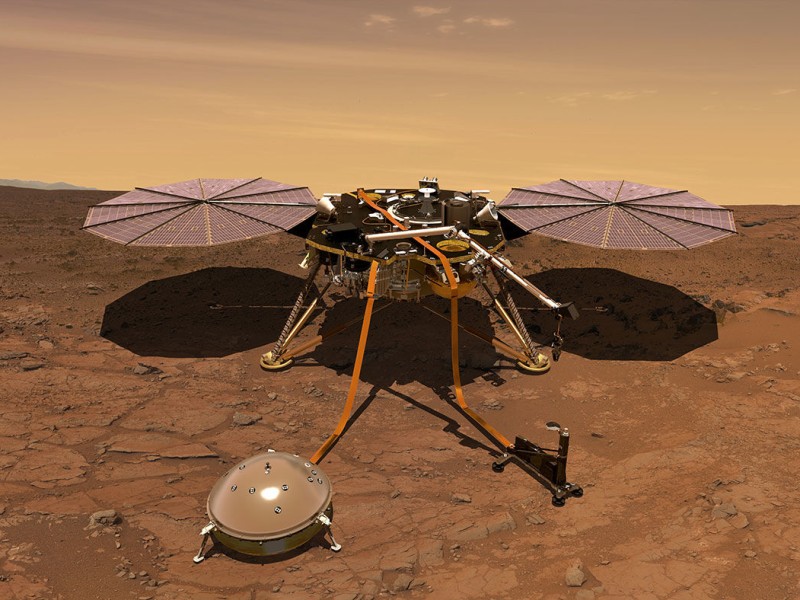
There have been eight successful U.S. Mars landings: Viking 1 and Viking 2 (both 1976), Pathfinder (1997), Spirit and Opportunity (both 2004), Phoenix (2008), Curiosity (2012) and InSight (2018).
The only other country to land a spacecraft on Mars was the Soviet Union in 1971 and 1973.
The United States, the Soviet Union, the European Space Agency and India have successfully sent spacecraft to enter Mars’ orbit.
Timeline
1965: Mariner 4 passes within 6,000 miles of Mars and takes the first close-up photos of the planet’s surface.
1969: Mariners 6 and 7 pass within about 2,500 miles of the planet and transmit information about the planet’s surface and atmosphere.
Nov. 3, 1971: Mariner 9 launches. It reaches orbit on Nov. 24, becoming the first U.S. spacecraft to orbit a planet other than Earth.
Dec. 2, 1971: The USSR’s Mars 3 lander makes the first successful landing on the planet’s surface. It transmits data for 20 seconds before failing.
July and August 1973: The USSR successfully launches Mars 4, 5, 6 and 7. Each spacecraft takes about seven months to reach the planet’s orbit. Only Mars 6 lands.
1975: Viking 1 and Viking 2 are launched.
July 20, 1976: Viking 1’s lander reaches the surface of Mars.
Sept. 3, 1976: Viking 2’s lander reaches Mars.
Sept. 25, 1992: The United States launches the Mars Observer. Contact is permanently lost in August 1993.
November 1996: The Mars Global Surveyor is launched. It reaches Mars in September 1997 and begins its orbit. It is last heard from on Nov. 2, 2006.
July 4, 1997: The Mars Pathfinder, after six months of travel, lands on Mars. For four months the rover Sojourner explores the planet’s surface and returns photos to Earth.
Jan. 3, 1999: The Mars Polar Lander is launched. On Dec. 3, it fails to make contact with ground control. NASA believes the lander was destroyed upon impact with Mars.
April 7, 2001: The Mars Odyssey Orbiter is launched and reaches Mars on Oct. 24.
June 2, 2003: The European Space Agency launches the Mars Express Orbiter and the Beagle 2 lander. The Beagle 2 is scheduled to land on Mars on Dec. 25, 2003, but never makes contact. The Mars Express Orbiter is successfully guided on to an orbit around the Red Planet, where it will study Mars for two years.
Jan. 3, 2004: At approximately 11:35 p.m. ET, the rover Spirit lands on Mars and immediately starts to send back pictures from the surface.
Jan. 15, 2004: The Mars rover Spirit rolls off its lander and begins the next phase of its mission to study the rocks and soil of the Martian surface for signs of water.
Jan. 24-25, 2004: The rover Opportunity lands on Mars.
Feb. 2, 2004: For the first time, both Spirit and Opportunity are fully operational. The rovers, 6,600 miles apart, collect soil samples and take photographs of the Martian surface. Both rovers find evidence of ancient Martian environments that were intermittently wet and habitable.
Aug. 12, 2005: The Mars Reconnaissance Orbiter launches. It will scan the planet for more signs of water.
March 10, 2006: The Reconnaissance Orbiter reaches Mars and establishes its orbit. It carries the most powerful camera ever to leave Earth, called HiRise. The camera takes its first four pictures on March 23, while the orbiter circles Mars at a distance of between 600 and 2,500 miles.
Aug. 4, 2007: NASA’s Phoenix Mars Lander is launched successfully. Its rocket launches at Cape Canaveral Air Force Station in Florida and takes about 10 months to reach Mars. Phoenix is designed to analyze soil samples and scan the Martian atmosphere after landing near its northern pole.
May 25, 2008: The Mars Phoenix Lander completes a 296-day, 422-million-mile journey, landing near the planet’s north pole.
November 2008: The Mars Phoenix Lander ceases communications after completing its mission. Originally expected to last 90 Martian solar days, the lander performs scientific investigations for 149 days of its 152-solar-day lifetime.
March 22, 2010: Last communication is heard from Spirit. The project continues to monitor for further communication. Opportunity is still operational.
Sept. 10, 2010: Scientists release data from the Mars Phoenix Lander suggesting that water has been weathering Mars’ surface throughout history. Data also suggest that Mars’ carbon dioxide atmosphere has been replenished by geologically recent volcanic eruptions providing evidence for what could be ongoing activity.
Nov. 26, 2011: The Curiosity rover launches from Cape Canaveral at 10:02 a.m. ET, aboard an Atlas V rocket bound for Mars. The journey is scheduled to last approximately 8.5 months.
Aug. 6, 2012: Curiosity successfully lands on Mars at 1:32 a.m. ET.
Sept. 21, 2014: NASA’s MAVEN craft arrives in Mars’ orbit after traveling 442 million miles in the course of 10 months to get there. It is the first mission devoted to studying the upper Martian atmosphere as a key to understanding the history of Mars’ climate, water and habitability.
Sept. 24, 2014: India’s Mars Orbiter Mission successfully enters Mars’ orbit, becoming the first nation to arrive on its first attempt and the first Asian country to reach the Red Planet.
March 2015: India’s Mars Orbiter completes its 160-day mission. It continues operating.
Sept. 28, 2015: NASA scientists say potentially life-giving water still flows across the surface of Mars from time to time, a discovery that may mean a breakthrough in both the search for life beyond Earth and human hopes to one day travel there.
March 14, 2016: The European Space Agency launches a module bound for Mars with its ExoMars Trace Gas Orbiter. The module, called Schiaparelli, is scheduled to enter Mars’ orbit and land on October 19, but it crashes when landing.
May 5, 2018: NASA launches InSight, the first outer space robotic explorer to study the interior of Mars during a two-year mission. InSight — short for Interior Exploration using Seismic Investigations, Geodesy and Heat Transport — will touch down just north of the Martian equator on Nov. 26, joining five other NASA spacecraft operating on and above Mars.
June 7, 2018: NASA announces organic matter has been found on Mars in soil samples taken from 3 billion-year-old mudstone in the Gale crater by the Curiosity rover. The rover has also detected methane in the Martian atmosphere.
July 25, 2018: Researchers from the Italian Space Agency publish a study indicating that a lake of liquid water has been detected beneath the southern polar ice caps of Mars using the European Space Agency’s MARSIS instrument.
Nov. 26, 2018: InSight lands on Mars and begins sending signals to NASA minutes later, including a photo of the surface where it landed.
Related Articles

TARA FLETCHER: Women are often trapped by abusive partners
Today, and every day after, in the United States, three women will be murdered by their significant other.
CARLTON FLETCHER: Great — and maybe not so great — expectations
During his heyday, mostly in the ‘80s and ‘90s, Lewis Grizzard was one of, if not the, most celebrated columnists in America.
MICHAEL FERGUSON II: A family reunion, an AR-15, and the truth America must face
A family reunion should never become a battlefield.
