
‘There’s only one Palmyra’: Residents defeat Ledo Road rezoning
A standing-room-only crowd erupted in applause Tuesday after Lee County commissioners rejected a request to expand general commercial zoning along Ledo Road beside the Palmyra subdivision.
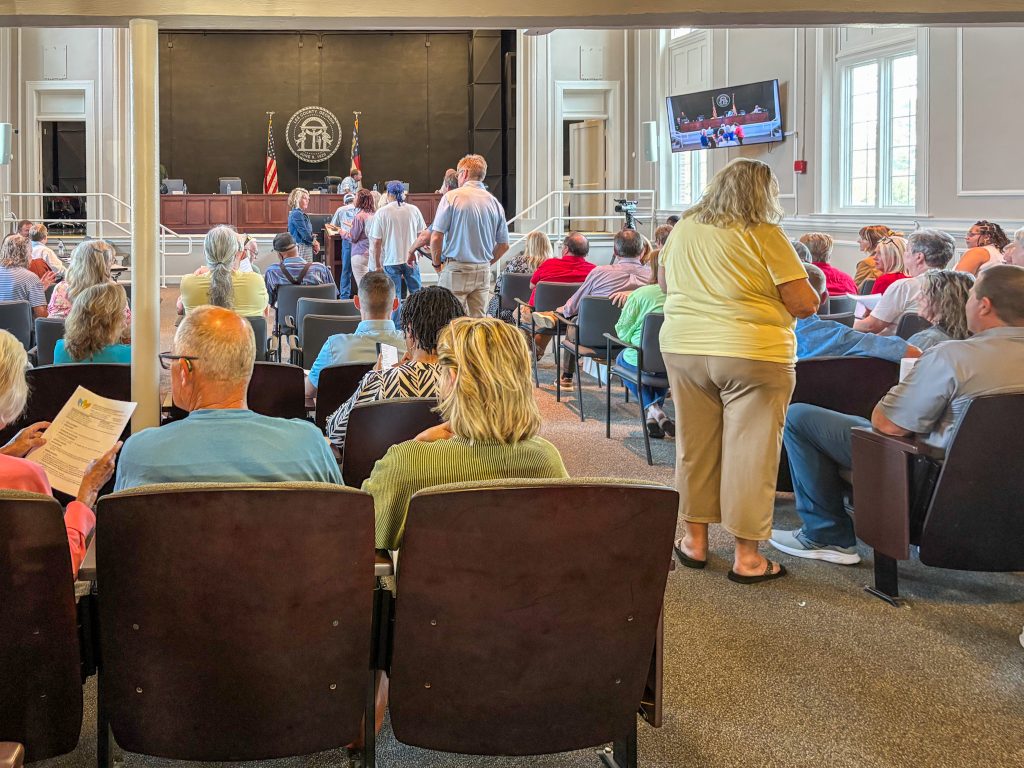
LEESBURG — A standing-room-only crowd erupted in applause Tuesday after Lee County commissioners rejected a request to expand general commercial zoning along Ledo Road beside the Palmyra subdivision.
Commissioners voted unanimously to deny Palmyra Development LLC’s request to rezone approximately 21.16 acres from C-1 neighborhood commercial and R-1 single-family residential to C-2 general business.
The vote followed more than 25 minutes of public discussion dominated by drainage, traffic and the range of businesses that could be built under the broader classification. About 30 names were read from the public participation sheets. Six residents spoke before William Hancock, representing the applicant, responded.
The undeveloped, wooded property is north of Ledo Road between Hugh Road and Archie Drive. County records list automobile dealerships and retail development as proposed uses, but the rezoning would have remained with the land and allowed a wider range of C-2 businesses regardless of the applicant’s current plans.
That uncertainty became the central argument against the request.
Johnny Johnson, who said he has lived in Palmyra since 1993, told commissioners residents had never fought development along Ledo Road — not Walmart, not Tractor Supply Co., not the dealerships or the car wash.
“This is totally different,” Johnson said. “There’s no way to know what type of business we’re looking at — a big-box store, a Walmart, a truck stop, warehouses. We have no idea what it’s going to look like.”
He said a national retailer would have little reason to answer to the neighborhood beside it.
“A national chain — their only tie to Lee County is financial,” Johnson said. “They don’t feel like they have to be a good neighbor to us. If it’s C-1, you’re going to have a smaller business, and we will be their best customers.”
Johnson pointed to children on bikes, walkers and delivery traffic cutting through residential streets and asked commissioners to send larger businesses to land already zoned for them.
“There are many C-2 sites suitable for large businesses in Lee County,” he said. “There’s only one Palmyra subdivision, and that’s our home.”
Drainage ran through nearly every comment.
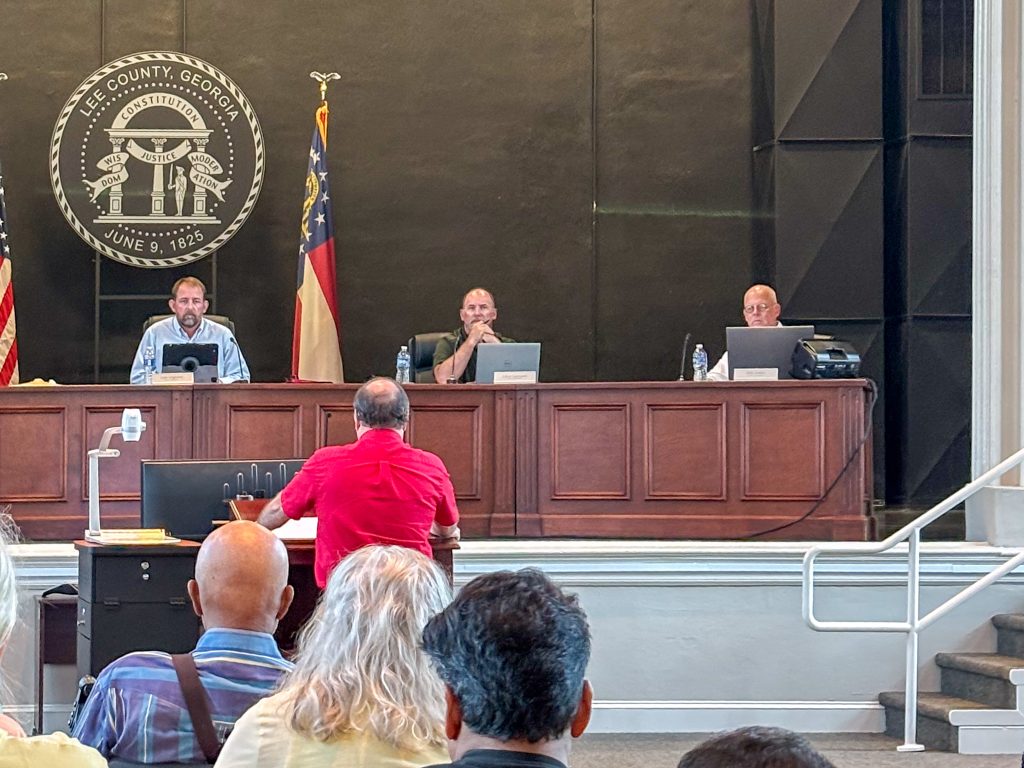
Ralph Paustian, the meeting’s first speaker, said Palmyra was established in 1980 and that the land behind the existing C-1 frontage is low-lying, dropping roughly 10 to 12 feet from the road — one reason, he argued, it has never been developed. Filling and paving it, he said, could push water toward Ledo Road or toward homes.
“I believe a professional drainage study should answer these questions before rezoning is approved, and the study should be completed at the developer’s cost,” Paustian said.
He also framed what residents felt was at stake.
“There’s a major difference between buying a home knowing commercial property is already behind you, and buying in an established residential area only to have the property behind you changed to more intensive commercial zoning,” Paustian said. “Lee County needs growth, but it needs responsible growth in the right location.”
Stacy Evans, a 23-year resident who said he has replaced his septic system twice because of poor soil, put the zoning difference in terms of hours.
“Mom and pop shops would close at six. They go home and spend a quiet evening with their families,” Evans said. “When you have drive-throughs or bigger, national chains, they may be open later — 10, 11. All that would create noise, light, sound pollution and probably trash pollution in our neighborhood.”
Water already pools chest-deep on the site after heavy rain, he said.
“If you’re backfilling and taking out half of that area, that water’s got to go somewhere,” Evans said.
Ernie Culpepper said water already reaches his yard, though his home sits roughly 300 yards from Ledo Road.
“I’m not opposed to this land being commercially developed. I always thought it would be,” Culpepper said. “But I don’t know where the water’s going to go. I’m afraid it’s going to come in my back door.”
Lori Newman raised traffic concerns, saying the new roundabout has made turning onto Ledo Road harder and that there is little room for a signal without backing up nearby roads. She also asked commissioners to consider the deer and other wildlife on the tract.
“C-1’s good,” Newman said. “C-2, not so good.”
Brent Howell, a second-generation Palmyra resident, said the subdivision is on wells and septic tanks and that acres of new impervious surface would be a health issue, not just a nuisance.
“Increased water is going to decrease the efficiency of our septic systems,” Howell said. “I don’t want to have that health concern.”
The rezoning request originally covered the full 33.16-acre parcel. After residents objected at an earlier hearing, the developer removed approximately 12 acres at the rear, which would have remained R-1, and proposed a 30-foot undisturbed natural buffer along the eastern boundary. Some residents questioned whether 30 feet would screen year-round, and who would maintain it if the property sold.
The Lee County Planning Department recommended approval, noting the property is designated for commercial use on the county’s Future Land Use Map and sits along an established corridor. Staff’s condition would have barred buildings, parking, loading areas, Dumpsters, outdoor storage and stormwater facilities from the buffer, and any development would have required further county review of access, utilities and stormwater.
The Planning Commission disagreed twice — recommending denial of the original application Aug. 6 and, unanimously, of the revised 21.16-acre version Sept. 3, citing the range of C-2 uses and the lack of engineering and stormwater detail available at the zoning stage.
Hancock told commissioners the developer had already responded to residents by pulling back the rear acreage. He described Ledo Road as a five-lane, county-maintained corridor running parallel to the Liberty Expressway and built to carry growth, said the front 21 acres would be self-contained with on-site retention, and argued the residents’ specific questions belong to a later stage.
“Zoning is just zoning,” Hancock said. “Stormwater, site plan, drainage, traffic — the planning staff has regulations and professionals to impose those requirements before they can get to a final building.”
Commissioners sided with the Planning Commission and residents. No commissioner voted against the motion to deny, and claps and cheers followed the vote.
Commission Chairman Luke Singletary later said zoning decisions become particularly difficult when development could affect neighboring homeowners.
“This is their lifetime investment,” Singletary said. “We weren’t comfortable with the proposed plan and didn’t feel like it was the right use of the property.”
The decision does not prevent all commercial development. Portions of the property remain zoned C-1, allowing lower-intensity neighborhood businesses, and Palmyra Development could submit a new proposal.
Related Articles

PHOTOS: Albany State’s Good Life City Expo
Photos by Reginald Christian, Albany State University

Dawson City Council uninformed as state freezes sewer loans, audits remain incomplete
With three overdue audits, no Mauldin & Jenkins briefing on Thursday’s agenda and funding deadlines approaching, the larger question is increasingly urgent: How will Dawson pay to finish the work, and what will further delay mean for the future reliability of the city’s water and wastewater systems?
Across a county line, foster care rates reveal stark divide
An abandoned home in Dawson sits overgrown and deteriorating, one example of the city’s ongoing struggle with blighted and unusable housing. Dawson’s long-range planning documents identify both a high vacancy rate and a need for more safe, affordable housing. Staff Photo: Kathryn Crockett
