
Albany city attorney announces resignation; city leadership votes no to new liquor licenses in east Albany
Staff Photo Lucille Lannigan
By Lucille Lannigan
[email protected]
ALBANY – After more than 21 years as Albany’s City Attorney, Nathan Davis announced his resignation during Tuesday’s commission meeting.
Davis began his law practice in Albany in 1975. He was a part-time U.S. Magistrate Judge in Albany from 1979 to 1988 and solicitor in the Municipal Court from 1986 until he assumed the city attorney position.
Davis said throughout his tenure, he recognized what an important role he had in the city.
“I was excited to go to work everyday,” he said.
Ward I Commissioner Jon Howard shared words in Davis’ honor during the meeting. He spoke highly of the long-time attorney’s expertise and his ability to educate commissioners. He said it’s rare for a city to keep a city attorney for 21 years, and he considers it an iconic point for the city.
“It’s unfortunate that Mr. Davis is going to retire,” Howard said. “I hate to see him go.”
Mayor Bo Dorough said Davis brought life to his position, and the citizens of Albany are grateful.
“We’re grateful to Mr. Davis for his guidance,” Dorough said. “He’s done an exemplary job.”
The city accepted his resignation, effective May 31. Assistant City Attorney Michael Custer will take his place.
Albany’s city commissioners and Mayor also approved $213,900 from red speed camera funds to be used for license plate reader cameras and fixed cameras from Flock Group, the creators of Albany’s school zone speed cameras and gunshot detection devices. The commission also authorized the use of the same funds to buy APD service weapons. Michael Persley, Albany’s Police Chief, said the department was using outdated weapons before.
The commission also voted unanimously against two new liquor licenses in east Albany Tuesday night.
The proposed licenses would’ve been for AB Food and Drink at 2005 E. Broad Ave. and EZ Food and Drink at 2444 Rosebrier Ave. The two locations, east Albany residents say, are in close proximity to Turner Elementary School, a day care and residential areas.
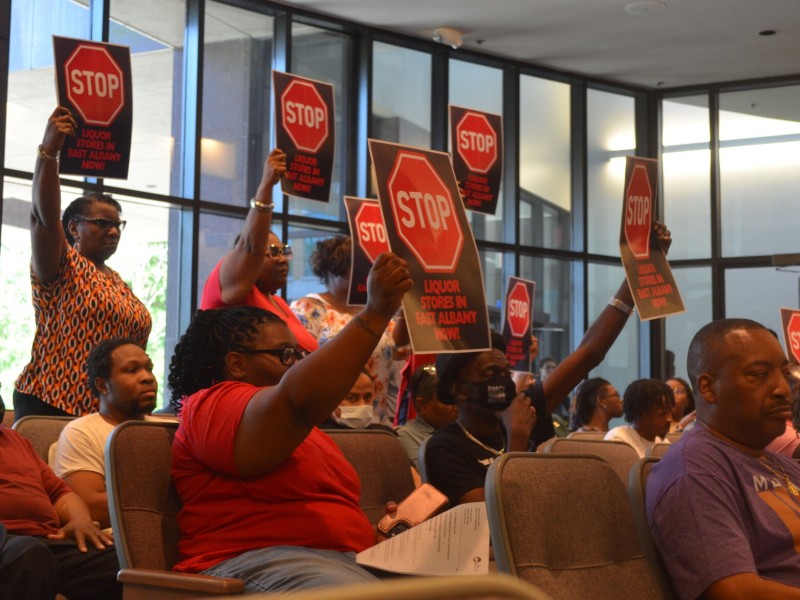
East Albany residents organized a Change.org petition against the proposed liquor licenses and many showed up to Tuesday’s commission meeting in red shirts, holding signs that read “Stop liquor stores in east Albany now!”
While the city’s decision to say no to the liquor licenses last night was a win, community members say the density of liquor stores on the east side is still concerning.
Lonnie Hunter, a Dougherty County resident just outside of east Albany, said he’s concerned about the community’s churches, schools and young people and their proximity to liquor stores. He said he’s seen the number of alcohol outlets increase over the last 15 years.
“They keep coming in as grocery stores and clothing stores leave,” Hunter said. “We don’t want any more alcohol places in east Albany. We have too many over there now.”
He said he’s concerned about the accessibility of alcohol to youths in east Albany, especially if liquor stores are close to schools. Hunter attended Tuesday night’s meeting in a red shirt, sign in hand.
Sherrell Byrd, executive director of SOWEGA Rising, said approving the licenses would have been a complete disregard for the community that lives there.
Byrd said east Albany is a vulnerable community. It’s majority black and suffers from high poverty and crime. Liquor stores are often disproportionately prevalent in black neighborhoods, creating a disproportionate health risk. A 2021 Rutgers study analyzed ways this jeopardizes the lives of black people through “social and material conditions that are broader than health risk.”
Byrd said there is no need for more liquor stores in the already “alcohol dense” east Albany. These stores, she said, lead to deterioration.
“It’s such an economically depressed area,” she said. “There’s been no economic development, and alcohol outlets are not economic development … they’re actually negative development.”
Byrd said city leadership has ignored the pleas of east Albanians in the past. After continued advocacy in spring 2023, she said the city went under an alcohol moratorium for 45 days to study the impact of alcohol outlets in vulnerable communities.
“But, it did nothing,” she said. “It just went back to business as usual. It shows a disregard for people living in these communities.”
Howard has been outspoken about more liquor stores in his ward. He led discussion at Tuesday’s meeting on how the approval of the proposed liquor licenses would negatively impact existing community entities.
“If you look at east Albany, we are a marginalized area,” he said. “Things that we would like to come to the city are not coming. If you continue to inundate each neighborhood with alcohol licenses … it’s going to be hard to attract new businesses.”
Hunter said he feels good about the commission’s decision. He said the east side has great city and county commissioners that “are really in the circle” with the community.
Barbara Hunter, his wife, said the city made a decision that was best for the community.

Author

Related Articles
Dawson Council approves $400,000 lifeline in emergency meeting as financial accountability remains elusive
Less than a week after city officials publicly acknowledged the City of Dawson cannot continue operating without additional financing, the Dawson City Council convened a hastily called emergency meeting Tuesday evening and unanimously approved authority to borrow up to $400,000 through a tax anticipation note.

Lee County homeowners have until Aug. 1 to claim property tax exemptions
Lee County homeowners have until Aug. 1 to apply for homestead and other property tax exemptions for the 2026 tax year, a deadline members of the Lee County Board of Tax Assessors highlighted Monday as they encouraged eligible residents to take advantage of available tax relief.
Albany Herald – July 16, 2026
Albany among local governments looking… ASU Marching Rams first HBCU band
invited…
