
Calhoun County votes to opt out of Floating Homestead Tax Exemption, following other small, rural governments
City and school board leaders from Calhoun agreed to opt out of HB581, Tuesday. Some, Morgan and Edison, had already voted on the issue and were scheduled to advertise their three public hearings. Others, Arlington, Leary and the Calhoun County School Board, said they planned to opt out and had meetings to discuss scheduled for this week.

MORGAN – Calhoun County and its municipalities and school board plan to opt out of a new state Floating Homestead Tax Exemption, leaders agreed at a Tuesday meeting.
Calhoun County leaders voted to opt out of the exemption during a special called meeting. In order to opt out, cities, counties and school boards must advertise the intent to opt out one week in advance of hosting three required public hearings on the matter. This process had to begin Jan. 1 and must be completed by March 1, giving local governments a short window to make the decision.
The Floating Homestead Tax Exemption, created by House Bill 581 went into effect Jan. 1. It essentially places a “freeze” on a homestead’s valued assessment, leading to some tax relief for homeowners. However, it could create challenges in small, rural cities and counties with stagnant tax bases, forcing them to raise millage rates in order to offset revenue loss from the exemption.
Calhoun County Chief Appraiser Adriane Ashley said county residents have to look at the holistic impact of this exemption. She said that while it might help homeowners with their homesteads, it’ll hurt them elsewhere.
“If we have to go up on the millage rate, you’re going to hurt yourself on the other properties you can’t get an exemption on,” she said.
City and school board leaders from Calhoun agreed to opt out of HB 581, Tuesday. Morgan and Edison officials had already voted on the issue and were scheduled to advertise their three public hearings. Officials with Arlington, Leary and the Calhoun County School Board said they planned to opt out and had meetings to discuss the matter scheduled for this week.
Arlington already released its dates for public hearings. All hearings will be held at Jimmie C. Harpe Community Center at 31 Martin Luther King Dr.. The first will be Jan. 23 at 7:00 pm. The second will be Jan. 30 at 7:00 pm. The third will be Feb. 6 at 6:00 pm.
Residents of these municipalities who wish to know more about how this will affect them should keep an eye out for the public hearings schedule.
HB 581 appeared as Amendment 1, House Resolution No. 1022 on ballots in November.
It passed widely across Georgia’s 159 counties, 120 of them considered rural by a study from the University of Georgia. Calhoun County Vice Chairman and District 5 Commissioner Charlie Williams said he believes the text on the ballot was misleading for voters. He said the county and its cities will have to work together to communicate to residents that opting out will not hurt them but most likely be better for their wallets.
“We’re all in this boat together then,” Williams said upon the entire county’s leadership coming to an agreement.
Mark Strickland, a Calhoun County resident and the county’s former chief appraiser, said Calhoun County and its municipalities, like many smaller governments, have tight budgets and most of the areas where these types of exemptions work have other things – businesses, industries – to balance tax revenue.
“We don’t have any of that,” he said. “There is no such thing as property tax relief. There’s only a shifting of the burden. Who would we shift it to?”
Edison Councilman Curtis Adams said the city voted to opt out during its Monday night council meeting. The city has spent the last year recovering from upwards of a half-million dollars in debt since the summer of 2023. Part of the cause for debt was operating city utilities – water, sewage and garbage pick-up – at a deficit that wasn’t adjusted for inflation over the years.
“I think the last thing Edison wants is to see a decrease in taxes coming in – any kind of loss of revenue because they’re just now getting back on their feet,” Strickland said.
In order to recover from the debt and get the city’s finances back on track, Edison leaders had to raise the city’s millage rate. It’s the highest rate in the county. Adams said a large part of the city’s decision to opt out of HB 581 is because it has nowhere to shift the burden.
“We don’t have the room, nor do we have the inclination, to raise anything,” Adams said. “We’re already at the max of what we need to be collecting, both in services and with the mill rate.”
Arlington’s leaders attended a meeting about HB 581 hosted by the Georgia Municipal Association in Macon Monday. The city’s mayor, Jerome Brackins, said it is clear the best option for the city is to opt out. Arlington is one of three Georgia cities that is split between two counties – Early and Calhoun. Brackins said he’s had communication with Early, which also is opting out.
“Small counties are going to be the ones who will be hurt by this legislation,” Strickland said.
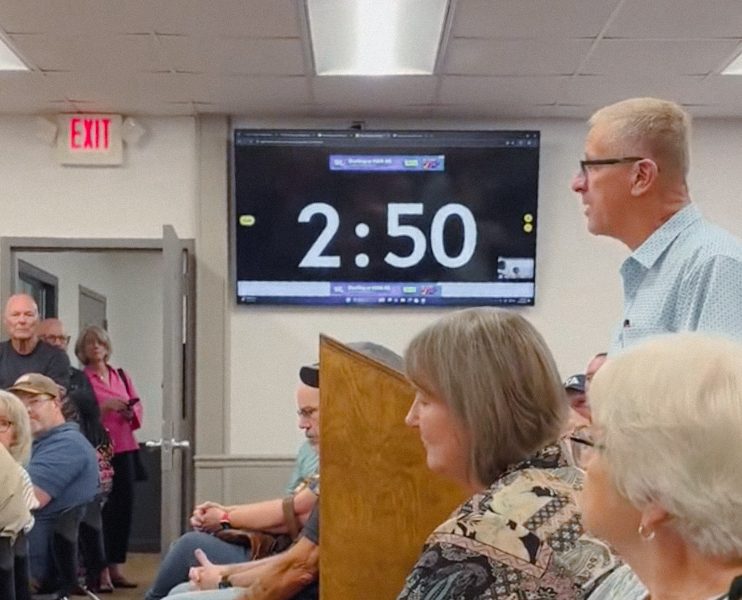
He talked during public comments about conversations he had with former Georgia Rep. Penny Houston, R-Nashville, about what she believed to be an underlying goal of this law: to shut down small counties because there are too many in the state. Georgia has the second-largest number of counties of any state in the U.S., behind only Texas.
“That was the viewpoint of many of the powers that be in our legislature,” he said.
One belief is that Georgia’s large number of counties makes it expensive to maintain government infrastructure. Consolidating might relieve some of those expenses and allow communities to run more efficiently.
However, Strickland said he doesn’t believe the savings would be great. He pointed to officials like sheriffs, probate judges and tax commissioners, who he said have salaries based on population.
“When you start combining counties together, you’re increasing population, which is going to increase their price,” he said. “You’re also increasing workload on those offices, which leads to increased personnel. So are you really saving any money?”
Combined counties would also have to take on each other’s debts, Strickland said.
“It’s a logistical nightmare,” he said.
Regardless of the intent of HB 581, local governments have about six weeks to complete the process if they wish to opt out of the Floating Homestead Tax Exemption.
Some Calhoun County’s cities will begin hosting their public hearings as early as next week.
Author

Related Articles

Blackberry Smoke celebrate 25 years with tour supporting greatest hits: ‘Rattle, Ramble and Roll’
Blackberry Smoke frontman Charlie Starr talks to The Albany Herald about the band’s show here Oct. 22.

Albany burning
Albany firefighters battled a two-structure blaze in the city’s downtown just before noon Friday.
‘It’s time to listen to us’: Lee County school tax proposal draws fire
A longtime Lee County resident urged the school board to reject a proposed property tax increase during its first public hearing Oct. 8, questioning spending priorities and warning about the burden on families and older residents.
