
Chief Michael Persley speaks at Rotary
Rotary hosts APD Chief Michael Persley
By Jon Gosa
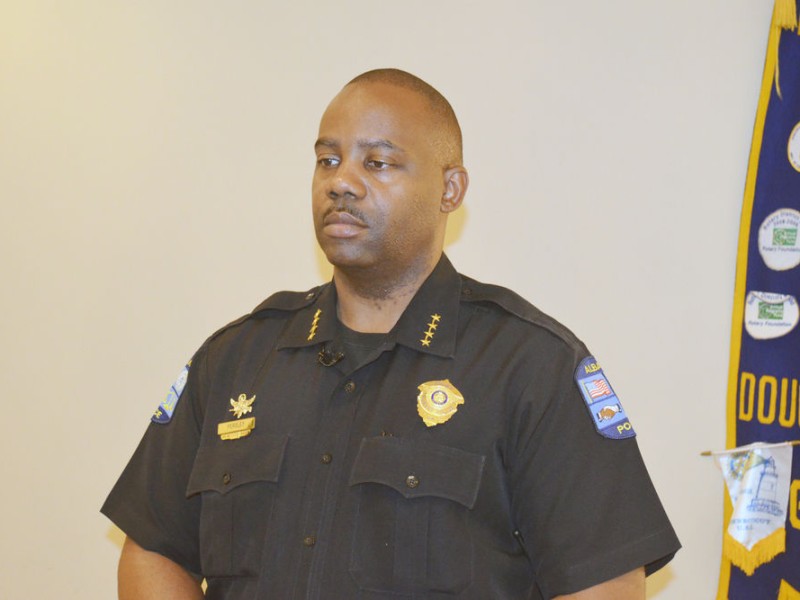
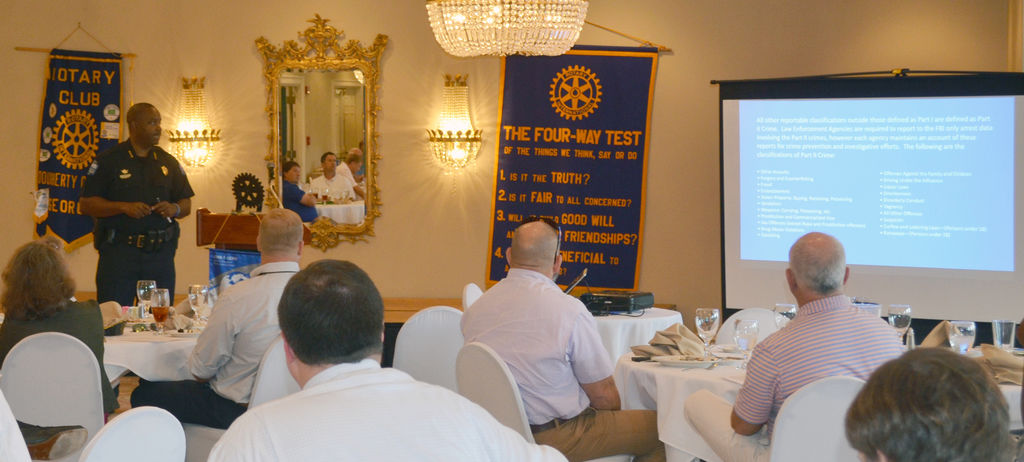
ALBANY — Albany Police Department Chief Michael Persley discussed crime in Albany and suggested means through which the department and the community can curb criminal activity during the Dougherty County Rotary Club meeting on Tuesday.
“Today, I want to give an overview of what we’ve been doing with crime here in Albany,” said Persley. “There is a lot going on across the country, and there’s plenty of talk about that there’s a breakdown in the police and the community relationships. I would say that that is true in certain areas.
“When you look at the dynamics of how the community is and you look at the city government and how they interact with the constituents, every city has their dynamic. But here in Albany, we have our own dynamics. I can tell you that as long as I have been a police officer, there has always been a strong connection between the citizens and law enforcement in Albany.”
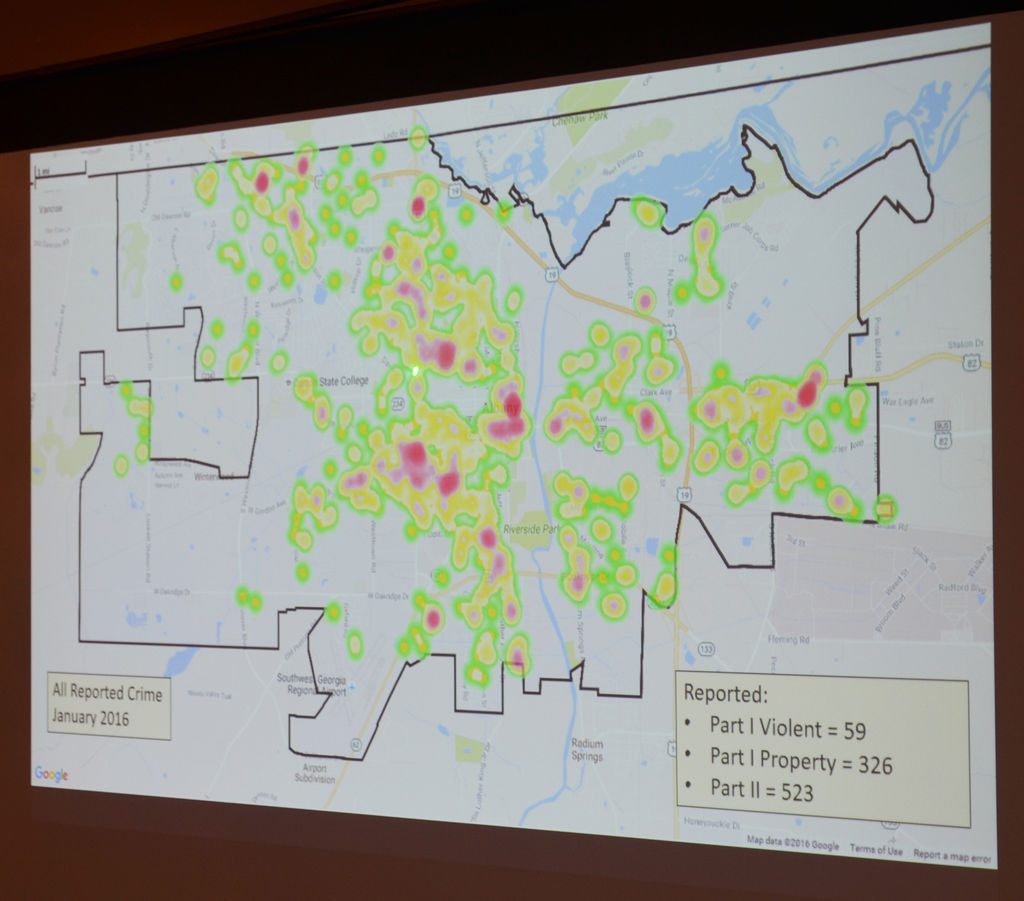
According to Persley, law enforcement deals with an array of crimes, which are categorized as Part I and Part II offenses.
“Part I crimes are primarily violent crimes,” said Persley. “These are the crimes that we report to the FBI. We don’t report all crime, because they don’t want to know about all crimes. However, they do want to know about these Part I crimes. These are the crimes that most communities are judged on how crime rate goes up and down.”
Each month, participating law enforcement agencies submit information on the number of Part I offenses through the Uniform Crime Reporting Program (UCR) to the FBI. Those offenses that are cleared by arrest or exceptional means, and the age, sex and race of persons arrested for each of the offenses are also reported.
According to the U.S. Department of Justice, the UCR program collects data about Part I offenses in order to measure the level and scope of crime occurring throughout the nation. The founders of the program chose these offenses because they are serious in nature, they occur with regularity in all areas of the country, and they are likely to be reported to police.
Part I crimes include criminal homicide, forcible rape, robbery, aggravated assault, burglary, larceny-theft, motor vehicle theft and arson.
“Every week we have command staff meetings where I get an update on where we are at on Part I crimes,” said Persley. “Every other week, we have meetings and talk about the trends in the crimes. This is very important.”
According to Persley, statistical understanding of the nature of crimes committed and the areas in which they occur allow officers to be distributed more effectively. Also, efficiently deterring and resolving Part II crimes, crimes that are less serious in nature, such as drug abuse, disorderly conduct, DUI, commercialized vice, etc., prevents such offenses from escalating into Part I offenses.
“If you handle your Part II crimes, it reduces your Part I crimes,” said Persley. “For example, if you don’t handle a domestic violence case the right way, they can lead to an aggravated assault or homicide. When I say handling the right way, it does not always mean putting people in jail. It means putting people in touch with services they may need, be it for a mental health disorder or something else. If we handle these situations the right way, we won’t have to be reporting so many of the other more violent crimes.”
According to Persley, combating crime is not just an activity for police, but for the entire community.
“Police departments across the United States have turned into social service organizations,” he said. “That was not the intention of law enforcement. We need community partners out there. The only system that can trump the criminal justice system is the social justice system. If we work on families, if we build up our educational institutions and then we work on the religious aspect, as a community if you work on those three areas, then you won’t need as many police officers. You won’t have as many cases going to court, and you won’t have to build as many extra jails. Because now families are teaching the ethical part of right and wrong.”
Related Articles
Red light violations will bring citations at a dozen Albany intersections
“That was always the goal of the school zone cameras, to change the behavior. It’s the same with the red lights, we want to change the behavior. When you see a yellow light, you need to slow down and prepare to stop.”
Dougherty Commission considers $104 million budget for 2026-2027 budget year
“The other side of the coin is you could have higher revenues than projected. We’re very conservative in budgeting revenues. That also reduces the need to use fund balance”
Albany police investigate suspicious Sunday death
A 21-year-old Turner Job Corps student who was found unresponsive on Sunday evening was later pronounced dead at Phoebe Putney Memorial Hospital. The death is under investigation.
