
‘Fall’ finally arrives at gas pumps
Seasonal drop in prices slowed by hurricanes
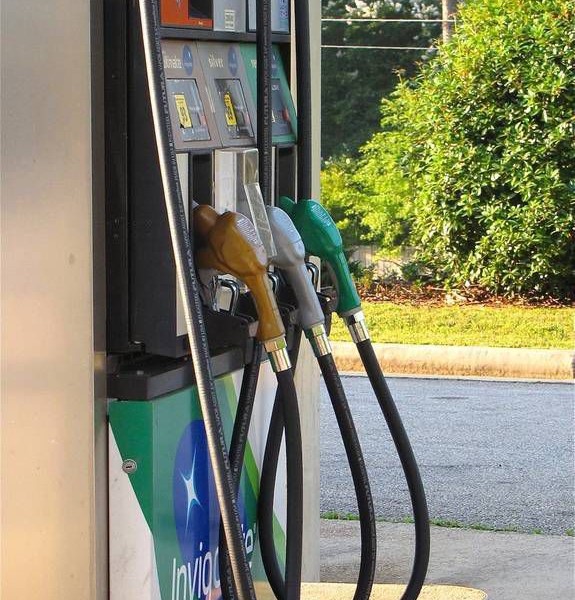
By Jim Hendricks
ALBANY — With autumn’s arrival, gas prices have finally begun to “fall” back. And they could drop another dime by the end of the week.
Still, the effects of major hurricanes Harvey and Irma have kept the average price of gas about a quarter per gallon higher than it should be, market experts say.
In the past week, average gas prices dropped a nickel across the board — nationally, statewide and locally, according to the AAA Daily Fuel Gauge Report. That survey showed the national average Monday at $2.572, down 5.1 cents in a week, with Georgia averaging $2.667, down a nickel, and metro Albany at $2.575, down 5.2 cents.
GasBuddy had Monday’s U.S. average at $2.581, down 2.5 cents from where its survey had the average pegged last week, and had Georgia at $2.666, down less than a penny.
“If it weren’t for the recent hurricanes, gas prices would be about 25 cents lower,” Mark Jenkins, a spokesman for AAA Auto Club Group, said. “Since gas prices decline much slower than they rise, it could take a few weeks before they reach equilibrium. Gas prices in the Southeastern U.S. should drop another 5-10 cents this week.”
Patrick DeHaan, senior petroleum analyst for GasBuddy, concurred on the possibility of a sharp decline this week, as well as the slow return to normal market conditions.
“For the second straight week, almost every state saw average gasoline prices fall notably as refineries continue to heal after Harvey and work on restoring production of motor fuels,” DeHaan said. “While oil prices have gained momentum in the last few weeks, it will not be enough to stymie the continued decline at gas pumps, which will bring the national average down another 5-10 cents in the week ahead.”
Prices have actually swooned in some areas of the country.
“Impressively,” DeHaan, said, “some gas stations in areas of the Great Lakes have dropped their prices by as much as 30-65 cents per gallon in the last two weeks, even as the national average has dropped just half of that, thanks to intense price wars and undercutting.
“But for those motorists in those states — Michigan, Indiana, Ohio and Kentucky — prices may temporarily bounce back up in the next day or two as stations reset their prices. Nationwide, many motorists have asked why all gas prices haven’t come back down to pre-Harvey levels, and while the answer is complex, in short, it will take weeks or months to see gasoline inventories recover fully, but prices will continue to slowly drift lower as inventories slowly improve.”
Averages prices are well above their levels of a year ago. Both AAA and GasBuddy had the national average on Sept. 25, 2016, at $2.208, which means motorists are paying 36.4-37.3 cents more per gallon this year. That’s just under $6 more on a 16-gallon fill-up.
Georgia’s year-to-year change is less dramatic, even though the average is nearly a dime higher than the U.S. average, because the Southeast was being affected this time last year by the Colonial Pipeline interruption. AAA’s survey had Georgians spending $2.351 last year, while GasBuddy had the state average at $2.359. That makes the difference this year 30.7-31.6 cents higher.
For the five-county metro Albany area, the year-to-year difference is 27.9 cents, according to the Daily Fuel Gauge Report. That translates to about $4.50 more on a 16-gallon fill-up.
Albany was only three-tenths of a cent higher than the Georgia metro area that had the lowest average on the AAA report Monday — Macon, which at $2.572 edged perennial leader Augusta by a tenth of a cent. Metro Atlanta was in its customary spot of having the highest average price, which was $2.718 on Monday.
While hurricanes Maria and Lee are continuing to churn in the Atlantic, no tropical storm formations are threatening the oil production areas of the Gulf or a U.S. landfall.
Related Articles
Dougherty Commission considers $104 million budget for 2026-2027 budget year
“The other side of the coin is you could have higher revenues than projected. We’re very conservative in budgeting revenues. That also reduces the need to use fund balance”

Albany police investigate suspicious Sunday death
A 21-year-old Turner Job Corps student who was found unresponsive on Sunday evening was later pronounced dead at Phoebe Putney Memorial Hospital. The death is under investigation.

James Rubino installed in new role at Marine Corps Logistics Command in Albany
James L. Rubino recently assumed the role as executive deputy of Marine Corps Logistics Command in Albany. In his new role he will oversee integrated logistics support.
