
T-SPLOST or not, Georgians will pay

Carlton Fletcher
I started with nothin’, now I’ve got less. … Live now, pay later.
— Foghat
None of us among this country’s unwashed truly understands the complexities of government, its layered structure and intentionally confusing language cleverly designed to keep “outsiders” like us in the dark.
Even so, I was surprised to hear the twisted logic used by a usually well-informed businessman recently in expressing his disdain for the state’s pending special-purpose local-option transportation sales tax — the so-called T-SPLOST.
“I will vote against T-SPLOST,” this gentleman declared. “I’m tired of having to pay taxes to support the freeloaders who never pay their share.”
Now I understand all too well this gentleman’s frustration. As a property owner, he’s paying greater and greater sums to ensure government-provided services that are utilized by a large segment of the population that owns no property and, thus, is subject to a proportionately smaller tax burden.
There’s that old saying about bleeding a turnip for only so long.
But opposition to T-SPLOST — and, yes, it is an additional 1 percent tax on the citizens of Georgia; no politico-speak mumbo-jumbo spin job can change that — based on a desire not to support others who are not paying their fair share of taxes is actually contradictory. The special-purpose taxes, in fact, require everyone in a community or region — including those who visit — to take on an equal share of the tax burden.
Some local black elected officials are even expressing their opposition to T-SPLOST by calling it a “Robinhood tax,” proclaiming that the government is “robbing from the ‘hood” in asking citizens there to pay the same 1 percent on goods and services that others — i.e. those people not from the ‘hood — pay.
As a matter of fact, the special-purpose local-option sales taxes utilized in Georgia now for infrastructure and education projects approved by voters are as fair a tax — I know, oxymoron — as citizens can pay. If a community has a large influx of visitors or shoppers, such as Albany in Southwest Georgia, a large portion of its SPLOST-funded improvements is paid by people just passing through.
I also am a bit confused by people who say they’re going to vote against T-SPLOST “to show those clowns up in Atlanta that we’ve had enough.” And God bless you for your anti-tax revolutionary stance. Yet, I can’t help but wonder if a rejection of T-SPLOST in Southwest Georgia is not going to end up being one of those cut-off-your-nose-to-spite-your-face kind of things.
Consider that any of the state’s regions that don’t approve T-SPLOST will pay a greater percentage (30 percent compared to 10 percent) of matching funds for Local Investment Maintenance Grant-funded projects thereafter and that any projects being considered for steadily dwindling federal or state funds will come under considerably greater scrutiny in regions that reject the special tax.
But perhaps most ominous of all in this whole puzzle are the words of Lee County Planning and Engineering Director Bob Alexander, who’s been involved in the transportation wars in this region for decades. Alexander, a staunch supporter of the T-SPLOST measure, warns that the July 31 vote may be Southwest and indeed all of rural Georgia’s one shot at getting transportation funding that will impact its roads directly.
“There is a provision that is supposed to allow any region that votes against T-SPLOST an opportunity to bring it to its voters again in two years,” Alexander said. “But it would have to go back to the legislative body in Atlanta for consideration, and I can’t see them giving a second chance for at least four years, if they can stomach going through that process at all.
“But what concerns me is that, without the T-SPLOST funding, the state at some point is going to go into crisis mode. When that happens, you can bet that there will be some kind of statewide tax. And you know when that happens that all of the money collected is going to go to Atlanta. For us in rural Georgia, I’m afraid (the July 31 vote) is going to be our one and only chance.”
I will not go so far as to encourage local voters to levy another 1 percent tax on themselves; that’s a matter for each individual to consider. But I will ask that voters think beyond the “no new taxes” rhetoric that some groups are throwing out to confuse the public.
Because if our region turns down this 1 percent tax that everyone pays into equally, there will be another tax coming in the very near future. And, rest assured, that tax will come with much sharper teeth and take a much much bigger bite.
Email Metro Editor Carlton Fletcher at [email protected].
Related Articles
Dawson Council approves $400,000 lifeline in emergency meeting as financial accountability remains elusive
Less than a week after city officials publicly acknowledged the City of Dawson cannot continue operating without additional financing, the Dawson City Council convened a hastily called emergency meeting Tuesday evening and unanimously approved authority to borrow up to $400,000 through a tax anticipation note.
Lee County homeowners have until Aug. 1 to claim property tax exemptions
Lee County homeowners have until Aug. 1 to apply for homestead and other property tax exemptions for the 2026 tax year, a deadline members of the Lee County Board of Tax Assessors highlighted Monday as they encouraged eligible residents to take advantage of available tax relief.
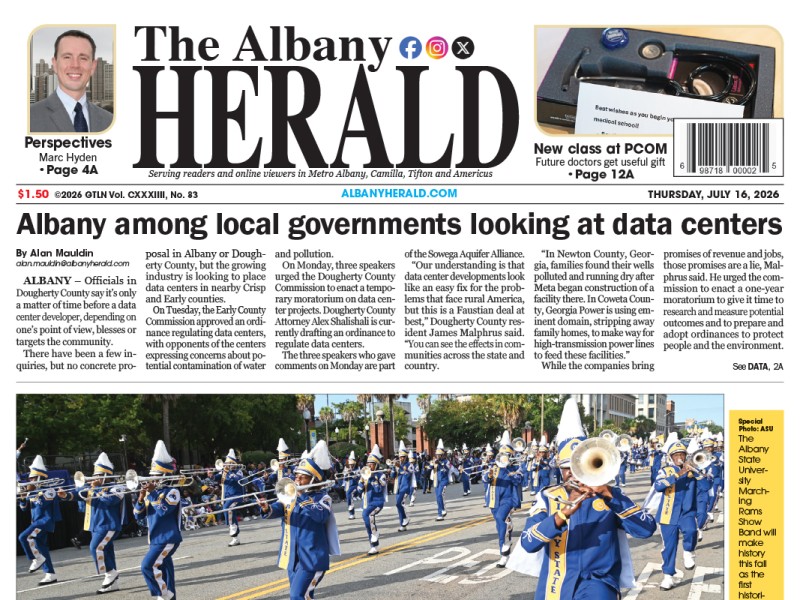
Albany Herald – July 16, 2026
Albany among local governments looking… ASU Marching Rams first HBCU band
invited…
