
University of Alabama honors Albany State President Art Dunning, who helped break color barrier on football team
Terry Lewis
ALBANY — In the early spring of 1967, segregation at the University of Alabama was slowly dying, inch-by-inch. Black students were scattered throughout the university, yet the Crimson Tide football team remained completely white.
That was about to change.
Four years after then-Gov. George Wallace’s infamous stand in the schoolhouse door, five black football players made history by walking onto the team during Alabama’s spring practice.
The five — Art Dunning, Dock Rone, Melvin Leverette, Jerome Tucker and Andrew Pernell — were making a statement.
“Four of us made the decision collectively to walk on and one, Dock Rone, did it individually. He’d already had a conversation with Coach (Bear) Bryant,” said Dunning, now the interim president at Albany State University. “We thought if Dock was going out, let’s go out with him. It’s time for transition.”
Alabama had never had an African-American football player. Now it had five.
“1967 was a time of pulsating social change in Alabama,” the soft-spoken Dunning said. “The Cold War was raging and there was a hot war in Vietnam and that war divided the country. At the same time Alabama was undergoing the most extraordinary social change in its history. We were in the center of defining that social change and Alabama was the epicenter of southern football.
“Some of us wanted to play football, others wanted to make a statement, and I think we did both.”
None of the five made the roster, but they redefined Alabama football. Three years later, Wilbur Jackson became the first African-American to sign a football scholarship and, in 1971, junior college transfer John Mitchell became the first to don a Crimson jersey in a regular season game.
The experience of 1967 also defined Dunning, who went on to receive three degrees from the university.
“Two of the most physically challenging things I have ever done in my life were (Air Force) basic training and Alabama spring football,” Dunning said. “I was always aware of what I wanted to do academically and that’s what I am doing today — to spend my life in higher education. During that spring I realized that expectations of an Alabama football player took me away from my scholarly work. The time constraints were so demanding that they didn’t mesh with my academic side. I could not make a commitment to playing at that level and also make the commitment I needed to make it through the learning process.
“And after a few days on Thomas Field (Alabama’s practice facility), I was so physically drained I almost could not make it to some of my classes. Coach Bryant told us, ‘We don’t play for SEC championships here, we play for national championships.’ The expectations were so high that if you are going to reach them you are going to pay a price for it.”
Dunning left the team to concentrate on his academics, and time slipped by.
Forty-eight years later, Dunning said, he got a phone call from Alabama great Shaun Alexander, who told Dunning that he, Pernell and Roan were to be inducted into the university’s letterman’s club.
“He said, ‘Dr. Dunning, I wanted to be the one to call you and tell you that you guys paved the way and we are going to put your names in nomination’ for the A Club,” Dunning recalled.
In Alexander’s nomination letter, he wrote: “”Dr. Arthur Dunning’s bold and fearless act was a foundational piece to Alabama football being what it is today and gave goals to many black boys to one day wear the crimson and white. It was more than playing football, it was breaking a barrier that seemed unthinkable at the time, but was one of the greatest things to happen at our university ever. This letter is more than a nomination letter. It is a thank you letter.”
“The guys that walked on talked about it among ourselves, but no one thought about making a big deal of it,” Dunning said of 1967. “When I got the call, I was pleased from the standpoint that there was some recognition of when there is extraordinary change that strengthens all of us somebody has to step out and create a narrative of what this change can look like.
“It would be hard to make a case that Alabama football is worse off because of it; it would be hard to say with a straight face that we no longer play good football at Alabama.”
Two weeks ago, Dunning, along with Pernell and Roan, attended Alabama’s spring game and were given plaques commemorating their induction into the A Club.
When Dunning looks at that plaque, earned through a courageous move in 1967, what does he see?
“I see a symbolic reflection of an action taken by a person whose family and ancestors helped make the state of Alabama and the athletic program of its flagship institution a better place,” Dunning answered. “As I said earlier, there is no way to make a case that Alabama football has declined because of Wilbur Jackson, John Mitchell, Shaun Alexander or us.”
Related Articles
Dawson Council approves $400,000 lifeline in emergency meeting as financial accountability remains elusive
Less than a week after city officials publicly acknowledged the City of Dawson cannot continue operating without additional financing, the Dawson City Council convened a hastily called emergency meeting Tuesday evening and unanimously approved authority to borrow up to $400,000 through a tax anticipation note.

Lee County homeowners have until Aug. 1 to claim property tax exemptions
Lee County homeowners have until Aug. 1 to apply for homestead and other property tax exemptions for the 2026 tax year, a deadline members of the Lee County Board of Tax Assessors highlighted Monday as they encouraged eligible residents to take advantage of available tax relief.
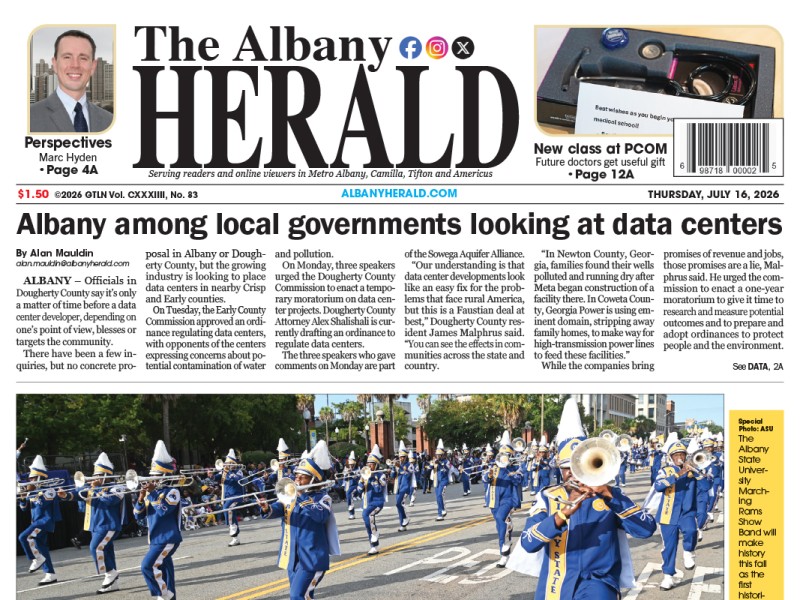
Albany Herald – July 16, 2026
Albany among local governments looking… ASU Marching Rams first HBCU band
invited…
