
South Georgia counties OK’d for federal public assistance for storm damage expenses
Declaration allows 75 percent reimbursement on local governments’ disaster-releated expenses
By Jim Hendricks
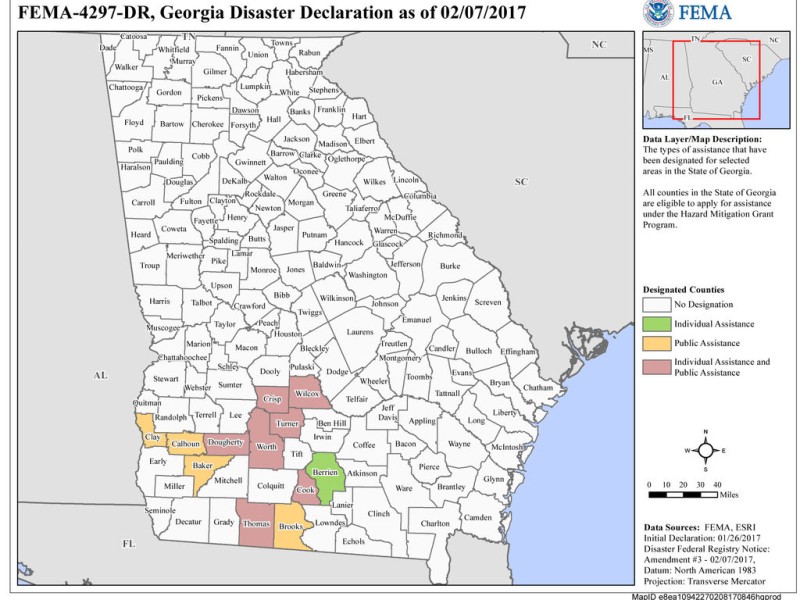
ALBANY — Eleven South Georgia counties, including Dougherty, Baker and Worth in metro Albany, were approved by the federal government Wednesday for public assistance for disaster-related expenses caused by the Jan. 21-22 storms, tornadoes and high winds.
Also on Wednesday, FEMA reported that 387 assistance individual applications totalling nearly $1.84 million had been approved in the counties, including Dougherty and Worth, covered by a federal individual assistance declaration. Of that, more than $1.19 million was for housing assistance and just under $645,000 was for other assistance needs.
“I am thankful for the attention and assistance Georgia has received from President Trump, FEMA, the Georgia Emergency Management and Homeland Security Agency, and our state and local partners,” Deal said. “I am also encouraged by the continued efforts of everyone involved as we work together to rebuild these communities during this difficult time.”
The 11 counties approved for public assistance, in addition to the three in metro Albany, are Brooks, Calhoun, Clay, Cook, Crisp, Thomas, Turner and Wilcox.
The declaration means that the local governments in the 11 counties can apply for reimbursement of 75 percent of their respective expenses related to the storm damage, including the cost of repairing certain infrastructure like water treatment plants and publicly owned utilities.
“That program can lessen the burden on the taxpayers of all 11 of those counties because disaster-related expenses incurred by local governments can be reimbursed 75 percent with federal dollars,” John Mills, external affairs official with FEMA, said.
Mills said FEMA officials will “work closely with the local governments” on the assistance.
According information posted on FEMA’s website, public assistance provides government organizations and certain private non-profits with supplemental federal disaster grant assistance for debris removal, life-saving emergency protective measures, and the repair, replacement, or restoration of disaster-damaged publicly owned facilities and the facilities of certain private non-profit organizations. The program also encourages protection of these damaged facilities from future events by providing assistance for hazard mitigation measures during the recovery process.
Meanwhile, the eight counties approved for individual assistance for people and businesses adversely affected by the Jan. 21-22 storms are Dougherty, Worth, Berrien, Cook, Crisp, Thomas, Turner and Wilcox counties. Dougherty also has been approved for individual assistance from the Jan. 2 storm and tornado.
There are six FEMA Disaster Recovery Centers open in Southwest Georgia where people can register. They are:
— The Albany Mall, 2601 Dawson Road, and the former East Albany police station, 1721 E. Oglethorpe Blvd.;
— The Cordele Fire Department, 112 Eddie Road, Cordele;
— The Turner Civic Center, 354 Lamar St., Ashburn;
— The Thomas County Fire Department, 1202 Remington Ave., Thomasville;
— The Cook County Administration Building, 1200 S. Hutchinson Ave., Adel. A seventh center is expected to open soon in Worth County.
All of the centers are open 9 a.m. to 7 p.m. weekdays and 9 a.m. to 5 p.m. Saturdays. They are closed Sundays.
Anyone in the eligible counties whose residence or business sustained damage from the storms can meet with FEMA officials and register at any of the centers. Registration may also be done online at DisasterAssistance.gov or by phone at (800) 621-3362 or TTY (800) 462-7585.
Registration is required before help can be assessed. Those who are offered recovery help from the U.S. Small Business Administration also must register with that organization. FEMA assistance does not duplicate private insurance but can help with uninsured or under-insured damage.
Information a registrant needs to have available includes Social Security Number, address of the damaged home or apartment, a description of the damage, information about insurance coverage, a current contact number and an address where the registrant can receive mail and bank account and routing numbers for direct deposit of funds. Only one member of a household should register.
Related Articles
Dawson Council approves $400,000 lifeline in emergency meeting as financial accountability remains elusive
Less than a week after city officials publicly acknowledged the City of Dawson cannot continue operating without additional financing, the Dawson City Council convened a hastily called emergency meeting Tuesday evening and unanimously approved authority to borrow up to $400,000 through a tax anticipation note.

Adult leadership group spreads concept to high school students
“The purpose of Albany Junior Leaders is to pull together leaders from all over the community. We wanted to give these youth the same experience and the same exposure we’re getting in Leadership Albany.”
Albany/Dougherty County among local governments looking at data centers
“Our understanding is that data center developments look like an easy fix for the problems that face rural America, but this is a Faustian deal at best. You can see the effects in communities across the state and country.
