
Street drug cluster in Georgia reflective of ongoing opioid crisis
More than two dozen believed to have overdosed on street drug in central and south Georgia
By Jennifer Parks
ALBANY — As more information emerges about a new street drug recently discovered on Georgia streets, it is evident that the uniqueness of the circumstances involved is reflective of an ongoing challenge the state’s agencies are facing.
When the new drug, found after preliminary testing performed by the Georgia Bureau of Investigation to be a mixture of two synthetic opioids including one consistent with a new fentanyl analogue, was discovered on the streets late Monday and into early Tuesday, officials with Georgia Poison Center found themselves sacrificing sleep in order to call around to hospitals around the state to see how widespread the cluster was.
By early Tuesday, the drug, believed to be Percocet by those taking it, was thought to be connected to 20 cases — a number that increased to 26 on Wednesday. Many victims suffered respiratory depression to the point that a ventilator was necessary, and large amounts of Narcan had to be used to counteract the drug.
As is standard procedure, Gaylord Lopez, the director of the state poison center, was notified of the situation. At around 10 p.m. on Monday, word came down from Navicent Health that five people in Macon had apparently fallen victim to the then-unidentified drug.
“We had five cases in one household,” Lopez said. “They were ingesting what they said was Percocet. People were going from unconscious to not breathing. We called neighboring hospitals to poke around.”
A call to another hospital nearby revealed that there had been several patients in the previous 24 hours exhibiting the same symptoms. By 7 a.m. Tuesday, the 20 possible cases had been identified in an area officials said included Centerville, Perry, Macon, Warner Robins and Albany.
Maj. Prurince Dice, commander of the Albany-Dougherty Drug Unit, said his office received no new information in the days following public acknowledgement of the drug, but that the ADDU had received alerts from other agencies.
Lopez said the cluster was centered almost entirely around the Bibb County area, and as many as four people had died of overdoses related to the drug by Tuesday afternoon.
Counterfeit pills are not unheard of. What surprised many officials was the amount of exposure that took place in a short amount of time. Lopez described it as “eye-popping.”
“If people are dying from one or two Percocet, you don’t have to be a rocket scientist to figure out that’s not Percocet,” he said.
Lopez said if a drug is potent enough, skin exposure is enough to cause damage. He warned that, instead of picking suspicious drugs up, report it — and call an ambulance. The bottom line is to assume that the drug is something lethal unless it comes from a valid prescription.
“If you notice someone with pills without a prescription, and they are not seeing a doctor, assume that it is illegal,” he said. “Stay away from that type of stuff.”
Nelly Miles, a spokeswoman for the GBI, said the agency often has the task in similar situations of assisting law enforcement agencies when the agency’s help is requested. In this case, the GBI’s task was performing drug analysis, autopsies on the four decedents and stressing the public messaging.
“We are trying to stress this really isn’t a joke,” she said.
Miles said the timetable for the drug analysis was expedited, and that authorities have been working around the clock to track down the source of the drugs. Miles said she agreed with Lopez about the unusual nature of the situation, but opioid investigations are far from new territory for the GBI.
“We are currently expanding the morgue (in our crime lab) in large part because of the opioid crisis,” she said. “It is our duty to inform the public.
“It is out of the norm in that it is not every day you are going to see clusters like this, but we have seen (drug-related) deaths. Maybe we didn’t identify them as a cluster because we didn’t know they were there.”
Glenn Swanson, medical director for the emergency center at Phoebe Putney Memorial Hospital, said respiratory depression and pinpoint pupils might be early signs of opioid usage, but the focus at the beginning of a potential case is to keep the patient breathing and make sure the heart is still pumping before finding the underlying cause.
“(With some drugs) it knocks out your respiratory drive, and within a few minutes they get hypoxic brain injury,” Swanson said. “In our history, we have seen here folks with respiratory depression. The first instinct is to get them up and running. Then, we start looking on down the road to see what (is causing the problem).”
Swanson said blood tests and toxicology tests are common procedures in such cases, and it is not uncommon to support respiratory function in order to allow time for the liver and kidneys to do their jobs and flush the drugs out.
He said opioids are associated with “an amazing depression” of respiratory function. Narcan, used to treat opioid-induced symptoms, is short-lived and fast-acting, and some opioids are meant to stay in the system for a long time. When Narcan does not work after a while, a health care provider may move on to other treatment methods.
Either way, treatment does not stop in order to figure out what the underlying cause is.
“Even if we don’t know what it is, we will still treat them the same and still save their life,” Swanson said. “I don’t think we see any more or any less (than any other hospital). For a small area like this, we see our share of overdoses.
“It is not going to do them harm by giving them more (Narcan). One of the things we will be looking for (with new drugs) is data on reasonable doses. With a new drug, you may not know what or how much to give. Some of these things, we just don’t know what they are ingesting.”
While commenting on the particular new drug that startled the state last week, Swanson promoted the “Say No To Drugs” mindset to make a good decision from the beginning by veering away from the path of addiction.
“I think you really have to think twice about taking this drug,” he said. “What you might be doing is potentially threatening your life.”
The most recent update from officials on the counterfeit drug stated that the fentanyl analogue in it has not been previously identified by the GBI crime lab, so more testing has been required to confirm the full identity of the drug. The source of the drug remains under investigation.
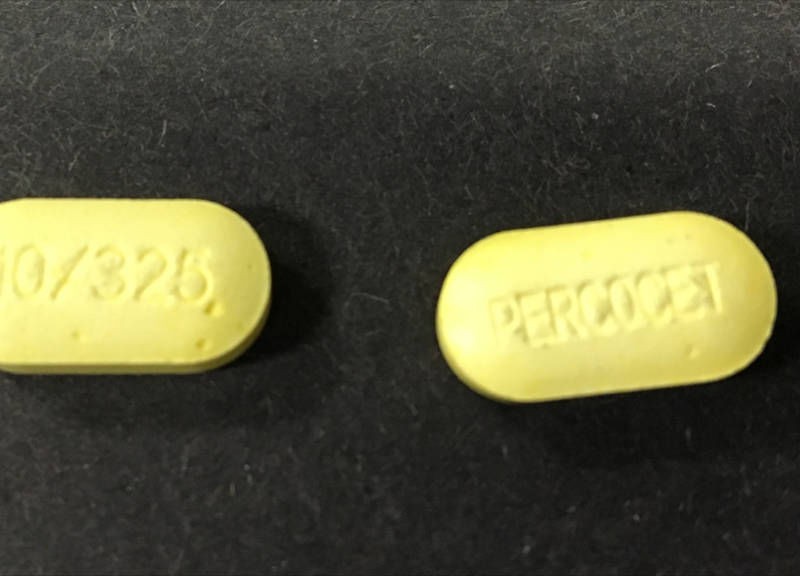
The pills are yellow and oval with the numbers “10/325” on one side and “PERCOCET” imprinted on the other side. The imprints are at an angle and not stamped at the same depth as the drug Percocet.
The Georgia Department of Public Health, the poison center, GBI, Georgia Drugs and Narcotics Agency, hospitals and other partners are involved in the ongoing investigation. The public has been encouraged not to handle any pills they might come upon, and that 911 needs to be called immediately if exposure is suspected to reduce damage associated with the drug.
Related Articles

Albany recycling center enacts material separation rule
Mixed items will no longer be accepted at the Albany recycling center at its 2521 Meredyth Drive facility. Individuals will now be required to separate items befor they will be accepted.
Albany City Commission takes action on proposed downtown hotel, two theater renovation projects
“We’re taking the original building back to, hopefully, it’s glory days. One of the cool things about the project is we are going to restore the balcony. It’s going to have a balcony, so it’s going to be super cool.”
Dawson’s $10.2 million sewer project leaves major financial questions unresolved
As Dawson’s finance director resigns and operating pressures mount, records show $10.2 million in sewer funding, frozen loans, missing audits and gaps in the public accounting of project money.
